Biology • Year 12 • Module 8 • Lesson 16
Autoimmune Diseases and Allergies
Lock in core vocabulary, distinguish the self-tolerance failure mechanism from IgE-mediated hypersensitivity, and connect named diseases to their immune targets.
1. Label the IgE-mediated allergy mechanism
The diagram below shows the two-stage mechanism of Type I hypersensitivity. Write the missing labels into boxes A–H. Each answer is drawn from the lesson's Key Terms or the process-step descriptions in Card 3. 8 marks
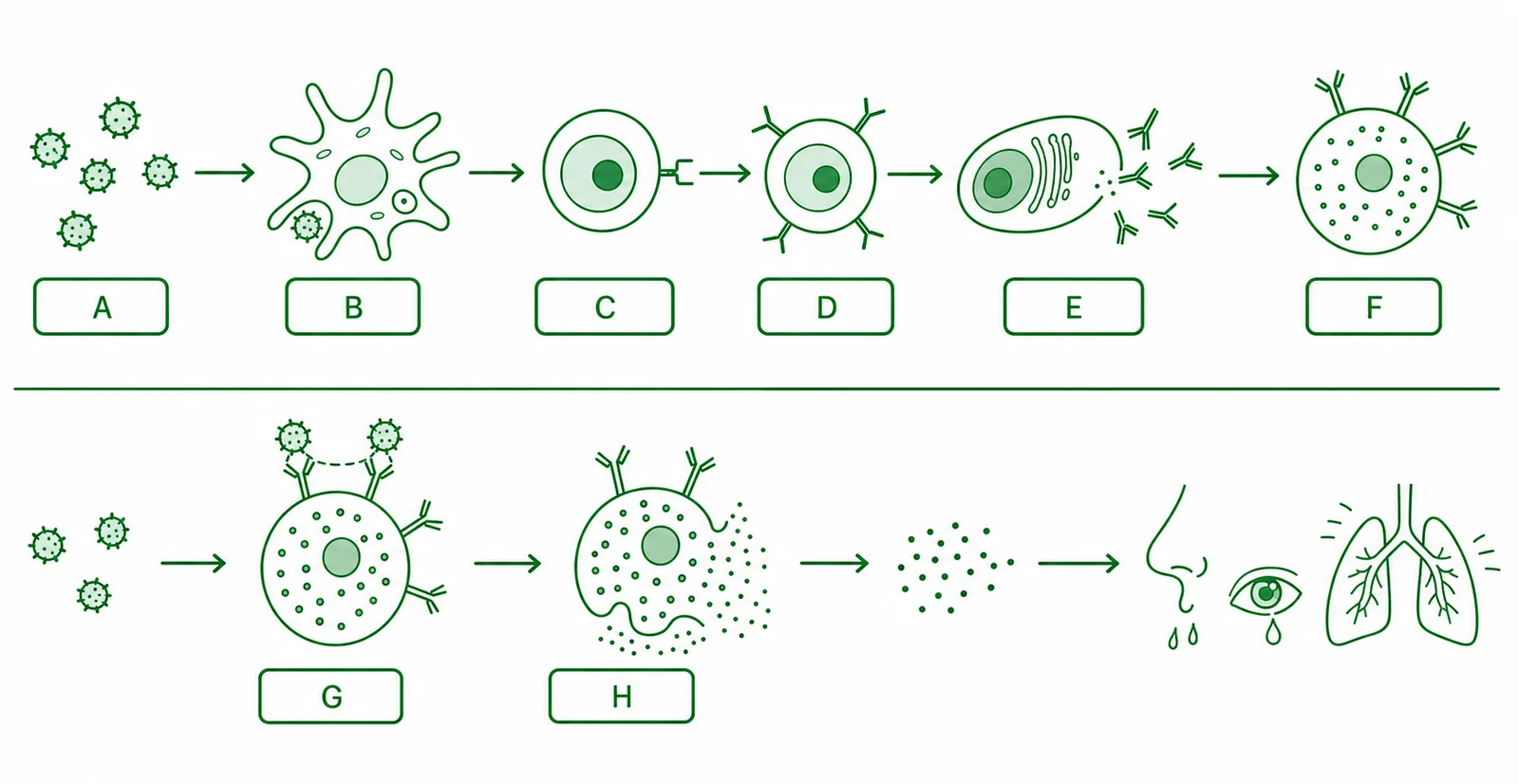
| Box | Your label |
|---|---|
| A | |
| B | |
| C | |
| D | |
| E | |
| F | |
| G | |
| H |
2. Term–definition match
The definitions below are shuffled. Write the matching term from this list in the right-hand column: autoimmune disease, self-tolerance, allergen, IgE, mast cell, histamine, anaphylaxis, clonal deletion, molecular mimicry, desensitisation. 10 marks
| # | Definition (shuffled) | Matching term |
|---|---|---|
| 2.1 | The immune system's ability to recognise and avoid attacking the body's own cells, maintained chiefly by clonal deletion in the thymus. | |
| 2.2 | A non-infectious disorder in which immune effectors attack self-tissues due to failure of immune self-recognition. | |
| 2.3 | A normally harmless environmental substance (e.g. pollen, peanut protein) that triggers an exaggerated immune response in a sensitised person. | |
| 2.4 | The antibody class produced against allergens; binds to mast cells and basophils, sensitising them for rapid degranulation on re-exposure. | |
| 2.5 | A tissue-resident immune cell that stores chemical mediators in granules and releases them rapidly when surface-bound IgE is cross-linked. | |
| 2.6 | A chemical mediator released during allergic reactions that causes vasodilation, increased vascular permeability and bronchoconstriction. | |
| 2.7 | A severe, life-threatening systemic allergic reaction involving massive, body-wide mast cell degranulation, causing cardiovascular and respiratory collapse. | |
| 2.8 | The thymic process by which T lymphocytes that react strongly to self-antigens are destroyed before they can circulate. | |
| 2.9 | A mechanism by which a pathogen antigen resembles a self-antigen; antibodies raised against the pathogen may therefore accidentally target host tissue. | |
| 2.10 | An allergy treatment that administers escalating doses of the allergen to shift the immune response from IgE (Th2) to IgG (Th1/Treg); the only disease-modifying allergy treatment. |
3. True or false, with correction
Circle T or F. If the statement is false, write the corrected version on the line below. 8 marks (1 T/F + 1 correction where needed)
3.1 Autoimmune disease is caused by a weak immune system that cannot respond to pathogens. T / F
3.2 Anaphylaxis can occur on a person's very first exposure to an allergen, before any IgE has been produced. T / F
3.3 Antihistamines work by preventing mast cells from releasing histamine into the surrounding tissue. T / F
3.4 In Type 1 Diabetes, the immune system destroys the beta cells of the pancreatic islets, causing absolute insulin deficiency. T / F
4. Function recall
Answer each question in 1–2 sentences using precise lesson terminology. 10 marks (2 each)
4.1 What is the function of clonal deletion during T-cell development in the thymus?
4.2 What is the function of IgE antibodies in sensitising a person to a specific allergen?
4.3 What is the function of intramuscular adrenaline (epinephrine) in treating anaphylaxis?
4.4 What is the function of regulatory T cells (T-reg cells) in maintaining immune tolerance?
4.5 What is the function of biologic therapies such as anti-TNF-α in treating autoimmune diseases?
5. Build a concept map
Draw labelled arrows between the six terms below. Each arrow must carry a linking phrase (e.g. "triggers", "leads to", "prevents", "releases"). Aim for at least 6 labelled arrows. 6 marks
Supplied terms: self-tolerance · autoimmune disease · IgE · mast cell degranulation · histamine · anaphylaxis.
6. Cloze, fill in the blanks
Complete the paragraph using words from the word bank below. Each word is used once. 8 marks
Type I hypersensitivity occurs in two stages. During _______________, first contact with the _______________ causes B cells to produce _______________ antibodies, which bind to the surface of _______________ in tissues. On re-exposure, the allergen cross-links these antibodies, triggering _______________the rapid release of pre-formed chemical mediators. The key mediator, _______________, causes _______________ (widening of blood vessels) and _______________ (narrowing of airways). When this reaction becomes systemic, it is called _______________, treated as a medical emergency with intramuscular _______________.
Q1, Labelled allergy mechanism diagram
A: allergen (a normally harmless foreign substance). B: IgE (immunoglobulin E). C: mast cell (tissue-resident cell that binds IgE via high-affinity Fc receptors). D: mast cell degranulation (cross-linking of two adjacent IgE molecules triggers rapid release of granule contents). E: histamine (the primary pre-formed mediator responsible for immediate symptoms). F: vasodilation (increased vessel diameter → redness, heat, lowered blood pressure). G: bronchoconstriction (smooth muscle contraction in airways → wheeze, difficulty breathing). H: anaphylaxis (life-threatening systemic reaction; treat with IM adrenaline).
Q2, Term–definition matches
2.1 self-tolerance · 2.2 autoimmune disease · 2.3 allergen · 2.4 IgE · 2.5 mast cell · 2.6 histamine · 2.7 anaphylaxis · 2.8 clonal deletion · 2.9 molecular mimicry · 2.10 desensitisation.
Q3, True / false with correction
3.1 False. Correction: autoimmune disease is caused by an overactive or misdirected immune system, one that attacks self-tissues. The immune system is functional but has lost self-tolerance; it is not deficient.
3.2 False. Correction: anaphylaxis requires prior sensitisation. The first exposure produces IgE antibodies that bind to mast cells; anaphylaxis can only occur on a subsequent exposure when the allergen cross-links pre-bound IgE.
3.3 False. Correction: antihistamines block H1 histamine receptors on target cells (preventing histamine from binding), they do not prevent mast cells from releasing histamine. Mast cell stabilisers (e.g. cromoglicate) prevent histamine release.
3.4 True.
Q4, Function recall answers
4.1 Clonal deletion: Clonal deletion destroys T lymphocytes in the thymus that react strongly to self-antigens before they can enter circulation, preventing those autoreactive clones from attacking the body's own tissues and maintaining self-tolerance.
4.2 IgE in sensitisation: IgE antibodies, produced by B cells after first allergen exposure, bind with high affinity to receptors on mast cells and basophils. This "loads" these cells so that a second allergen contact causes rapid degranulation, the individual is now sensitised with no symptoms yet occurring.
4.3 Adrenaline in anaphylaxis: Adrenaline acts via alpha-adrenergic receptors to cause vasoconstriction (reversing the dangerous blood pressure drop) and via beta-receptors to cause bronchodilation (opening constricted airways) and increase cardiac output, directly reversing the three life-threatening effects of massive histamine release.
4.4 T-reg cells: Regulatory T cells (T-regs) suppress self-reactive lymphocytes that escaped clonal deletion, providing a second checkpoint for self-tolerance. If T-regs malfunction, self-reactive clones can proliferate and attack host tissue, contributing to autoimmune disease.
4.5 Anti-TNF-α biologics: Anti-TNF-α monoclonal antibodies (e.g. adalimumab) bind and neutralise tumour necrosis factor-alpha, a pro-inflammatory cytokine central to tissue destruction in diseases such as rheumatoid arthritis. By blocking this specific mediator, they reduce joint inflammation with fewer global immunosuppressive side effects than corticosteroids.
Q5, Sample concept map
Correct maps should include arrows such as:
- self-tolerancefailure of leads to → autoimmune disease
- allergen (re-exposure)cross-links surface → IgE
- IgEcross-linking triggers → mast cell degranulation
- mast cell degranulationreleases → histamine
- histamineif systemic, causes → anaphylaxis
- self-tolerancemaintained by clonal deletion and T-reg cells, preventing → autoimmune disease
Award 1 mark per biologically correct labelled arrow (maximum 6).
Q6, Cloze answers (in order)
sensitisation · allergen · IgE · mast cells · degranulation · histamine · vasodilation · bronchoconstriction · anaphylaxis · epinephrine