Biology • Year 12 • Module 8 • Lesson 11
Causes Mastery: Diagnosing Disease Types, Mechanisms and Misconceptions
Lock in the four IQ2 disease categories, key terms, and mechanism vocab, and detect the misconceptions that cost marks.
1. Label the disease-classification framework
The diagram below shows how biologists classify non-infectious diseases by their primary mechanism. Write the missing labels into boxes A–H. Each label is drawn from the Lesson 11 key terms and the four IQ2 disease categories. 8 marks
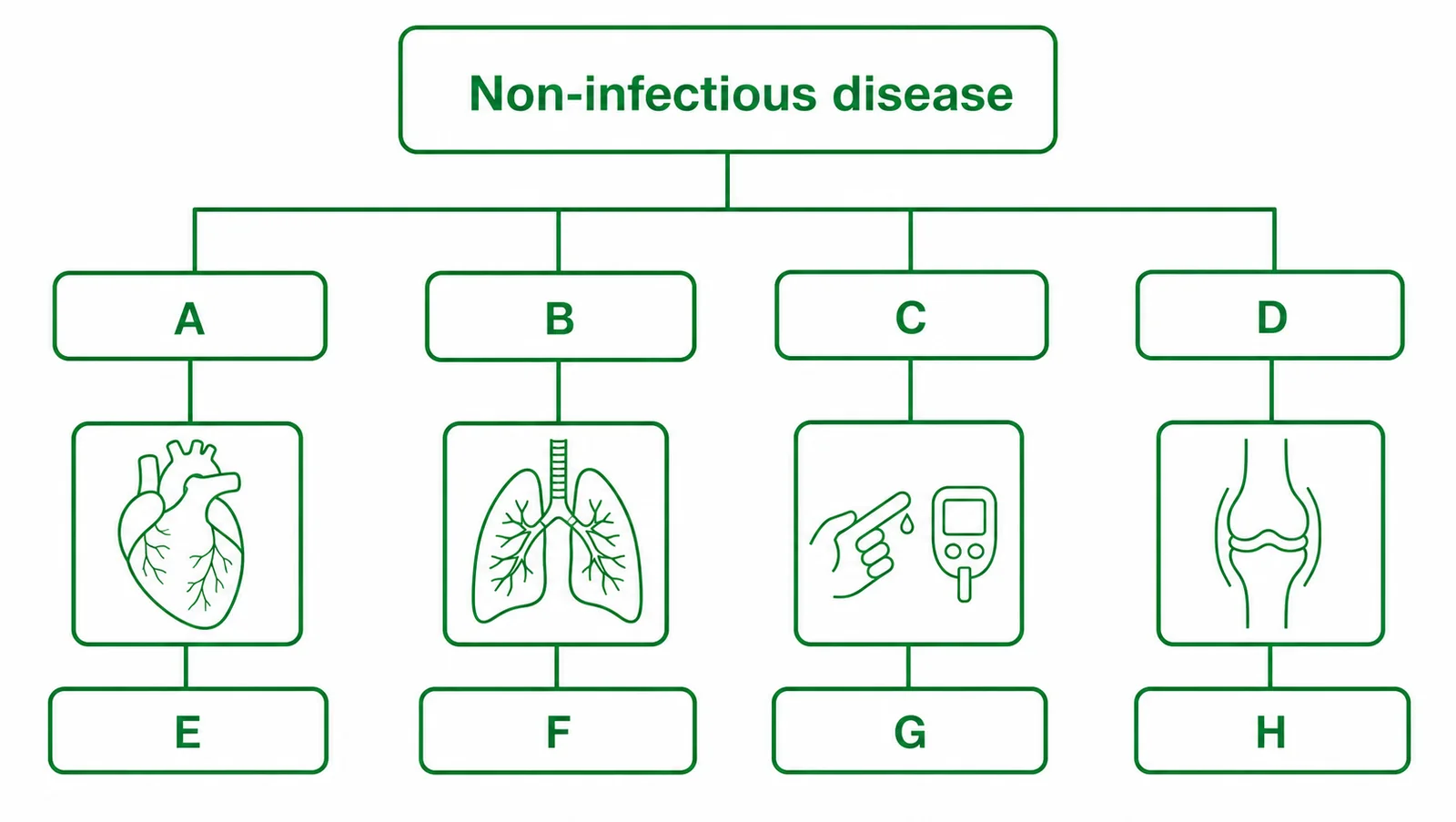
- A, primary disease category (inherited gene mutation as cause) _______________________
- B, specific protein disrupted in cystic fibrosis _______________________
- C, primary disease category (external carcinogen / exposure as cause) _______________________
- D, primary disease category (nutrient deficiency or excess as cause) _______________________
- E, primary disease category (uncontrolled cell division as defining feature) _______________________
- F, name of the hypothesis requiring inactivation of both tumour suppressor alleles _______________________
- G, term for a disease caused by multiple interacting genetic and environmental factors _______________________
- H, term for cancer cells spreading from primary tumour to distant organs _______________________
| Box | Your label |
|---|---|
| A | |
| B | |
| C | |
| D | |
| E | |
| F | |
| G | |
| H |
2. Term–definition match
Match each definition to its correct term from the list below. Write the matching term in the right-hand column.
Terms: aetiology, pathophysiology, penetrance, multifactorial, risk factor, proto-oncogene, tumour suppressor gene, biological carcinogen, two-hit hypothesis, metastasis. 10 marks
| # | Definition | Matching term |
|---|---|---|
| 2.1 | The cause or set of causes of a disease, can be genetic, environmental, nutritional, or multifactorial. | |
| 2.2 | The proportion of individuals with a disease-causing genotype who actually develop the disease; rarely 100% for complex diseases. | |
| 2.3 | Any variable that increases the probability of developing a disease; may be modifiable or non-modifiable. | |
| 2.4 | The process by which malignant tumour cells leave the primary site, travel through blood or lymph, and establish secondary tumours at distant organs. | |
| 2.5 | A gene that normally encodes a protein promoting cell division; when mutated to a gain-of-function form, it becomes an oncogene. | |
| 2.6 | Caused by multiple interacting genetic and environmental factors; most non-infectious diseases fall into this category. | |
| 2.7 | A living organism (e.g. HPV, Helicobacter pylori) that increases cancer risk through viral or bacterial proteins that alter cell cycle regulation. | |
| 2.8 | The functional changes in the body that result from a disease, how normal physiology breaks down. | |
| 2.9 | A gene that normally encodes a protein inhibiting cell division or triggering apoptosis; requires inactivation of BOTH alleles to lose its brake function. | |
| 2.10 | The requirement that BOTH alleles of a tumour suppressor gene must be inactivated before a cell loses braking of division (Knudson's model). |
3. True or false, with correction
Circle T or F. If the statement is false, write the corrected version. 10 marks (1 for T/F, 1 for each correction)
3.1 Carrying a BRCA1 mutation guarantees that a person will develop breast cancer during their lifetime. T / F
3.2 Oncogenes arise from gain-of-function mutations in proto-oncogenes, genes that normally encourage cell division. T / F
3.3 Goitre is caused by excess iodine in the diet, which overstimulates thyroid hormone synthesis and causes gland enlargement. T / F
3.4 Huntington's disease is an autosomal dominant disorder, a single inherited mutant copy of the huntingtin gene is sufficient to cause disease. T / F
3.5 Type 2 diabetes is a purely lifestyle disease caused entirely by the individual's food choices and physical inactivity. T / F
4. Function recall
Answer each in 1–2 sentences using precise terms from Lesson 11. 8 marks (2 each)
4.1 What is the function of the CFTR protein, and what happens in airway cells when it is absent?
4.2 What is the function of p53 in the cell cycle, and how does HPV-16 E6 protein disrupt it?
4.3 What is the function of RB1 in the cell cycle, and how does HPV-16 E7 protein disrupt it?
4.4 What is the function of TSH (thyroid-stimulating hormone) in the feedback loop disrupted in iodine-deficiency goitre?
5. Fill the gaps, disease mechanism cloze
Complete the paragraph using the word bank below. Each word is used once. 8 marks
Word bank: dominant, recessive, loss-of-function, gain-of-function, two-hit, oncogenes, tumour suppressor, proto-oncogenes, somatic, inherited
Mutations in two classes of genes drive cancer. ________________ arise from mutations in ________________ genes that normally promote cell division, producing a ________________ protein that constitutively drives cells into division. These mutations are functionally ________________: a single mutant allele is sufficient to drive uncontrolled growth. In contrast, ________________ genes normally act as brakes; their mutations are ________________ and ________________ both alleles must be inactivated for the brake to be lost. This is the basis of Knudson's ________________ hypothesis. When one copy is ________________ (first hit), cells are vulnerable to a second ________________ mutation that removes the remaining allele and releases the brake.
6. Build a concept map
Draw labelled arrows between the six terms below to show how they connect in the progression from HPV infection to cervical cancer. Each arrow must carry a linking phrase. Aim for at least 5 labelled arrows. 5 marks
Supplied terms: HPV-16 infection · E6 protein · p53 degradation · E7 protein · RB1 inactivation · uncontrolled S-phase entry
Q1, Disease-classification framework labels
A: Genetic (disease). B: CFTR protein (chloride ion channel). C: Environmental (disease). D: Nutritional (disease). E: Cancer. F: Two-hit hypothesis. G: Multifactorial. H: Metastasis.
Q2, Term–definition matches
2.1 aetiology • 2.2 penetrance • 2.3 risk factor • 2.4 metastasis • 2.5 proto-oncogene • 2.6 multifactorial • 2.7 biological carcinogen • 2.8 pathophysiology • 2.9 tumour suppressor gene • 2.10 two-hit hypothesis.
Q3, True / false with correction
3.1 False. Correction: carrying a BRCA1 mutation confers elevated susceptibility (~70% lifetime breast cancer risk), not a guarantee. Cancer only develops if a second somatic mutation inactivates the remaining allele in a specific breast cell (two-hit hypothesis). Penetrance is high but not 100%.
3.2 True.
3.3 False. Correction: goitre is caused by iodine deficiency, not excess. Insufficient iodine prevents adequate thyroid hormone (T3/T4) synthesis; falling hormone levels trigger elevated TSH from the pituitary, chronically stimulating the thyroid to enlarge in compensation.
3.4 True.
3.5 False. Correction: Type 2 diabetes is multifactorial. Genetic susceptibility variants (e.g. in TCF7L2 and KCNJ11), nutritional factors, socioeconomic circumstances, and lifestyle all interact. Genetic risk and social determinants of health are beyond individual control.
Q4.1, CFTR function
The CFTR protein forms a chloride ion channel in the apical membrane of airway epithelial cells, allowing Cl− to exit the cell. Without functional CFTR, Cl− cannot exit; water is not drawn out osmotically from the cell, so mucus becomes thick and sticky, blocking airways and the pancreatic duct.
Q4.2, p53 and HPV E6
p53 is a tumour suppressor protein that halts the cell cycle at checkpoints when DNA damage is detected and triggers apoptosis in severely damaged cells. HPV-16 E6 protein binds to p53 and recruits ubiquitin ligase E6AP, tagging p53 for proteasomal degradation. Without p53, damaged cells cannot be halted or killed, permitting accumulation of further mutations.
Q4.3, RB1 and HPV E7
RB1 (retinoblastoma protein) normally sequesters the transcription factor E2F during G1, preventing cells from entering S-phase without appropriate growth signals, acting as a G1/S brake. HPV-16 E7 protein binds and inactivates RB1, releasing E2F, so cells continuously enter S-phase regardless of cell cycle signals, driving uncontrolled division.
Q4.4, TSH in iodine-deficiency goitre
TSH (from the anterior pituitary) stimulates the thyroid gland to produce and release thyroid hormones T3 and T4. In iodine deficiency, the thyroid cannot synthesise adequate T3/T4; falling T3/T4 levels remove negative feedback on the pituitary, causing chronically elevated TSH secretion. The constant TSH stimulation drives compensatory hypertrophy (enlargement) of the thyroid gland, goitre.
Q5, Cloze answers (in order)
Oncogenes arise from mutations in proto-oncogenes genes that normally promote cell division, producing a gain-of-function protein that constitutively drives cells into division. These mutations are functionally dominant: a single mutant allele is sufficient to drive uncontrolled growth. In contrast, tumour suppressor genes normally act as brakes; their mutations are loss-of-function and recessive both alleles must be inactivated for the brake to be lost. This is the basis of Knudson's two-hit hypothesis. When one copy is inherited (first hit), cells are vulnerable to a second somatic mutation that removes the remaining allele and releases the brake.
Q6, Sample concept map (HPV → cervical cancer)
A correct map should include at least five arrows such as:
- HPV-16 infectionencodes → E6 protein
- HPV-16 infectionencodes → E7 protein
- E6 proteinrecruits E6AP ubiquitin ligase to degrade → p53 degradation
- E7 proteinbinds and inactivates → RB1 inactivation
- p53 degradationremoves DNA-damage checkpoint, enabling → uncontrolled S-phase entry
- RB1 inactivationreleases E2F transcription factor, driving → uncontrolled S-phase entry
Award 1 mark per correctly directed, labelled arrow (max 5). Both p53 and RB1 pathways must be present for full marks.