Biology • Year 12 • Module 8 • Lesson 10
Cancer, Cell Cycle, Oncogenes, Tumour Suppressors and Metastasis
Lock in the core vocabulary: proto-oncogenes, tumour suppressors, benign vs malignant, the three carcinogen categories, and the five steps of metastasis.
1. Label the cancer-overview diagram
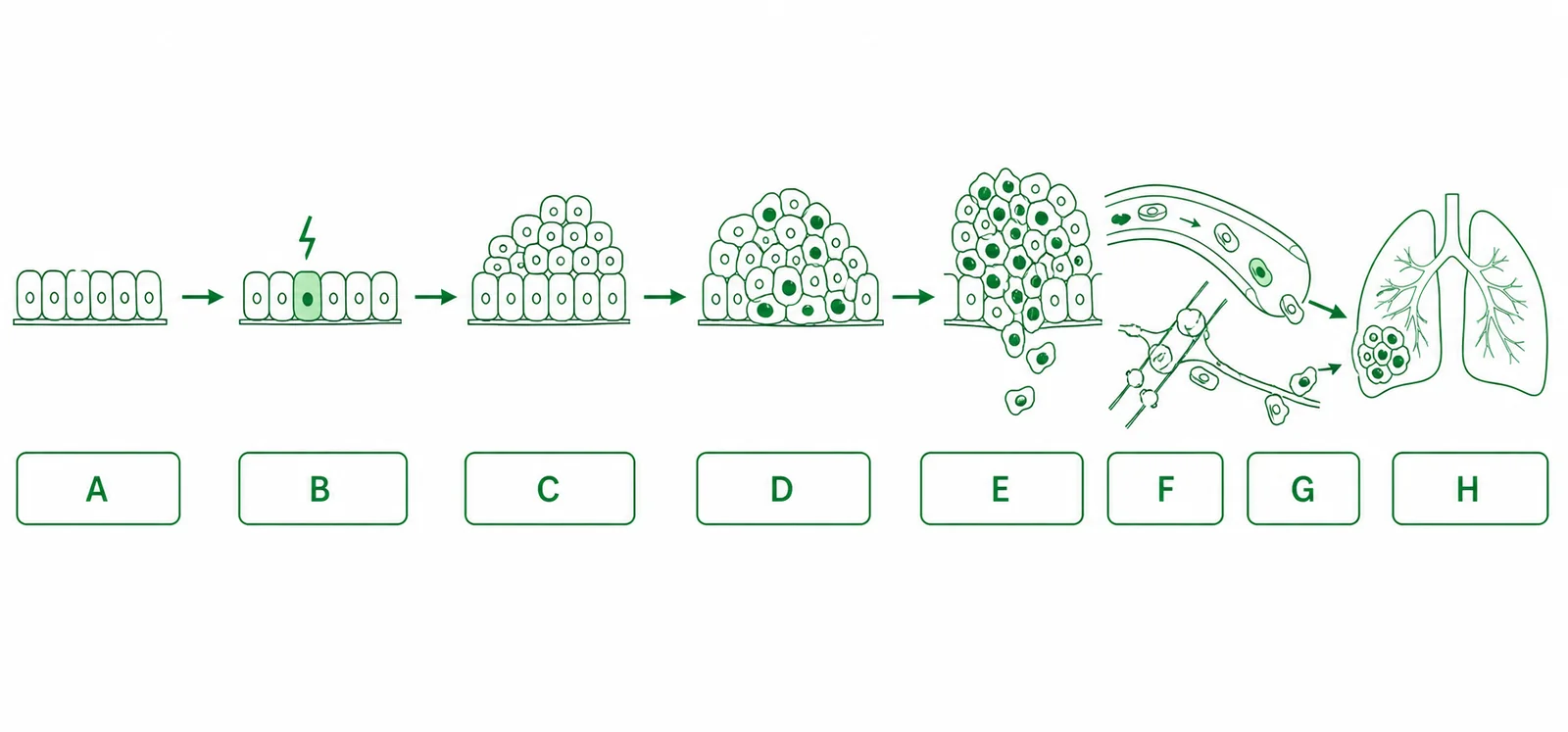
The diagram below shows how a normal cell acquires driver mutations and eventually progresses to metastatic cancer. Write the missing labels into boxes A–H. Each label is drawn from the lesson’s Key Terms or Cards 1–4. 8 marks
| Box | Your label |
|---|---|
| A | |
| B | |
| C | |
| D | |
| E | |
| F | |
| G | |
| H |
2. Term–definition match
The definitions below are shuffled. In the right-hand column write the matching term from this list: proto-oncogene, oncogene, tumour suppressor gene, p53, BRCA1, metastasis, apoptosis, benign tumour, malignant tumour, two-hit hypothesis. 10 marks
| # | Definition (shuffled) | Matching term |
|---|---|---|
| 2.1 | A normal gene that promotes cell division only when appropriate growth signals are present; mutated into a cancer-driving gene. | |
| 2.2 | A mutated version of a growth-promoting gene that drives continuous cell division even without growth signals; gain-of-function, dominant. | |
| 2.3 | A gene that normally halts the cell cycle or triggers programmed cell death; requires loss of both alleles to lose function. | |
| 2.4 | Programmed cell death, the orderly dismantling of a damaged or abnormal cell; cancer cells frequently evade this process. | |
| 2.5 | A tumour suppressor that detects DNA damage at the G1/S checkpoint; triggers cell cycle arrest, DNA repair, or apoptosis; mutated in ∼50% of human cancers. | |
| 2.6 | A tumour suppressor involved in DNA double-strand break repair; inherited mutations in this gene raise lifetime breast and ovarian cancer risk to ∼70%. | |
| 2.7 | A localised mass of abnormally dividing cells that does not invade surrounding tissue and does not spread; surgical removal is usually curative. | |
| 2.8 | An invasive tumour whose cells can enter the bloodstream or lymphatic system and establish secondary tumours in distant organs. | |
| 2.9 | The spread of cancer cells from the primary tumour to distant tissues via the bloodstream or lymphatic system. | |
| 2.10 | Alfred Knudson’s model explaining why inherited cancer syndromes require only one additional somatic mutation rather than two independent events in the same cell. |
3. True or false, with correction
For each statement, circle T or F. If the statement is false, write the corrected version on the line provided. 8 marks (1 for T/F, 1 for the correction where needed)
3.1 Oncogene mutations are dominant, one mutant allele is sufficient to drive excessive cell division because the mutant protein is constitutively active. T / F
3.2 Tumour suppressor mutations are dominant, only one mutant allele is needed for normal regulation to be lost. T / F
3.3 A benign tumour is dangerous primarily because it metastasises to distant organs through the bloodstream. T / F
3.4 HPV strains 16 and 18 cause cervical cancer by producing E6 and E7 proteins that degrade p53 and inactivate RB1, removing two critical cell-cycle brakes. T / F
4. Function recall
Answer each in 1–2 sentences using precise terms from the lesson. 10 marks (2 each)
4.1 What is the normal function of a proto-oncogene in a healthy cell, and how does a point mutation convert it into an oncogene?
4.2 What is the function of p53 at the G1/S checkpoint when DNA damage is detected?
4.3 What is the function of E-cadherin in normal epithelial cells, and why does its loss promote metastasis?
4.4 Why does UV radiation (UVB) act as a physical carcinogen? Name the specific type of DNA damage it causes and the mutation it can produce.
4.5 What is the function of matrix metalloproteinases (MMPs) in the first step of metastasis?
5. Fill-the-blank paragraph, the two-hit hypothesis
Complete the paragraph using the word bank below. Each word/phrase is used once. 8 marks
Word bank: first hit • second hit • somatic mutation • 70% • 12% • recessive • BRCA1 • both alleles
Tumour suppressor gene mutations are genetically _____________ (1), meaning _____________ (2) of the gene must be lost before normal cell cycle control fails. Alfred Knudson proposed the two-hit hypothesis to explain why some cancers run in families. In inherited breast cancer linked to _____________ (3) mutations, every cell in the body already carries the _____________ (4), an inherited non-functional allele. Cancer develops when a _____________ (5) in any breast epithelial cell inactivates the remaining functional allele, providing the _____________ (6). Because only one additional random event is needed (rather than two independent events in the same cell), lifetime breast cancer risk rises from the population average of _____________ (7) to approximately _____________ (8) in people who carry an inherited mutation.
6. Classify the carcinogens
For each agent below, write its category (Biological / Chemical / Physical), the specific DNA-damage mechanism it uses, and one associated cancer type. 9 marks (1 per column)
| Agent | Category | DNA-damage mechanism | Associated cancer |
|---|---|---|---|
| UVB radiation from sunlight | |||
| HPV strains 16/18 | |||
| PAHs in tobacco smoke |
Q1, Labelled diagram
A: gain-of-function (mutation type for proto-oncogene → oncogene). B: oncogene. C: loss-of-function (mutation type for tumour suppressor). D: apoptosis (programmed cell death). E: benign tumour. F: malignant tumour. G: metastasis. H: intravasation (cancer cells penetrating vessel wall to enter circulation).
Q2, Term–definition matches
2.1 proto-oncogene • 2.2 oncogene • 2.3 tumour suppressor gene • 2.4 apoptosis • 2.5 p53 • 2.6 BRCA1 • 2.7 benign tumour • 2.8 malignant tumour • 2.9 metastasis • 2.10 two-hit hypothesis.
Q3, True / false with correction
3.1 True. Oncogene mutations are dominant gain-of-function; one mutant allele produces a constitutively active protein that drives division regardless of the normal copy.
3.2 False. Correction: tumour suppressor mutations are recessive both alleles must be inactivated before the braking function is completely lost (two-hit model).
3.3 False. Correction: a benign tumour does not metastasise; it remains localised. It can still cause harm by compressing nearby structures (e.g. a benign brain tumour) but does not spread via blood or lymph.
3.4 True. HPV E6 degrades p53 (removing the G1/S DNA-damage checkpoint) and HPV E7 inactivates RB1 (removing the block on S-phase entry), simultaneously disabling two independent brakes.
Q4.1, Proto-oncogene and conversion to oncogene
A proto-oncogene is a normal gene that produces a protein promoting cell division only when growth factor signals are present. A point mutation can change one amino acid in the protein (e.g. RAS locked in GTP-bound active form), making it constitutively active, permanently ON regardless of signalling, thereby converting it into an oncogene.
Q4.2, p53 function at G1/S
p53 detects DNA damage (strand breaks, base mismatches) at the G1/S checkpoint. If damage is detected, p53 activates transcription of genes that halt the cell cycle to allow repair. If damage is irreparable, p53 triggers apoptosis, eliminating the cell before it can replicate damaged DNA and pass mutations to daughter cells.
Q4.3, E-cadherin and metastasis
E-cadherin is a cell-adhesion molecule that anchors epithelial cells to each other in a normal tissue architecture. Its loss allows cancer cells to detach from the primary tumour mass, a prerequisite for local invasion (the first step of metastasis) and subsequent entry into blood or lymphatic vessels.
Q4.4, UVB as a physical carcinogen
UVB causes thymine dimers, covalent bonds between adjacent thymine bases on the same DNA strand. If unrepaired before replication, this distortion causes DNA polymerase to insert adenine opposite the dimer, producing C→T (or CC→TT) transition mutations. These mutations in genes like CDKN2A (p16) or TP53 can disable tumour suppressor function in skin cells.
Q4.5, Matrix metalloproteinases in metastasis
MMPs are enzymes secreted by invasive cancer cells (or recruited stromal cells) that digest components of the extracellular matrix (ECM) surrounding the tumour. This creates physical passages through basement membranes and connective tissue, allowing cancer cells to invade local tissue, the first step of metastasis.
Q5, Two-hit cloze answers (in order)
(1) recessive • (2) both alleles • (3) BRCA1 • (4) first hit • (5) somatic mutation • (6) second hit • (7) 12% • (8) 70%.
Q6, Carcinogen classification
UVB: Physical • Thymine dimer formation → C→T mutations • Melanoma / BCC / SCC.
HPV 16/18: Biological • E6 degrades p53; E7 inactivates RB1 (tumour suppressor inactivation, not direct DNA mutation) • Cervical cancer.
PAHs in tobacco smoke: Chemical • Reactive PAH metabolites form covalent adducts with DNA bases → G→T transversion mutations • Lung cancer.