Biology • Year 12 • Module 8 • Lesson 9
Nutritional Diseases: Deficiency, Excess and Diet-related Disorders
Lock in the core vocabulary, the four deficiency diseases, and the nutrient → function → consequence framework before moving to applied and extended tasks.
1. Label the nutritional disease framework diagram
The diagram below maps the two categories of nutritional disease and shows the nutrient → function → consequence pathway for each. Write the missing labels into boxes A–H. Each label is drawn from the lesson’s Key Terms or Cards 1–4. 8 marks
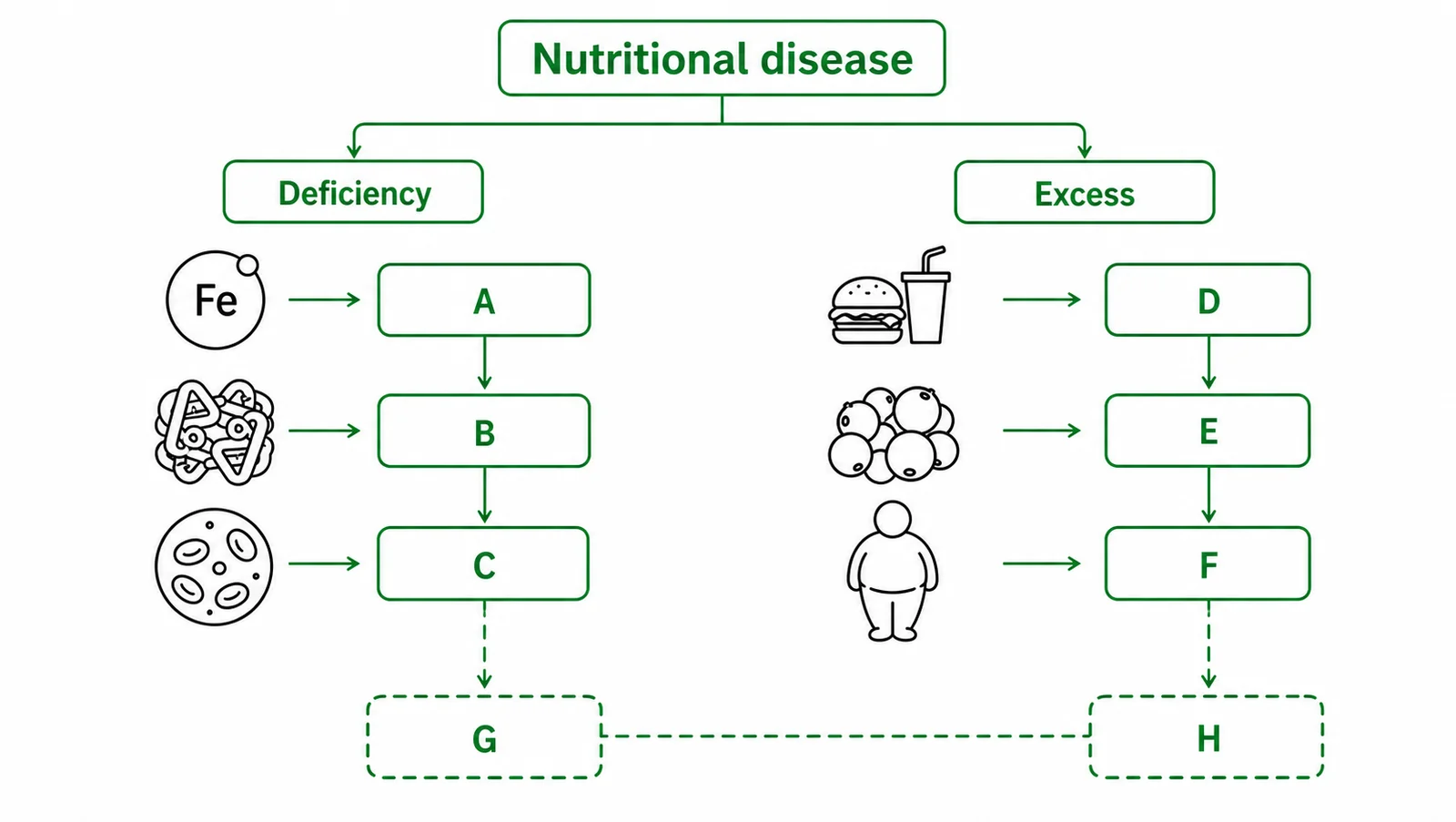
- A, category name for the left panel (diseases caused by too little of a nutrient) _______________________
- B, the nutrient missing in rickets _______________________
- C, the vitamin required as a cofactor for collagen synthesis _______________________
- D, the disease caused by iodine deficiency (visible thyroid enlargement) _______________________
- E, the blood protein whose synthesis is impaired in iron deficiency _______________________
- F, category name for the right panel (diseases caused by too much of a nutrient) _______________________
- G, the dietary macronutrient in excess that drives Type 2 diabetes (refined ___) _______________________
- H, the framework phrase linking all nutritional diseases (nutrient → function → ___) _______________________
| Box | Your label |
|---|---|
| A | |
| B | |
| C | |
| D | |
| E | |
| F | |
| G | |
| H |
2. Term–definition match
The ten definitions below are shuffled. In the right-hand column write the matching term from this list: nutritional disease, malnutrition, nutrient deficiency, scurvy, kwashiorkor, atherosclerosis, insulin resistance, hyperglycaemia, goitre, microcytic hypochromic anaemia. 10 marks
| # | Definition (shuffled) | Matching term |
|---|---|---|
| 2.1 | A disease arising from nutrient deficiency, excess, or imbalance, not caused by a pathogen or inherited mutation. | |
| 2.2 | Insufficient intake or absorption of an essential nutrient, disrupting normal physiological function. | |
| 2.3 | Any condition resulting from an inadequate or unbalanced diet, includes both undernutrition and overnutrition. | |
| 2.4 | Vitamin C deficiency; prevents collagen synthesis, causing weakened connective tissue, bleeding gums, and impaired wound healing. | |
| 2.5 | Severe protein deficiency causing oedema and stunted growth; distinct from marasmus (total calorie deficiency). | |
| 2.6 | Build-up of lipid-rich plaques in arterial walls; a diet high in saturated fat is a major risk factor. | |
| 2.7 | Condition in which liver, muscle, and fat cells fail to respond normally to insulin; a precursor state in Type 2 diabetes. | |
| 2.8 | Chronically elevated blood glucose concentration; the defining biochemical feature of both Type 1 and Type 2 diabetes. | |
| 2.9 | Visible enlargement of the thyroid gland caused by sustained high TSH stimulation in iodine deficiency. | |
| 2.10 | Iron deficiency anaemia characterised by small (low MCV), pale (low MCH) red blood cells with reduced haemoglobin content. |
3. True or false, with correction
For each statement, circle T or F. If the statement is false, write the corrected version. 8 marks (1 for T/F, 1 for the correction where needed)
3.1 Vitamin D is primarily obtained from food; skin synthesis from sunlight plays only a minor role in most Australians. T / F
3.2 Iron deficiency anaemia produces small (microcytic) and pale (hypochromic) red blood cells because haemoglobin synthesis is impaired. T / F
3.3 Atherosclerosis is caused by saturated fat passively depositing on artery walls like a pipe becoming clogged. T / F
3.4 In iodine deficiency, TSH levels rise because the pituitary detects low T3/T4 and compensates by releasing more TSH. T / F
4. Function recall
Answer each in 1–2 sentences using precise biochemical terms from the lesson. 10 marks (2 each)
4.1 What is the normal physiological function of vitamin D in calcium absorption, and why does deficiency cause bone deformation even when dietary calcium intake is adequate?
4.2 What is the biochemical function of vitamin C in collagen synthesis? Name the enzymes it acts as a cofactor for.
4.3 What is the function of iodine in thyroid hormone production? State the names of the two thyroid hormones that require iodine.
4.4 What is the function of iron in haemoglobin, and why is non-haem iron from plant sources less efficiently absorbed than haem iron from meat?
4.5 What is the function of insulin in normal blood glucose regulation, and what does “insulin resistance” mean at the cellular level?
5. Cloze, complete the atherosclerosis mechanism
Fill each blank with the correct term from the word bank below. Each word is used once. 8 marks (1 per blank)
Word bank: LDL • oxidises • endothelium • macrophages • foam cells • plaque • thrombus • myocardial infarction
Excess dietary saturated fat causes the liver to produce elevated levels of (1) _____________, which circulates in the bloodstream. At sites of damage to the arterial (2) _____________, LDL particles enter the sub-endothelial intima of the artery wall. Once inside, LDL (3) _____________ in the presence of reactive oxygen species, triggering an inflammatory response. (4) _____________ are recruited to the site and engulf oxidised LDL, becoming lipid-laden (5) _____________, which accumulate as an atherosclerotic (6) _____________. If the fibrous cap of this structure ruptures, blood contacts the lipid-rich core and a (7) _____________ (blood clot) rapidly forms. If this clot completely blocks a coronary artery, the result is a (8) _____________ (heart attack) as downstream cardiac muscle is deprived of oxygen.
6. Build a concept map
Draw labelled arrows between the six terms below to show how they connect. Each arrow must carry a linking phrase (e.g. “causes”, “is required for”, “leads to”). Aim for at least 6 labelled arrows. 6 marks
Supplied terms: vitamin C deficiency · prolyl/lysyl hydroxylase · collagen cross-linking · connective tissue failure · scurvy · bleeding gums / impaired wound healing.
Q1, Labelled diagram
A: Nutrient deficiency diseases (or “deficiency diseases”). B: Vitamin D (cholecalciferol/calcitriol). C: Vitamin C (ascorbic acid). D: Goitre. E: Haemoglobin. F: Dietary excess / diet-related diseases. G: Carbohydrates (refined carbohydrates / sugars). H: Consequence (the nutrient → function → consequence framework).
Q2, Term–definition matches
2.1 nutritional disease • 2.2 nutrient deficiency • 2.3 malnutrition • 2.4 scurvy • 2.5 kwashiorkor • 2.6 atherosclerosis • 2.7 insulin resistance • 2.8 hyperglycaemia • 2.9 goitre • 2.10 microcytic hypochromic anaemia.
Q3, True / false with correction
3.1 False. Correction: the primary source of vitamin D for most people is skin synthesis from UVB radiation, dietary sources are supplementary. Australians can be deficient despite abundant sunshine because of sunscreen use, indoor occupations, and darker skin pigmentation.
3.2 True. Iron is the central atom of haem in haemoglobin; without sufficient iron, haemoglobin synthesis is impaired and the resulting red blood cells are small (microcytic, low MCV) and pale (hypochromic, low MCH).
3.3 False. Correction: atherosclerosis is an inflammatory disease of the arterial wall, not passive fat deposition. LDL infiltrates the endothelium, oxidises, triggers macrophage recruitment, and foam cell accumulation forms plaques. Plaque rupture, not progressive narrowing alone, typically triggers the acute thrombotic event that causes a heart attack or stroke.
3.4 True. Low iodine → insufficient T3/T4 → pituitary detects low hormone levels via negative feedback → releases more TSH as a compensatory signal → TSH stimulates thyroid growth → goitre.
Q4.1, Vitamin D function
Vitamin D (as calcitriol) is required for the absorption of calcium and phosphate from the intestinal lumen into the bloodstream. Without vitamin D, calcium cannot be efficiently absorbed regardless of how much is eaten, hence blood calcium falls and calcium is mobilised from bone. In children this prevents mineralisation of developing bones, causing them to soften and deform under body weight (rickets).
Q4.2, Vitamin C function
Vitamin C is an essential cofactor for prolyl hydroxylase and lysyl hydroxylase the enzymes that hydroxylate proline and lysine residues in procollagen. This hydroxylation is required for collagen chains to form stable cross-linked triple helices. Without it, collagen is structurally defective throughout the body.
Q4.3, Iodine function
Iodine is a structural component incorporated into the thyroid hormones T3 (triiodothyronine, 3 iodine atoms) and T4 (thyroxine, 4 iodine atoms). These hormones regulate basal metabolic rate, growth, and brain development. Without dietary iodine, the thyroid cannot synthesise adequate T3/T4 regardless of its activity.
Q4.4, Iron function
Iron is the central atom of the haem group in haemoglobin, enabling the reversible binding and transport of oxygen. Without sufficient iron, haemoglobin synthesis is impaired, reducing oxygen-carrying capacity. Non-haem iron from plant sources is absorbed at only 2–10% efficiency compared to 15–35% for haem iron from meat, partly because its absorption is inhibited by phytates and oxalates in plant foods and it must first be reduced from Fe³+ to Fe²+ before absorption.
Q4.5, Insulin function
Insulin signals liver, muscle, and fat cells to take up glucose from the bloodstream, lowering blood glucose after a meal. In insulin resistance, target cells have downregulated their insulin receptors or post-receptor signalling in response to chronically elevated insulin levels, so they no longer respond adequately to insulin stimulation, less glucose is removed from the blood despite insulin being present.
Q5, Cloze paragraph
(1) LDL (2) endothelium (3) oxidises (4) macrophages (5) foam cells (6) plaque (7) thrombus (8) myocardial infarction
Q6, Sample concept map
A correct map should include arrows such as:
- vitamin C deficiencyinactivates / inhibits → prolyl/lysyl hydroxylase
- prolyl/lysyl hydroxylaseis required for → collagen cross-linking
- collagen cross-linkingwhen impaired, causes → connective tissue failure
- connective tissue failureproduces symptoms of → scurvy
- scurvyclinical signs include → bleeding gums / impaired wound healing
- vitamin C deficiencyleads to the disease → scurvy
Any biologically valid linking phrases are accepted. Award full marks for at least 6 correctly labelled arrows that respect causal direction.