Biology • Year 12 • Module 8 • Lesson 8
Environmental Diseases, Smoking, UV Exposure, Asbestos and Lifestyle Factors
Lock in the core vocabulary, the three-exposure framework (smoking, UV, asbestos), and the molecular mechanisms that link environmental exposure to disease.
1. Label the environmental disease overview diagram
The diagram below maps each major environmental agent to its target cell type, molecular mechanism and resulting disease. Write the missing labels into boxes A–H. Each label is drawn from the lesson’s Key Terms panel or Cards 1–4. 8 marks
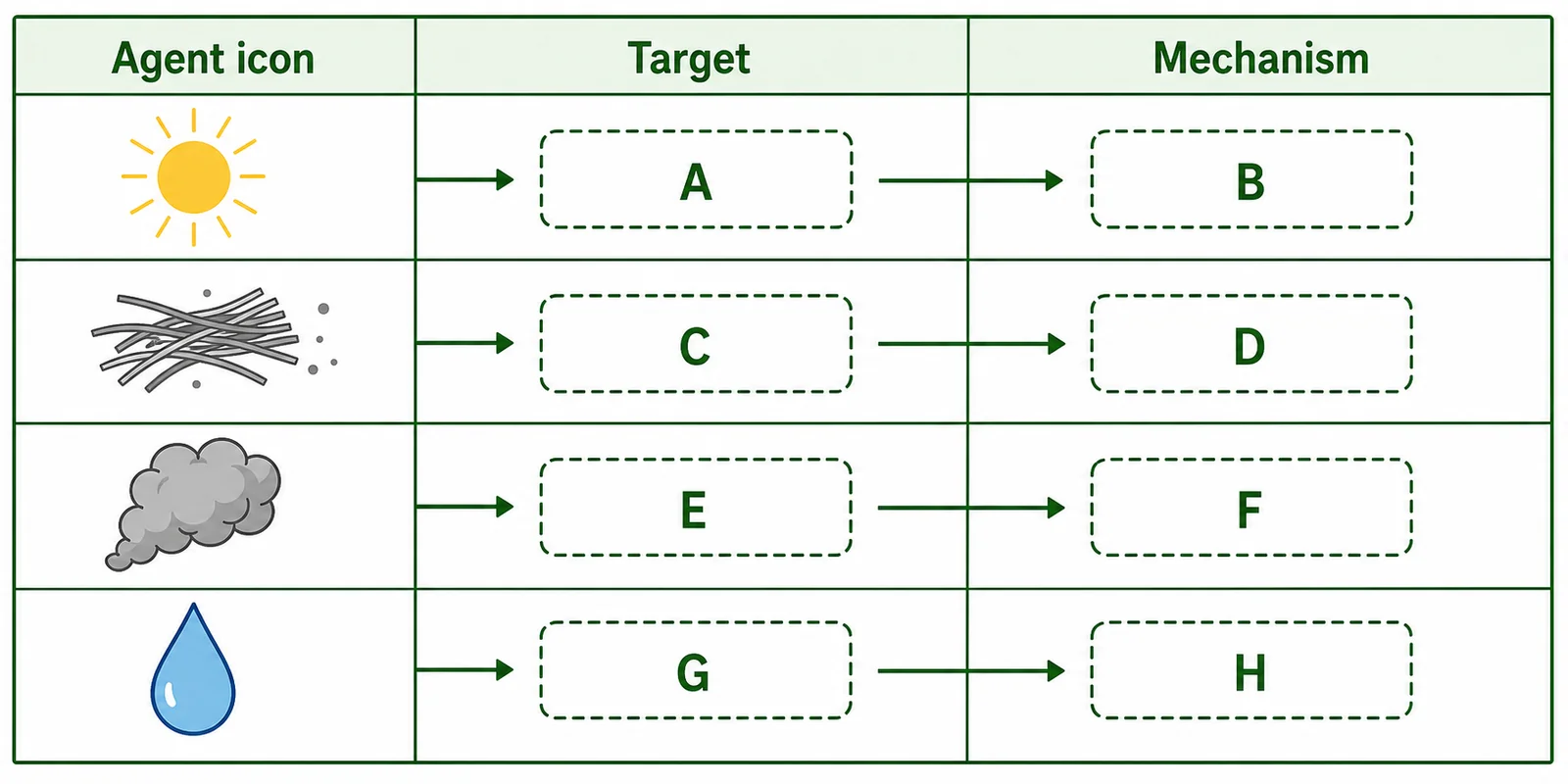
- A, type of carcinogen in tobacco smoke (chemical / physical / biological) _______________________
- B, cell type targeted by tobacco carcinogens leading to lung cancer _______________________
- C, name of the DNA lesion tobacco carcinogens form _______________________
- D, melanocyte-related cell type targeted by UV-B _______________________
- E, name of the UV-B-induced DNA lesion (full name or abbreviation) _______________________
- F, name given to the failed macrophage response to asbestos fibres _______________________
- G, damaging molecules released during that failed macrophage response _______________________
- H, malignant cancer of the pleural lining caused by asbestos _______________________
2. Term–definition match
Match each definition below to the correct term. Choose from: environmental disease, carcinogen, mutagen, epigenetics, dose-response relationship, pneumoconiosis, latency period, DNA adduct, thymine dimer, pack-year. 10 marks
| # | Definition (shuffled) | Matching term |
|---|---|---|
| 2.1 | A non-infectious disease caused or triggered by exposure to external physical, chemical or biological agents rather than by inherited genes alone. | |
| 2.2 | The pattern showing how increasing cumulative exposure to an environmental agent produces increasing levels of disease risk. | |
| 2.3 | Any agent that increases the rate of mutation; all carcinogens are examples, but not all examples cause cancer directly. | |
| 2.4 | An agent (chemical, radiation or biological) that damages DNA and increases the risk of cancer development. | |
| 2.5 | Heritable changes in gene expression that do not involve alterations to the DNA nucleotide sequence itself. | |
| 2.6 | The time between first exposure to an environmental agent and the clinical manifestation of the resulting disease. | |
| 2.7 | A distortion in the DNA helix formed when a tobacco carcinogen (such as benzopyrene) covalently bonds to a DNA base. | |
| 2.8 | A UV-B-induced DNA lesion in which a covalent cyclobutane ring forms between two adjacent thymine bases on the same DNA strand. | |
| 2.9 | An environmental lung disease caused by long-term inhalation of industrial dust particles (e.g. asbestosis from asbestos; silicosis from silica). | |
| 2.10 | A unit of tobacco exposure calculated as the number of packs of cigarettes smoked per day multiplied by the number of years of smoking. |
3. True or false, with correction
For each statement, circle T or F. If the statement is false, write the corrected version on the line provided. 10 marks (1 for T/F, 1 for the correction where needed)
3.1 Asbestos causes mesothelioma because it contains toxic chemicals that directly bond to DNA in the same way as tobacco carcinogens. T / F
3.2 UV-B radiation causes skin cancer primarily through the formation of thymine dimers that distort the DNA helix. T / F
3.3 Epigenetic changes alter the DNA nucleotide sequence to silence tumour suppressor genes. T / F
3.4 The latency period for asbestos-related mesothelioma (20–50 years) is shorter than the latency period for tobacco-related lung cancer (20–30 years). T / F
3.5 A person who smoked 20 cigarettes per day for 30 years has a tobacco exposure of 30 pack-years. T / F
4. Mechanism recall
Answer each question in 1–2 precise sentences. 8 marks (2 each)
4.1 What is the function of nucleotide excision repair (NER) in relation to UV-B damage in skin cells?
4.2 What does DNA methylation of a tumour suppressor gene promoter do to that gene’s expression?
4.3 What is the role of elastase in the development of emphysema caused by tobacco smoking?
4.4 What is the significance of the BRAF V600E mutation specifically in the context of UV-induced melanoma?
5. Fill the gaps, cloze paragraph
Complete the paragraph below using the word bank. Each word is used once only. 8 marks
Word bank: DNA adducts • TP53 • bronchial epithelial • frustrated phagocytosis • pack-years • thymine dimers • CDKN2A • reactive oxygen species
Tobacco smoke carcinogens such as benzopyrene are absorbed across _____________________ cells and metabolically activated to forms that covalently bond to DNA bases, forming _____________________. If these occur in the tumour suppressor gene _____________________, a mutation may remove a critical cell cycle checkpoint. Cumulative exposure is measured in _____________________. Meanwhile, asbestos fibres inhaled into the pleural lining trigger _____________________ when macrophages attempt but fail to engulf them; the macrophages then release _____________________ (ROS) that indirectly damage mesothelial cell DNA. In skin cells, UV-B radiation directly creates _____________________ between adjacent thymines. Environmental tobacco smoke can also silence the tumour suppressor _____________________ by DNA methylation of its promoter without changing the DNA sequence, an epigenetic mechanism.
6. Build a concept map
Draw labelled arrows between the six terms below showing how they connect. Each arrow must carry a linking phrase. Aim for at least 6 labelled arrows. 6 marks
Supplied terms: environmental exposure • DNA damage / mutation • dose-response relationship • latency period • cancer • epigenetic change.
Q1, Labelled diagram
A: Chemical (carcinogen). B: Bronchial epithelial cell. C: DNA adduct. D: Melanocyte. E: Thymine dimer (cyclobutane pyrimidine dimer / CPD). F: Frustrated phagocytosis. G: Reactive oxygen species (ROS). H: Mesothelioma.
Q2, Term–definition matches
2.1 environmental disease • 2.2 dose-response relationship • 2.3 mutagen • 2.4 carcinogen • 2.5 epigenetics • 2.6 latency period • 2.7 DNA adduct • 2.8 thymine dimer • 2.9 pneumoconiosis • 2.10 pack-year
Q3, True / false with correction
3.1 False. Correction: asbestos causes mesothelioma through a physical mechanism, not a chemical one. Asbestos fibres are chemically inert. Macrophages cannot degrade the long fibres (frustrated phagocytosis) and release reactive oxygen species (ROS), which indirectly damage DNA in adjacent mesothelial cells.
3.2 True.
3.3 False. Correction: epigenetic changes (e.g. DNA methylation) alter gene expression without changing the nucleotide sequence. A methylated promoter is still the same DNA sequence, transcription factors simply cannot bind, silencing the gene without any sequence change.
3.4 False. Correction: the asbestos latency period (20–50 years) is longer than, not shorter than, the tobacco latency period (20–30 years). Asbestos has the longest latency of any known occupational carcinogen.
3.5 True. 20 cigarettes/day = 1 pack/day; 1 pack/day × 30 years = 30 pack-years. The statement is correct.
Q4.1, NER function
Nucleotide excision repair (NER) enzymes recognise and excise thymine dimers (cyclobutane pyrimidine dimers) created by UV-B radiation. They remove the distorted nucleotides and replace them with correctly synthesised nucleotides using the complementary strand as a template. This prevents the dimers from causing mutations during DNA replication.
Q4.2, DNA methylation of tumour suppressor promoter
DNA methylation of a tumour suppressor gene promoter adds methyl groups (–CH3) to cytosine bases at CpG sites in that promoter region. Methyl-binding proteins then compact the chromatin and prevent transcription factors from binding, so the gene is transcriptionally silenced, it is not expressed. The protein the gene encodes is not produced, removing that gene’s tumour-suppressing function without changing the nucleotide sequence.
Q4.3, Elastase in emphysema
Tobacco smoke irritants trigger chronic recruitment of neutrophils and macrophages to the airways. These immune cells release elastase, a protease that degrades elastin, the protein that gives alveolar walls their elastic recoil. Progressive destruction of alveolar walls reduces the surface area available for gas exchange and eliminates the passive elastic recoil that drives exhalation, producing the hyperinflation and airflow obstruction of emphysema.
Q4.4, BRAF V600E in melanoma
The BRAF V600E mutation, found in approximately 60% of melanomas, is a point mutation in the BRAF proto-oncogene caused by UV-induced mutagenesis. The V600E variant constitutively (constantly) activates the MAPK/ERK signalling pathway independently of normal growth factor signals, driving uncontrolled melanocyte proliferation. This is a key oncogenic driver in melanoma development.
Q5, Cloze answers (in order of blanks)
bronchial epithelial • DNA adducts • TP53 • pack-years • frustrated phagocytosis • reactive oxygen species • thymine dimers • CDKN2A
Q6, Sample concept map
A correct map should include arrows such as:
- environmental exposureproduces → DNA damage / mutation
- environmental exposurecan also cause → epigenetic change
- epigenetic changesilences tumour suppressors, contributing to → DNA damage / mutation (functional loss)
- dose-response relationshipdescribes how more exposure increases probability of → DNA damage / mutation
- DNA damage / mutationaccumulates over → latency period
- latency periodends with manifestation of → cancer
Award 1 mark per correctly labelled, causally valid arrow (max 6).