Biology • Year 12 • Module 8 • Lesson 6
Causes of Non-infectious Disease, Overview
Lock in the core vocabulary, the four-category classification framework, and the distinction between risk factors and direct causes.
1. Label the non-infectious disease classification diagram
The diagram below shows the four categories of non-infectious disease with overlapping regions for multifactorial diseases, and three named diseases positioned within it. Write the correct label for each box A–H from the lesson’s key terms and content. 8 marks
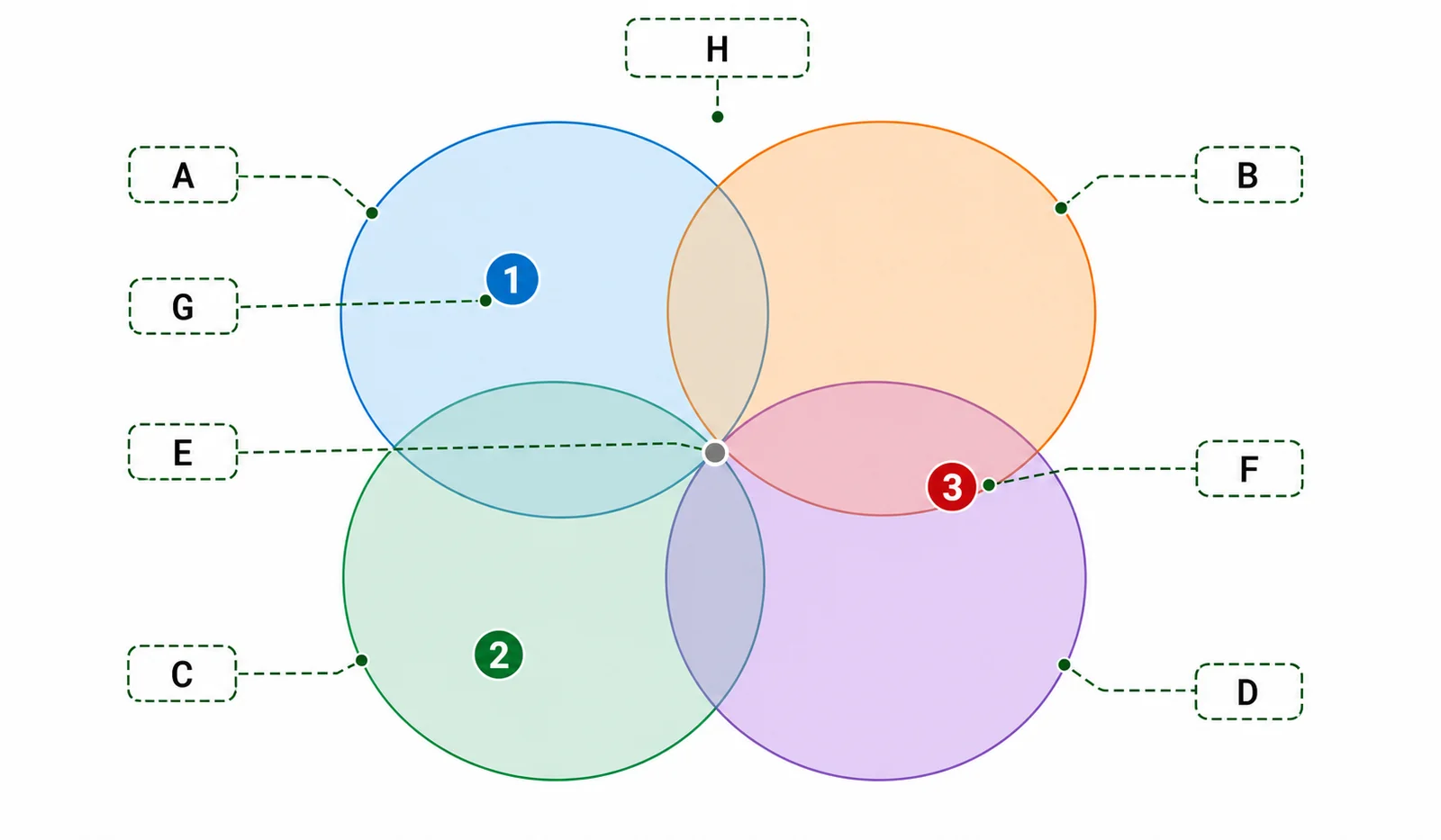
- A, circle name (diseases caused by gene mutations) _______________________
- B, circle name (diseases caused by external exposures e.g. UV, asbestos) _______________________
- C, circle name (diseases caused by nutrient deficiency or excess) _______________________
- D, circle name (diseases characterised by uncontrolled cell division) _______________________
- E, region label (disease spanning genetic + environmental + nutritional overlap) _______________________
- F, which two circles overlap at the melanoma pin? _______________________
- G, the primary category for cystic fibrosis _______________________
- H, term for a disease with multiple interacting causes _______________________
2. Term–definition match
The definitions below are shuffled. Write the matching term from this list in the right-hand column: non-infectious disease, risk factor, lifestyle disease, multifactorial disease, epidemiology, prevalence, genetic disease, environmental disease, nutritional disease, epidemiological transition. 10 marks
| # | Definition (shuffled) | Matching term |
|---|---|---|
| 2.1 | A disease that cannot be transmitted from person to person via a pathogen. | |
| 2.2 | Any characteristic, behaviour, or exposure that increases the statistical probability of developing a disease without making it inevitable. | |
| 2.3 | A non-infectious disease strongly associated with modifiable behaviours such as diet, physical activity, and smoking (e.g. Type 2 diabetes). | |
| 2.4 | A disease caused by the interaction of multiple genetic, environmental, and nutritional factors; most non-infectious diseases belong to this category. | |
| 2.5 | The scientific study of the distribution and determinants of health and disease in populations; uses data to identify risk factor patterns. | |
| 2.6 | The proportion of a population with a particular disease at a given point in time. | |
| 2.7 | A non-infectious disease caused by a mutation in one or more genes that produces an altered or non-functional protein (e.g. cystic fibrosis). | |
| 2.8 | A non-infectious disease caused or contributed to by exposure to a harmful physical, chemical, or biological agent in the environment (e.g. mesothelioma from asbestos). | |
| 2.9 | A non-infectious disease caused by deficiency or excess of specific nutrients that disrupts normal physiological processes (e.g. scurvy from vitamin C deficiency). | |
| 2.10 | The historical shift from infectious diseases to non-infectious diseases as the leading causes of death in a population, driven by improved sanitation, vaccines, and antibiotics. |
3. True or false, with correction
Circle T or F. If false, write the corrected version. 8 marks (1 for T/F, 1 for each correction)
3.1 Non-infectious diseases cannot involve genetics, the word ‘non-infectious’ means non-genetic. T / F
3.2 Cystic fibrosis is an infectious disease because it requires a mutation in both CFTR alleles to be transmitted. T / F
3.3 A risk factor increases the probability of developing a disease but does not guarantee disease development. T / F
3.4 According to AIHW data, the top five causes of death in Australia are all non-infectious diseases. T / F
4. Function recall
Answer each in 1–2 sentences using precise biological terms. 8 marks (2 each)
4.1 What feature of a disease determines whether it is classified as infectious rather than non-infectious?
4.2 Why does NESA classify cancer as a separate category from genetic, environmental, and nutritional diseases?
4.3 Why did the epidemiological transition result in non-infectious diseases becoming the dominant cause of death in Australia?
4.4 What does it mean to say that Type 2 diabetes is a ‘multifactorial’ disease?
5. Fill in the blank
Complete the paragraph below using the word bank provided. Each word or phrase is used once. 8 marks
Word bank: transmissible • pathogen • multifactorial • AIHW • epidemiological transition • risk factor • genetic predisposition • uncontrolled cell division
A disease is classified as infectious only if it is caused by a and can be from one individual to another. Non-infectious diseases cannot be caught. Cancer is treated as a distinct category because its defining feature is , regardless of whether the trigger was genetic, environmental, or infectious. Most non-infectious diseases are , meaning they result from several interacting causes. For example, family history (a ) is one factor that raises the likelihood of cardiovascular disease, but it is classified as a rather than a direct cause, because it increases probability without guaranteeing disease. The shift from infectious to non-infectious disease as Australia’s leading killer is called the . Current burden-of-disease data for Australia are published by the .
6. Build a concept map
Draw labelled arrows between the six terms below to show how they connect. Each arrow must carry a linking phrase (e.g. “contributes to”, “increases probability of”, “is classified under”, “is reduced by”). Aim for at least 6 labelled arrows. 6 marks
Terms: non-infectious disease · genetic predisposition · environmental exposure · risk factor · multifactorial disease · epidemiological transition.
Q1, Labelled diagram
A: Genetic disease. B: Environmental disease. C: Nutritional disease. D: Cancer. E: Type 2 diabetes (or any disease spanning genetic + nutritional + environmental, accept label “multifactorial overlap”). F: Environmental and Cancer (melanoma sits at the intersection of these two circles). G: Genetic disease (cystic fibrosis is classified primarily as a genetic disease, CFTR mutation in both alleles). H: Multifactorial disease.
Q2, Term–definition matches
2.1 non-infectious disease • 2.2 risk factor • 2.3 lifestyle disease • 2.4 multifactorial disease • 2.5 epidemiology • 2.6 prevalence • 2.7 genetic disease • 2.8 environmental disease • 2.9 nutritional disease • 2.10 epidemiological transition.
Q3, True / false with correction
3.1 False. Correction: ‘Non-infectious’ refers only to transmissibility via a pathogen, not to genetic involvement. Genetic diseases such as cystic fibrosis and Huntington’s disease are non-infectious diseases.
3.2 False. Correction: Cystic fibrosis is a non-infectious disease. The CFTR gene mutation is inherited (not transmitted via a pathogen), and the disease cannot be ‘caught’ from another person.
3.3 True.
3.4 True. AIHW data list coronary heart disease, dementia, cerebrovascular disease, lung cancer, and chronic lower respiratory diseases as the top five causes of death in Australia, all are non-infectious.
Q4.1, Feature distinguishing infectious from non-infectious
The defining feature is transmissibility via a pathogen. An infectious disease is caused by a bacterium, virus, fungus, or parasite that can spread from one host to another. A non-infectious disease cannot be transmitted via a pathogen between individuals, regardless of how serious or genetic it may be.
Q4.2, Why cancer is a separate NESA category
Cancer’s defining feature, uncontrolled cell division due to disruption of cell cycle regulation, is a unique biological mechanism that cuts across all other categories. A cancer can have a genetic trigger (BRCA1/2), an environmental trigger (UV, tobacco), a nutritional trigger, or an infectious trigger (HPV), but in every case the outcome is uncontrolled proliferation of cells. NESA treats it separately because the mechanism is distinct from gene-only, environment-only, or nutrition-only non-infectious diseases.
Q4.3, Why the epidemiological transition led to NID dominance
The introduction of antibiotics, vaccination programs, improved sanitation, and better nutrition dramatically reduced deaths from infectious diseases across the 20th century. As fewer people died prematurely from infections, populations aged. Because non-infectious diseases typically take decades to develop (e.g. atherosclerosis begins in young adulthood), a larger proportion of the population now lives long enough to develop and die from them. Coronary heart disease, dementia, and cancer consequently dominate Australian mortality statistics.
Q4.4, What ‘multifactorial’ means for Type 2 diabetes
Type 2 diabetes is caused by the interaction of multiple factors: genetic predisposition (family history, ethnicity affecting insulin signalling genes), environmental factors (sedentary work, lack of access to safe exercise spaces), and nutritional factors (excess refined carbohydrates and saturated fat leading to insulin resistance and obesity). No single factor alone is necessary or sufficient, the disease arises from the combination of all interacting influences over time.
Q5, Cloze paragraph
In order: pathogen • transmissible • uncontrolled cell division • multifactorial • genetic predisposition • risk factor • epidemiological transition • AIHW.
Q6, Sample concept map
Correct arrows include (accept any biologically valid linking phrase):
- genetic predispositionis a type of → risk factor
- environmental exposureis a type of → risk factor
- risk factorincreases probability of → non-infectious disease
- non-infectious diseaseis often → multifactorial disease
- multifactorial diseaseinvolves interaction of → genetic predisposition & environmental exposure
- epidemiological transitionexplains why → non-infectious disease now dominates mortality
Award 1 mark per correctly labelled arrow that respects causal direction, up to 6 marks.