Biology • Year 12 • Module 8 • Lesson 5
Plant Water Balance and Homeostasis in Other Organisms
Apply stomatal control, xerophytic adaptations and fish osmoregulation to real data, experimental scenarios and diagram critique.
1. Interpret transpiration data, potometer experiment
A researcher measured water uptake rate (proxy for transpiration) of a leafy Eucalyptus camaldulensis (river red gum) shoot over 24 hours using a potometer. The shoot was kept under controlled conditions in a glasshouse, and one environmental variable was altered at each time period. The results are shown below. 8 marks
Figure 1.1. Water uptake rate in a Eucalyptus camaldulensis (river red gum) shoot under five sequential experimental conditions. Adapted from potometer methodology (Nobel, 2009).
1.1 Describe the overall pattern in water uptake rate across the five conditions (A–E). 2 marks
1.2 Condition B (fan on) produced the highest water uptake rate. Using the concept of water vapour concentration gradient, explain the mechanism responsible. 2 marks
1.3 Condition D (high humidity, 90% relative humidity) caused a large drop in water uptake compared to condition C. Explain why using the diffusion gradient. 2 marks
1.4 Condition E involved both darkness and ABA application. Explain the physiological mechanism by which ABA reduced transpiration to near zero. 2 marks
2. Diagram critique, spot the errors in this student’s osmoregulation diagram
A student drew the diagram below to compare marine and freshwater fish osmoregulation. There are three biological errors. Identify each error and write the correction. 6 marks (2 per error: 1 identify, 1 correct)
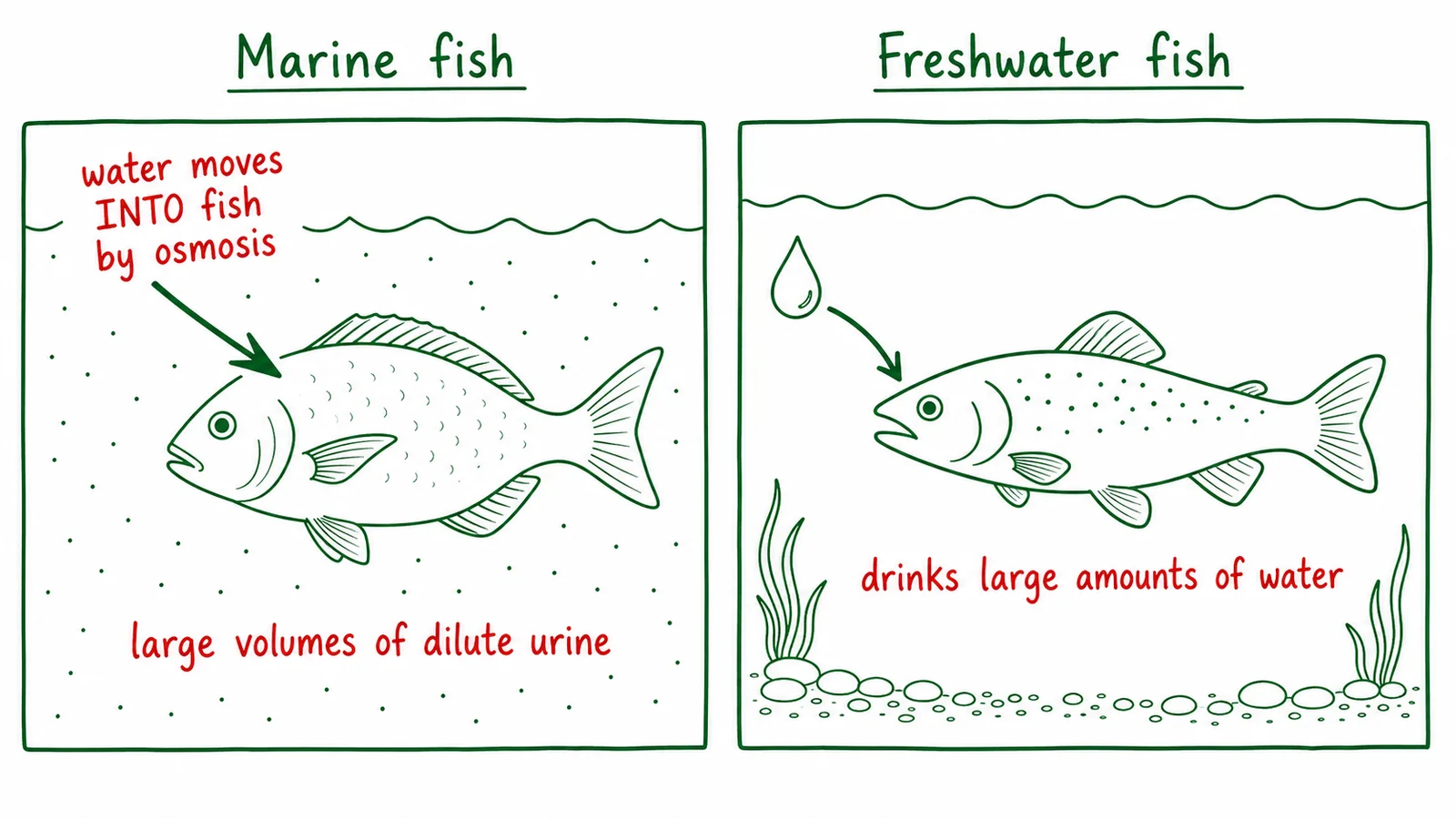
2.1 Error 1: What is wrong?
Correction:
2.2 Error 2: What is wrong?
Correction:
2.3 Error 3: What is wrong?
Correction:
3. Compare xerophytic adaptations, mechanism and effectiveness
Complete the table comparing four xerophytic adaptations. For each: name the mechanism by which it reduces water loss and state whether it primarily reduces cuticular transpiration, stomatal transpiration, or both. 8 marks (2 each)
| Adaptation | Mechanism (how it reduces water loss) | Type of transpiration reduced |
|---|---|---|
| Thick waxy cuticle | ||
| Sunken stomata (e.g. Hakea spp.) | ||
| Dense trichomes (e.g. silver wattle) | ||
| Small/reduced leaf size (e.g. phyllodes in wattles) |
4. Predict and justify, salmon in the Murray–Darling
Atlantic salmon (Salmo salar) are euryhaline, they can survive in both seawater and freshwater. A hatchery program in the Murray–Darling Basin is trialling the introduction of juvenile Atlantic salmon from ocean holding tanks (seawater) directly into a freshwater river section. 5 marks
4.1 Predict and explain the immediate osmotic challenge the salmon will face as they enter the freshwater river. 2 marks
4.2 Explain the changes in osmoregulatory strategy the salmon must make (gills and kidneys) to survive in freshwater. 2 marks
4.3 Explain why this change in strategy is an example of homeostasis. 1 mark
5. Data table, transpiration rate across five plant species
A study measured mean transpiration rate (mL H2O per cm2 leaf area per hour) of five plant species under identical conditions (30°C, 40% humidity, still air, full sun). Structural features of each species are also given. 7 marks
| Species | Habitat | Key leaf features | Transpiration rate (mL cm−2 h−1) |
|---|---|---|---|
| Eucalyptus camaldulensis (river red gum) | Seasonally dry Australian floodplains | Vertically oriented, waxy cuticle, moderate size | 0.38 |
| Atriplex vesicaria (bladder saltbush) | Arid Australian outback | Small, silvery-grey, dense trichomes, waxy cuticle | 0.12 |
| Hakea leucoptera (needle bush) | Semi-arid inland Australia | Needle-like with sunken stomata, no flat blade | 0.09 |
| Helianthus annuus (sunflower) | Agricultural (temperate mesic) | Large flat leaves, no trichomes, no sunken stomata | 1.85 |
| Triodia pungens (soft spinifex) | Sandy desert, Australia | Rolled leaves (stomata on inner surface), waxy | 0.07 |
Data adapted from Dunin & Greenwood (1986), Plant and Soil 98: 119–134, and Australian Dryland Plant Ecology (2002).
5.1 Rank the five species from highest to lowest transpiration rate and identify which species are xerophytes. 2 marks
5.2 Account for the difference in transpiration rate between Hakea leucoptera (0.09) and Helianthus annuus (1.85) using structural features. 3 marks
5.3 Predict what would happen to the transpiration rate of Helianthus annuus if humidity increased from 40% to 90%. Justify your prediction using the concentration gradient concept. 2 marks
Q1.1, Pattern description (2 marks)
Water uptake rate was moderate in condition A (still air, baseline), increased sharply and peaked in condition B (high wind), remained elevated but slightly lower in condition C (high temperature), fell sharply in condition D (high humidity), and dropped to near zero in condition E (darkness + ABA). Overall the pattern shows that wind and high temperature increase transpiration, while high humidity, darkness and ABA suppress it.
Q1.2, Condition B mechanism (2 marks)
Wind removes the humid boundary layer of still air adjacent to the leaf surface [1]. This layer, which would partially saturate with water vapour and reduce the concentration gradient, is continuously replaced by drier moving air. The concentration gradient between the humid leaf interior and the dry air outside the stomata is therefore maintained at its maximum, driving rapid diffusion of water vapour outward through the stomata [1].
Q1.3, Condition D explanation (2 marks)
At 90% relative humidity, the air outside the leaf already contains a high concentration of water vapour [1]. This reduces the difference between the water vapour concentration inside the leaf (nearly saturated) and outside the leaf (high), meaning the diffusion gradient is much shallower. With a smaller gradient, the net rate of diffusion of water vapour outward falls sharply [1].
Q1.4, ABA mechanism (2 marks)
ABA was applied exogenously (mimicking drought stress). ABA acts on guard cells, triggering K+ to leave the guard cells via ion channels [1]. Water follows K+ out of the guard cells by osmosis; the guard cells lose turgor (become flaccid) and straighten, closing the stomatal pore. With stomata closed, the main pathway for water vapour diffusion out of the leaf is blocked, reducing transpiration to near zero [1].
Q2, Diagram critique (6 marks)
2.1 Error 1 (water direction for marine fish): The diagram incorrectly shows water entering the marine fish by osmosis. Correction: seawater (~1000 mOsm/kg) is more concentrated than fish blood (~350 mOsm/kg), so water moves OUT of the marine fish by osmosis, toward the area of higher solute concentration. [1 + 1]
2.2 Error 2 (urine of marine fish): The diagram incorrectly labels marine fish urine as “large volume, very dilute.” Correction: marine fish conserve water by producing small volumes of concentrated urine, to minimise the water lost from an already dehydrating situation. [1 + 1]
2.3 Error 3 (freshwater fish drinking): The diagram incorrectly shows freshwater fish drinking large amounts of freshwater. Correction: freshwater fish do NOT drink, because osmosis is already driving excess water into the fish. Drinking would worsen the problem. Instead, they expel excess water via large volumes of very dilute urine and absorb ions from the water via their gills. [1 + 1]
Q3, Compare xerophytic adaptations
Thick waxy cuticle: The lipid layer is impermeable to water, preventing water from diffusing through the surface of epidermal cells (cuticular transpiration). Reduces: cuticular transpiration.
Sunken stomata: Stomata in pits trap a pocket of humid, still air; the water vapour concentration in the pit is higher than the open atmosphere, reducing the concentration gradient between leaf interior and air, slowing diffusion outward. Reduces: stomatal transpiration.
Dense trichomes: Fine hairs create a humid, still boundary layer adjacent to the leaf surface; water vapour accumulates there, reducing the concentration gradient for diffusion. Trichomes also reflect some solar radiation, reducing leaf temperature and further reducing the vapour pressure gradient. Reduces: stomatal transpiration (and marginally cuticular by lowering leaf temperature).
Small/reduced leaf size (phyllodes): Smaller surface area means fewer stomata in total and less area through which transpiration can occur; absolute water loss per plant is reduced even if rate per unit area is similar. Reduces: both (total transpirational water loss is reduced).
Q4.1, Osmotic challenge (2 marks)
In freshwater, the surrounding water (~5 mOsm/kg) is far more dilute than the salmon’s blood (~350 mOsm/kg) [1]. Water will enter the salmon continuously by osmosis through the permeable gill surfaces, threatening to dilute blood and tissue fluids to dangerously low osmolarity (hypo-osmotic stress) [1].
Q4.2, Strategy changes (2 marks)
In freshwater, the salmon must stop drinking (which it does in seawater to replace osmotic water loss) [1]. Gill cells must switch from excreting Na+/Cl− to actively absorbing Na+/Cl− from the surrounding water to prevent salt depletion; kidneys must produce large volumes of very dilute urine to expel the excess water entering by osmosis [1].
Q4.3, Homeostasis explanation (1 mark)
The physiological changes in gills and kidneys constitute a negative feedback response: the stimulus (blood osmolarity falling below set point as water enters) triggers effector responses (gills absorb salt, kidneys expel water) that oppose the change and return blood osmolarity toward the set point. This matches the homeostatic stimulus-response model. [1]
Q5.1, Ranking and xerophyte identification (2 marks)
Highest to lowest: Helianthus annuus (1.85) → E. camaldulensis (0.38) → A. vesicaria (0.12) → H. leucoptera (0.09) → Triodia pungens (0.07) [1]. Xerophytes: A. vesicaria, H. leucoptera, T. pungens (Australian arid/semi-arid habitats with multiple structural water-conservation features) [1].
Q5.2, Accounting for the rate difference (3 marks)
Hakea leucoptera has needle-like leaves with sunken stomata: the stomata in pits trap humid air, reducing the water vapour concentration gradient and slowing diffusion outward [1]. It has no broad flat blade, minimal surface area for transpiration [1]. Helianthus annuus has large flat leaves (maximum surface area), no sunken stomata (stomata flush with surface, full atmospheric exposure), and no trichomes, so there is no reduction in the concentration gradient and maximum pore area is available for diffusion [1].
Q5.3, Prediction at 90% humidity (2 marks)
The transpiration rate of Helianthus annuus would fall substantially [1]. At 90% humidity, the air outside the leaf contains a much higher concentration of water vapour than at 40%. This reduces the concentration difference between the saturated leaf interior and the air outside the stomata, shallowing the diffusion gradient and slowing the rate of net water vapour movement out of the leaf [1].