Biology • Year 12 • Module 8 • Lesson 5
Plant Water Balance and Homeostasis in Other Organisms
Lock in the core vocabulary for stomatal control, xerophytic adaptations, and aquatic osmoregulation before moving to applied tasks.
1. Label the stomatal control diagram
The diagram below shows one stoma in the open state and one in the closed state, with key components labelled A–H. Write the correct term or phrase for each letter. 8 marks
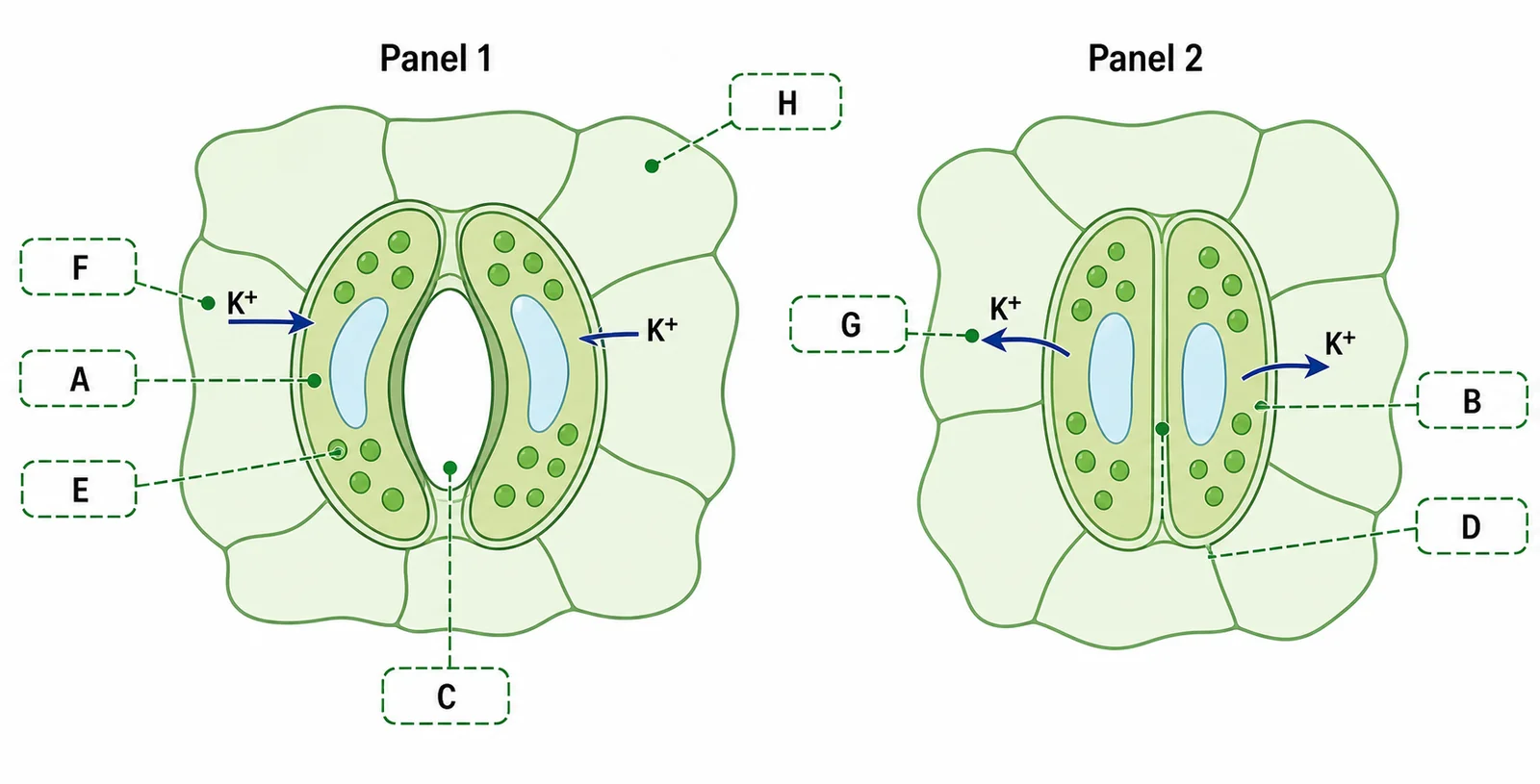
| Box | Your label |
|---|---|
| A | |
| B | |
| C | |
| D | |
| E | |
| F | |
| G | |
| H |
2. Term–definition match
Match each definition below to the correct term from this list: transpiration, stomata, guard cell, xerophyte, osmoconformer, osmoregulator, ABA (abscisic acid), turgor pressure, trichome, sunken stomata. 10 marks
| # | Definition (shuffled) | Matching term |
|---|---|---|
| 2.1 | An organism that allows its internal osmolarity to change with the environment; most marine invertebrates. | |
| 2.2 | Microscopic pores in the leaf epidermis through which gas exchange and water vapour loss occur. | |
| 2.3 | A plant adapted to survive in dry environments, typically with structural features that reduce water loss. | |
| 2.4 | The plant hormone released under drought stress that triggers K+ efflux from guard cells and stomatal closure. | |
| 2.5 | The evaporation of water vapour from leaf surfaces, primarily through stomata; drives water movement up the xylem. | |
| 2.6 | One of the paired cells flanking a stoma that actively transport K+ to change their turgor and open or close the pore. | |
| 2.7 | An organism that actively maintains a constant internal osmolarity regardless of external conditions. | |
| 2.8 | The pressure exerted by a cell's contents against its cell wall when the cell is full of water; drives guard cell shape changes. | |
| 2.9 | A fine hair on a leaf surface that traps still, humid air and may also reflect solar radiation. | |
| 2.10 | Stomata positioned in pits or grooves below the leaf surface, trapping humid air to reduce the water vapour concentration gradient. |
3. True or false, with correction
Circle T or F. If false, write the corrected statement on the line provided. 10 marks
3.1 Guard cells open stomata by pumping water directly into themselves. T / F
3.2 ABA (abscisic acid) is released by leaves during drought and causes K+ to leave guard cells. T / F
3.3 Marine fish must continuously drink seawater because their blood is more dilute than the surrounding seawater. T / F
3.4 Freshwater fish produce large volumes of dilute urine because water constantly enters their bodies by osmosis. T / F
3.5 Xerophytic structural adaptations (such as a thick waxy cuticle) are active physiological responses that the plant switches on during drought. T / F
4. Function recall
Answer each in 1–2 sentences using precise lesson terms. 10 marks (2 each)
4.1 What is the function of the thick waxy cuticle on a xerophyte leaf?
4.2 What is the function of K+ active transport in opening a stoma in the morning?
4.3 What is the function of chloride cells in the gills of marine fish?
4.4 What is the function of rolled leaves in spinifex grass (Triodia spp.) in Australian desert habitats?
4.5 What is the function of producing large volumes of very dilute urine in freshwater fish?
5. Fill-the-blank, stomatal control
Complete the paragraph using the word bank below. Each term is used once. 8 marks
Word bank: ABA • osmosis • K+ • turgor • flaccid • turgid • photosynthesis • transpiration
During daylight, guard cells actively pump _______ ions into themselves. Water then follows by _______ from surrounding cells, making the guard cells _______ (swollen). The high _______ pressure causes the asymmetrically thickened guard cell walls to bow outward, opening the stomatal pore so CO2 can enter for _______. However, every minute the pore is open, water vapour is also lost by _______. During drought stress, the hormone _______ is released, reversing the process: K+ leaves the guard cells, water follows osmotically, and the guard cells become _______ (limp), closing the pore.
6. Build a concept map
Draw labelled arrows between the six terms below to show how they connect. Each arrow must carry a linking phrase (e.g. “triggers”, “reduces”, “results in”). Aim for at least 6 labelled arrows. 6 marks
Supplied terms: drought stress · ABA · K+ efflux from guard cells · loss of turgor · stomatal closure · reduced transpiration.
Q1, Stomatal diagram labels (suggested)
A: Guard cell. B: K+ actively transported into guard cells (influx). C: Water follows by osmosis (into guard cells). D: High turgor pressure → guard cells bow outward → pore opens. E: ABA (abscisic acid), drought trigger. F: K+ leaves guard cells (efflux). G: Low turgor pressure → guard cells straighten (flaccid). H: Pore closes (stomatal aperture = 0).
Q2, Term–definition matches
2.1 osmoconformer • 2.2 stomata • 2.3 xerophyte • 2.4 ABA (abscisic acid) • 2.5 transpiration • 2.6 guard cell • 2.7 osmoregulator • 2.8 turgor pressure • 2.9 trichome • 2.10 sunken stomata.
Q3, True/False with correction
3.1 False. Guard cells do not pump water directly. They actively transport K+ ions; water follows by osmosis. The active step is K+ transport; water movement is passive and osmotic.
3.2 True.
3.3 True. (Seawater ~1000 mOsm/kg; fish blood ~350 mOsm/kg → net water loss by osmosis → must drink to replace water.)
3.4 True. (Freshwater ~5 mOsm/kg; fish blood ~300 mOsm/kg → net water influx by osmosis → large dilute urine expels excess water.)
3.5 False. Xerophytic structural adaptations such as a thick waxy cuticle are permanent, passive features, they are present at all times and require no energy expenditure or switching on. They are not active physiological responses.
Q4, Function recall
4.1 The thick waxy cuticle is an impermeable lipid layer coating the outer epidermal cells. It prevents cuticular transpiration, water loss through non-stomatal surfaces, reducing overall water loss, especially when stomata are closed.
4.2 Light activates K+ pumps in guard cells; K+ is actively transported into the guard cells. Water follows by osmosis, increasing turgor pressure; the asymmetric cell walls cause guard cells to bow outward, opening the pore so CO2 can enter for photosynthesis.
4.3 Chloride cells in the gills of marine fish actively excrete Na+ and Cl− (salt) against the concentration gradient. This removes the excess salt ingested when the fish drinks seawater, preventing dangerous increases in blood osmolarity.
4.4 The rolled leaf encloses the stomata on the inner surface within a cylindrical humid chamber. Trapped air in the enclosed space becomes saturated with water vapour, minimising the water vapour concentration gradient between the leaf interior and the air adjacent to the stomata, reducing the rate of water loss by transpiration.
4.5 Freshwater is more dilute than fish blood, so water continuously enters the fish by osmosis. Producing large volumes of very dilute urine expels this excess water, preventing the blood from becoming dangerously dilute (hypo-osmotic stress).
Q5, Cloze paragraph
K+ • osmosis • turgid • turgor • photosynthesis • transpiration • ABA • flaccid.
Q6, Sample concept map
A correct map should include arrows such as:
- drought stresstriggers release of→ ABA
- ABAcauses→ K+ efflux from guard cells
- K+ efflux from guard cellsresults in water leaving by osmosis → loss of turgor
- loss of turgorcauses guard cells to straighten → stomatal closure
- stomatal closureproduces→ reduced transpiration
- reduced transpirationis the homeostatic response to→ drought stress
Award full marks for at least 6 correctly labelled arrows that follow the correct causal direction through the sequence.