Biology • Year 12 • Module 8 • Lesson 4
Water Balance, Neural and Hormonal Coordination
Lock in the key vocabulary, hormone site-of-action pairings, and the structural steps of the ADH and aldosterone pathways before tackling exam-style application.
1. Label the ADH water-balance pathway
The diagram below shows the complete ADH feedback pathway from dehydration to restored blood osmolarity. Write the missing labels into boxes A–H using terms from the lesson’s Key Terms and Cards 1–2. 8 marks
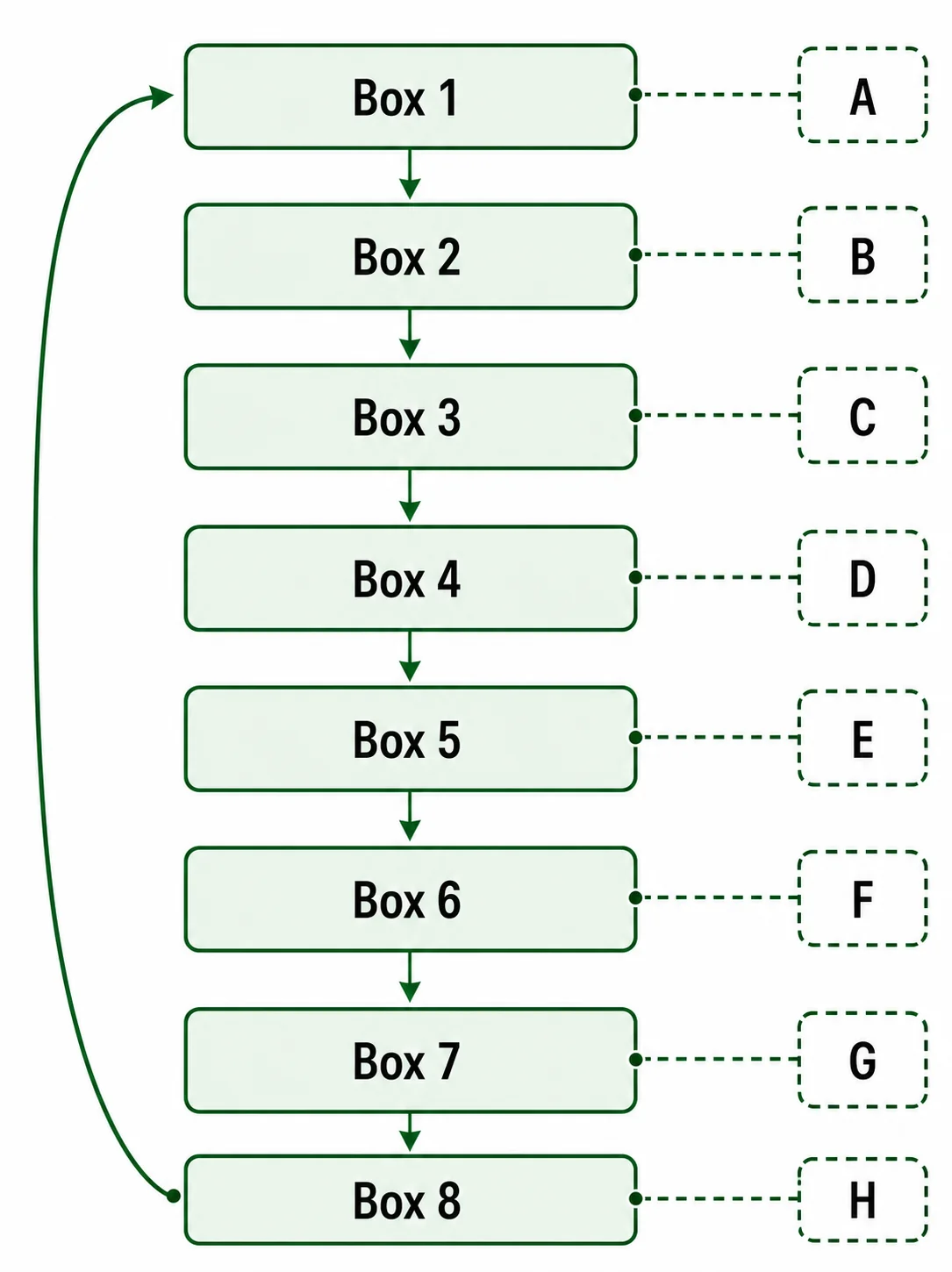
- A, stimulus that triggers this pathway _______________________
- B, receptor cells that detect the change _______________________
- C, gland that releases ADH _______________________
- D, full name of the hormone ADH _______________________
- E, effector organ (where ADH acts) _______________________
- F, segment of nephron where ADH acts _______________________
- G, channel proteins inserted by ADH _______________________
- H, type of feedback that terminates ADH release _______________________
2. Term–definition match
The ten definitions below are shuffled. In the right-hand column write the matching term from this list: osmoregulation, ADH, aldosterone, osmoreceptor, nephron, aquaporin, reabsorption, renin, angiotensin II, juxtaglomerular cells. 10 marks
| # | Definition (shuffled) | Matching term |
|---|---|---|
| 2.1 | Homeostatic control of blood osmolarity through regulation of water and solute balance, primarily by the kidneys. | |
| 2.2 | A hormone released from the posterior pituitary when blood osmolarity rises; increases water reabsorption in the collecting duct. | |
| 2.3 | An adrenal hormone that promotes Na&sup+; reabsorption in the distal convoluted tubule, with water following by osmosis. | |
| 2.4 | Specialised cells in the hypothalamus that detect changes in blood osmolarity by shrinking or swelling. | |
| 2.5 | The functional filtration unit of the kidney; adjusts water and solute levels through filtration, reabsorption and secretion. | |
| 2.6 | A water channel protein inserted into the collecting duct membrane in response to ADH, increasing water permeability. | |
| 2.7 | The process of reclaiming water and solutes from the filtrate back into the blood as it passes through the nephron tubules. | |
| 2.8 | An enzyme released by kidney cells when blood pressure falls; it begins the RAAS cascade. | |
| 2.9 | The active form of the RAAS cascade molecule that stimulates the adrenal cortex to release aldosterone. | |
| 2.10 | Specialised kidney cells that detect reduced pressure in the afferent arteriole and release renin as part of the RAAS pathway. |
3. True or false, with correction
For each statement, circle T or F. If the statement is false, write the corrected version on the line below. 8 marks (1 for T/F, 1 for each correction)
3.1 ADH acts on the distal convoluted tubule (DCT) by inserting aquaporin channels into the membrane. T / F
3.2 Aldosterone directly causes water reabsorption in the DCT by activating aquaporin channels. T / F
3.3 ADH is synthesised in the hypothalamus and released from the posterior pituitary gland. T / F
3.4 Neural coordination produces longer-lasting effects than hormonal coordination because nerve impulses persist after the stimulus ends. T / F
4. Function recall
Answer each in 1–2 sentences using precise terms from the lesson. 10 marks (2 each)
4.1 What is the function of osmoreceptors in the hypothalamus in the ADH pathway?
4.2 What is the function of aquaporin channels in regulating urine concentration?
4.3 What is the function of renin in the aldosterone (RAAS) pathway?
4.4 What is the function of the collecting duct in water balance homeostasis?
4.5 What is the function of negative feedback in the ADH pathway once blood osmolarity returns to normal?
5. Fill the blanks, the aldosterone pathway
Complete the paragraph below using the word bank provided. Each word is used once only. 8 marks
When _______________________ falls, specialised kidney cells called _______________________ detect the reduced pressure in the afferent arteriole and release the enzyme _______________________. This enzyme converts a liver protein through a two-step cascade that produces the hormone _______________________, which then stimulates the _______________________ to secrete _______________________. This hormone acts on the _______________________ (DCT) of the nephron, increasing _______________________ (Na&sup+;) reabsorption from the filtrate. Water then follows by _______________________, raising blood _______________________ toward normal.
6. Connect the terms, ADH vs aldosterone
Draw labelled arrows between the six terms below to show how they relate. Each arrow must carry a linking phrase (e.g. “is released from”, “acts on”, “responds to”). Aim for at least 5 labelled arrows. 5 marks
Supplied terms: ADH • aldosterone • collecting duct • distal tubule (DCT) • high blood osmolarity • low blood pressure.
Q1, Labelled ADH pathway
A: Rising blood osmolarity (dehydration / high solute intake). B: Osmoreceptors (in the hypothalamus). C: Posterior pituitary gland. D: Antidiuretic hormone. E: Kidney (nephron). F: Collecting duct. G: Aquaporin (water channel) proteins. H: Negative feedback (as osmolarity falls, ADH secretion decreases and collecting duct permeability returns to baseline).
Q2, Term–definition matches
2.1 osmoregulation • 2.2 ADH • 2.3 aldosterone • 2.4 osmoreceptor • 2.5 nephron • 2.6 aquaporin • 2.7 reabsorption • 2.8 renin • 2.9 angiotensin II • 2.10 juxtaglomerular cells.
Q3, True / false with correction
3.1 False. Correction: ADH acts on the collecting duct by inserting aquaporin channels. Aldosterone acts on the distal convoluted tubule (DCT).
3.2 False. Correction: aldosterone directly causes Na&sup+; reabsorption in the DCT. Water then follows passively by osmosis down the osmotic gradient created, aldosterone does not directly cause water reabsorption and does not act via aquaporins.
3.3 True. ADH is synthesised in the hypothalamus and transported to the posterior pituitary, from which it is released into the bloodstream.
3.4 False. Correction: neural coordination produces brief effects (the response ends when the impulse stops). Hormonal coordination produces more sustained effects because the hormone persists in the blood until it is broken down.
Q4, Function recall model answers
4.1 Osmoreceptors in the hypothalamus detect rises in blood osmolarity by shrinking as water leaves them by osmosis. When osmolarity exceeds approximately 295 mOsm/kg, they trigger nerve impulses to the posterior pituitary to release ADH.
4.2 Aquaporin channels are water-selective channel proteins. When inserted into the collecting duct membrane in response to ADH, they increase the membrane’s permeability to water, allowing much more water to be reabsorbed from the filtrate back into the blood, producing concentrated urine.
4.3 Renin is an enzyme released by juxtaglomerular cells when blood pressure falls. It converts the liver protein angiotensinogen to angiotensin I, which is then converted by ACE (in the lungs) to angiotensin II, the active signal that stimulates the adrenal cortex to release aldosterone.
4.4 The collecting duct is the final tubule segment of the nephron. Its permeability to water is regulated by ADH: when ADH is high, aquaporins are inserted and more water is reabsorbed from the filtrate into the blood; when ADH is low, the duct is relatively impermeable and dilute, high-volume urine is produced.
4.5 As blood osmolarity returns to normal (~285–295 mOsm/kg), the osmoreceptors in the hypothalamus detect the fall and stop signalling the posterior pituitary. ADH secretion decreases, the collecting duct becomes less permeable to water, and urine volume increases. This prevents overcorrection (overhydration) and is self-limiting.
Q5, Cloze answers (in order of blanks)
blood pressure / juxtaglomerular cells / renin / angiotensin II / adrenal cortex / aldosterone / distal tubule / sodium / osmosis / volume.
Q6, Sample concept map arrows
- high blood osmolaritytriggers release of → ADH
- ADHacts on → collecting duct (inserts aquaporins)
- low blood pressuretriggers RAAS cascade and release of → aldosterone
- aldosteroneacts on → distal tubule (DCT) (Na&sup+; reabsorption)
- collecting ductreabsorption of water reduces → high blood osmolarity (negative feedback)
Any biologically correct linking phrases accepted. Award 1 mark per correctly labelled, directionally accurate arrow.