Biology • Year 12 • Module 8 • Lesson 3
Glucose Regulation, Insulin, Glucagon and the Pancreatic Feedback System
Lock in the core vocabulary, cell types, hormones, liver processes, and the Type 1/Type 2 distinction before moving to exam-style application.
1. Label the glucose regulation feedback diagram
The diagram below shows the two negative feedback pathways that maintain blood glucose homeostasis. Write the missing labels into boxes A–H. Each label is drawn from the lesson’s Key Terms and Cards 1–3. 8 marks
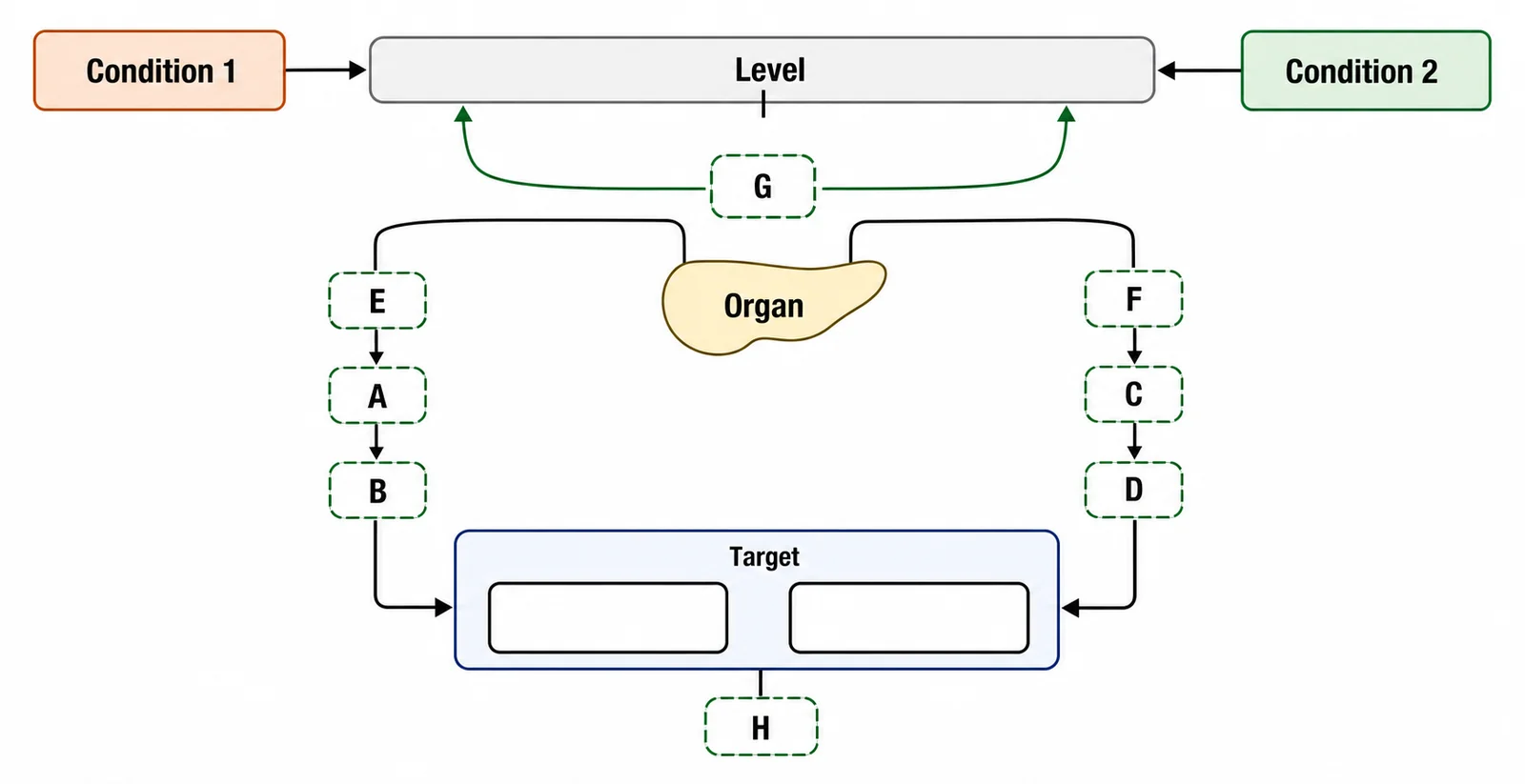
- A, hormone secreted when blood glucose is high _______________________
- B, liver process triggered by high blood glucose (glucose → glycogen) _______________________
- C, hormone secreted when blood glucose is low _______________________
- D, liver process triggered by low blood glucose (glycogen → glucose) _______________________
- E, pancreatic cell type that secretes the high-glucose hormone _______________________
- F, pancreatic cell type that secretes the low-glucose hormone _______________________
- G, type of feedback mechanism shown _______________________
- H, role of the liver in this system (key ___________) _______________________
| Box | Your label |
|---|---|
| A | |
| B | |
| C | |
| D | |
| E | |
| F | |
| G | |
| H |
2. Term–definition match
Ten definitions are listed below in shuffled order. In the right-hand column write the matching term from this list: blood glucose, insulin, glucagon, glycogenesis, glycogenolysis, negative feedback, islets of Langerhans, beta cells, alpha cells, hyperglycaemia. 10 marks
| # | Definition (shuffled) | Matching term |
|---|---|---|
| 2.1 | The concentration of glucose dissolved in the blood, normally maintained between 4–6 mmol/L. | |
| 2.2 | A hormone secreted by the pancreas that lowers blood glucose by promoting cellular glucose uptake and stimulating glycogen storage in the liver. | |
| 2.3 | A hormone secreted by the pancreas that raises blood glucose by signalling the liver to break down stored glycogen. | |
| 2.4 | The synthesis of glycogen from glucose molecules in the liver when blood glucose is elevated; promoted by insulin. | |
| 2.5 | The breakdown of glycogen into glucose in the liver when blood glucose is low; promoted by glucagon. | |
| 2.6 | A corrective mechanism in which the response to a change opposes the original stimulus, returning a variable toward its set point. | |
| 2.7 | Clusters of endocrine cells scattered throughout the pancreas that include alpha and beta cells; named after Paul Langerhans. | |
| 2.8 | The pancreatic cells that detect rising blood glucose and secrete insulin in response. | |
| 2.9 | The pancreatic cells that detect falling blood glucose and secrete glucagon in response. | |
| 2.10 | Chronically elevated blood glucose concentration; the hallmark of poorly controlled diabetes mellitus. |
3. True or false, with correction
Circle T or F for each statement. If false, write the corrected version on the line provided. 8 marks (1 for T/F, 1 for each correction where needed)
3.1 Glucagon is secreted by beta cells in the islets of Langerhans. T / F
3.2 Glycogenolysis is the conversion of glycogen into glucose in the liver. T / F
3.3 The pancreas is the primary effector organ in glucose homeostasis because it is where blood glucose concentration is actually changed. T / F
3.4 Type 1 diabetes results from autoimmune destruction of beta cells, producing a complete absence of insulin. T / F
4. Function recall
Answer each question in 1–2 precise sentences. Use terms from the lesson. 10 marks (2 each)
4.1 What is the function of insulin in returning blood glucose to its set point after a meal?
4.2 What is the function of glucagon during prolonged exercise when blood glucose falls?
4.3 What is the function of the liver in glucose homeostasis, and why is it described as the key effector rather than the pancreas?
4.4 What is the function of glycogenesis in a liver cell when insulin concentration in the blood is high?
4.5 What is the homeostatic function of the two-hormone system (insulin + glucagon) compared with a hypothetical single corrective hormone?
5. Fill the blanks, the glucagon pathway
Complete the paragraph below by filling each blank with the correct word or phrase from the word bank. Each word is used once only. 8 marks
Word bank: alpha cells • glucagon • glycogenolysis • liver • bloodstream • negative feedback • set point • 4 mmol/L
When blood glucose falls below approximately __________________ during fasting or exercise, __________________ in the islets of Langerhans detect this change and secrete the hormone __________________ directly into the __________________. The hormone travels to the __________________ where it triggers __________________, releasing stored glucose back into circulation. As blood glucose rises toward the __________________, the alpha cells reduce hormone output, an example of __________________ that is self-limiting.
6. Connect the terms, concept map
Draw labelled arrows between the six terms below to show how they are causally connected. Each arrow must carry a linking phrase (e.g. “triggers”, “is converted by”, “signals”). Aim for at least 6 labelled arrows. 6 marks
Terms: high blood glucose • beta cells • insulin • liver • glycogenesis • blood glucose returns to set point.
Q1, Labelled feedback pathway diagram
A: Insulin. B: Glycogenesis (glucose → glycogen). C: Glucagon. D: Glycogenolysis (glycogen → glucose). E: Beta cells. F: Alpha cells. G: Negative feedback. H: Key effector (the liver is the key effector because it is the organ that physically changes blood glucose concentration through glycogenesis and glycogenolysis).
Q2, Term–definition matches
2.1 blood glucose • 2.2 insulin • 2.3 glucagon • 2.4 glycogenesis • 2.5 glycogenolysis • 2.6 negative feedback • 2.7 islets of Langerhans • 2.8 beta cells • 2.9 alpha cells • 2.10 hyperglycaemia.
Q3, True / false with correction
3.1 False. Correction: glucagon is secreted by alpha cells; insulin is secreted by beta cells. (Memory cue: Beta cells, Blood glucose high, Bring it down = insulin.)
3.2 True. Glycogenolysis is correctly defined as the breakdown of glycogen into glucose in the liver.
3.3 False. Correction: the liver is the primary effector in glucose homeostasis; it is where blood glucose concentration is physically changed through glycogenesis and glycogenolysis. The pancreas is primarily the receptor and signalling gland.
3.4 True. Type 1 diabetes is caused by autoimmune destruction of beta cells, leaving little or no capacity to produce insulin.
Q4.1, Function of insulin
Insulin signals body cells to increase glucose uptake (via GLUT4 transporter mobilisation) and signals the liver to perform glycogenesis, converting excess blood glucose into glycogen for storage. Both actions remove glucose from the bloodstream, returning blood glucose toward the ~5 mmol/L set point.
Q4.2, Function of glucagon during exercise
When blood glucose falls during exercise, alpha cells secrete glucagon into the bloodstream; glucagon signals the liver to perform glycogenolysis, breaking down stored glycogen into glucose and releasing it into the blood, thereby raising blood glucose back toward the set point and sustaining the energy supply to working muscles.
Q4.3, Function of the liver as key effector
The liver physically changes blood glucose concentration by either storing glucose as glycogen (glycogenesis, when insulin is high) or releasing stored glucose (glycogenolysis, when glucagon is high). It is the key effector rather than the pancreas because the pancreas only detects the stimulus and releases a hormonal signal, it does not itself alter blood glucose; the liver is the organ that executes the correction.
Q4.4, Function of glycogenesis
When insulin is elevated (indicating high blood glucose), liver cells synthesise glycogen from excess glucose molecules via glycogenesis. This converts soluble blood glucose into compact, insoluble glycogen storage, removing it from circulation and lowering blood glucose toward the set point. The liver can store approximately 100 g of glycogen this way.
Q4.5, Function of the two-hormone system
Two opposing hormones (insulin and glucagon) allow faster and more precise fine-tuning than a single corrective hormone because they operate simultaneously, as insulin pushes glucose down, glucagon is suppressed, producing a tighter oscillation around the set point. A single bidirectional hormone would lag further behind stimulus changes, producing larger swings in blood glucose; the push-pull system maintains tighter control.
Q5, Cloze paragraph (glucagon pathway)
In order: 4 mmol/L • alpha cells • glucagon • bloodstream • liver • glycogenolysis • set point • negative feedback.
Q6, Sample concept map (insulin pathway)
A correct map should include arrows such as:
- high blood glucoseis detected by → beta cells
- beta cellssecrete → insulin
- insulinsignals → liver
- liverperforms → glycogenesis
- glycogenesisremoves glucose from blood, causing → blood glucose returns to set point
- blood glucose returns to set pointreduces stimulus on → beta cells (negative feedback loop closure)
Any biologically valid linking phrases are accepted. Award 1 mark per correctly labelled, directionally correct arrow (max 6).