Biology • Year 12 • Module 8 • Lesson 2
Temperature Regulation, Endotherm and Ectotherm Homeostatic Adaptations
Apply thermoregulation concepts to real data, causal chains, and case scenarios, including the 2019 flying fox mass death event and body-temperature data from a thorny devil study.
1. Interpret graph, body temperature of a thorny devil over a summer day
The figure below shows body temperature (Tb) and ambient temperature (Ta) recorded for a thorny devil (Moloch horridus) over a single summer day in central Australia. The lizard was free to move between microenvironments. Data are illustrative of patterns reported in studies of Australian desert reptiles. 7 marks
Illustrative data, after Anderson & Karasov (1981) patterns; not verbatim experimental values.
1.1 Describe the relationship between body temperature (Tb) and ambient temperature (Ta) between 06:00 and 10:00. 2 marks
1.2 Between 10:00 and 12:30, ambient temperature continues rising but body temperature remains nearly constant near 34°C. Identify the specific behavioural strategies that allow the thorny devil to achieve this, using lesson terms. 2 marks
1.3 After retreating underground at ~12:30, the thorny devil's body temperature drops to approximately 26°C and remains there. Explain why this is a successful thermoregulatory outcome for an ectotherm, even though body temperature has fallen below its preferred range. 3 marks
2. Cause-and-effect chain, heat stroke in the 2019 flying fox event
On 26 January 2019, approximately 23,000 spectacled flying foxes died near Cairns when ambient temperature reached 42–45°C. Complete the cause-and-effect chain below. Each effect box should be one sentence using correct biological terminology. 5 marks
Cause 1: Ambient temperature rises to 42–45°C (above normal core temperature ~38°C)
Effect 1 (physiological response attempt):
Cause 2: The thermal gradient between the flying fox body and environment is too small, heat cannot move from body to environment by conduction or radiation
Effect 2 (what happens to evaporative cooling):
Effect 3 (consequence for core temperature):
Overall outcome (so…): Using the concept of enzyme denaturation, explain the cellular mechanism by which rising core temperature led to death.
3. Diagram critique, what’s wrong with this student’s temperature regulation summary?
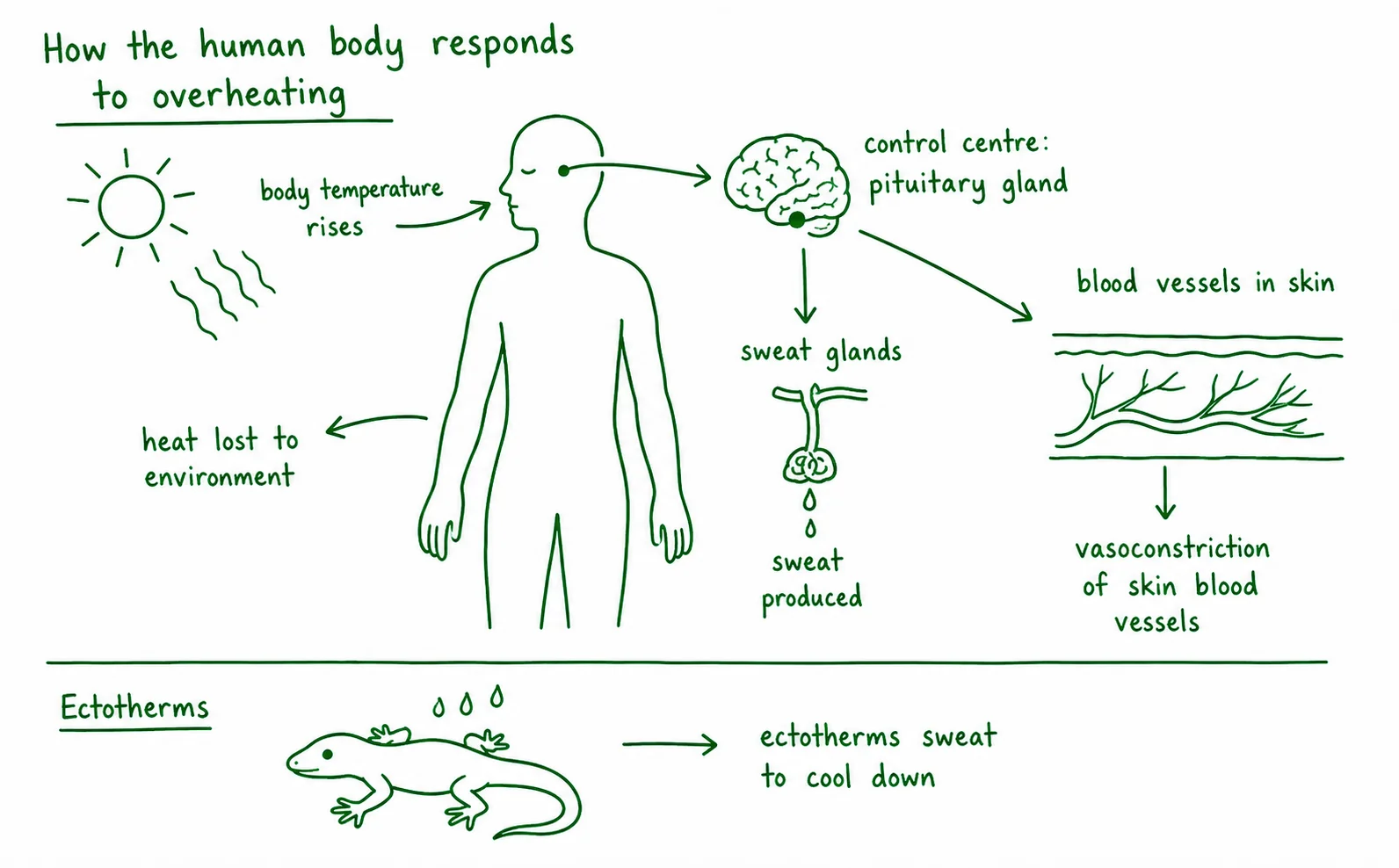
A Year 12 student has drawn the summary diagram below explaining how the human body responds to overheating. There are three biological errors. Identify each error and write the correction. 6 marks (2 per error: 1 identify, 1 correct)
3.1 Error 1: What is wrong?
Correction:
3.2 Error 2: What is wrong?
Correction:
3.3 Error 3: What is wrong?
Correction:
4. Apply to a new scenario, elderly residents in a Sydney heatwave
During a 42°C heatwave in western Sydney, hospital admissions for heat stroke rise sharply among residents over 75 years of age, but remain low among healthy adults in their 20s. Research has shown that sweat gland responsiveness decreases with age, and older adults can lose up to 50% of their peak sweating capacity. 5 marks
4.1 Explain, using lesson content, why reduced sweat gland responsiveness specifically increases the risk of hyperthermia in elderly people during a heatwave. 2 marks
4.2 Identify one other physiological cooling mechanism that remains functional in elderly people, and explain why this mechanism alone is insufficient when ambient temperature exceeds 40°C. 2 marks
4.3 A public health officer suggests that elderly residents “behave like ectotherms” during the heatwave by staying in the coolest room or moving to an air-conditioned centre. Justify this advice using lesson vocabulary. 1 mark
Q1.1, Relationship 06:00–10:00
Between 06:00 and 10:00, both Tb and Ta are rising, but Tb rises faster than Ta [1]. This indicates the thorny devil is actively basking, absorbing solar radiation and deliberately allowing its body temperature to rise above ambient temperature to reach its preferred range [1]. Accept equivalent description noting Tb tracks Ta but diverges as basking accelerates warming.
Q1.2, Behavioural strategies 10:00–12:30
The thorny devil uses shuttling between sun and shade to moderate heat gain [1]. It may also orient its body perpendicular or parallel to the sun’s rays to minimise the cross-sectional area exposed to direct radiation (reducing heat absorbed per unit time) [1]. Accept burrowing in shallow loose soil to avoid peak radiation at the surface.
Q1.3, Why burrowing is a successful outcome
Underground (below ~20 cm), soil temperature is significantly lower and more stable than surface temperature, the lizard avoids the potentially lethal ambient temperatures above 42°C at the surface [1]. Although Tb drops below the preferred range (~30–35°C) to ~26°C, this is still within the thermal tolerance range, not a lethal temperature [1]. The behavioural strategy has successfully prevented hyperthermia at a very low energy cost, since the lizard made no physiological investment, unlike an endotherm, it did not need to expend resources cooling itself [1].
Q2, Cause-and-effect chain (5 marks)
Effect 1: The hypothalamus detects rising core temperature and activates effectors, sweat glands (panting saliva in the case of flying foxes) and peripheral vasodilation, to attempt to dissipate heat. [1]
Effect 2: Evaporative cooling becomes ineffective, when ambient temperature equals or exceeds core temperature (~38°C), the temperature gradient driving heat transfer from skin to environment by conduction/radiation is eliminated. Only evaporation remains, but this requires the vapour pressure gradient to be maintained; in extreme heat with high solar radiation, even evaporative capacity is overwhelmed or the animal cannot maintain sufficient water loss rate. [1]
Effect 3: Core temperature rises beyond the homeostatic set point and continues to increase unchecked; the homeostatic mechanisms are physically overwhelmed, not broken. [1]
Overall outcome: As core temperature rises above ~40°C, enzyme proteins begin to denature, the hydrogen and ionic bonds maintaining their three-dimensional active-site shape break down, rendering the enzyme unable to catalyse its target reaction. Above ~41–42°C, neuronal enzymes and proteins in the brain dysfuncton rapidly; cardiac enzymes are also affected. Because all metabolic processes depend on functioning enzymes, widespread enzyme denaturation causes multi-organ failure and death. [2]
Q3, Diagram critique (6 marks)
3.1 Error 1 (vasoconstriction for cooling): The student shows vasoconstriction as a response to overheating. Vasoconstriction narrows peripheral blood vessels and reduces blood flow to the skin, which would reduce heat loss, this is a heating response. Correction: the response to overheating is vasodilation widening of peripheral arterioles increases blood flow to the skin surface, where heat is conducted and radiated to the cooler environment. [1 + 1]
3.2 Error 2 (pituitary gland as control centre): The hypothalamus, not the pituitary gland, is the control centre for temperature regulation. The hypothalamus contains thermoreceptors and processes incoming temperature signals from both central and peripheral receptors; the pituitary gland produces hormones but is not the thermostat. Correction: label the control centre as the hypothalamus. [1 + 1]
3.3 Error 3 (ectotherms sweat): The caption states that ectotherms use sweating as their primary cooling mechanism. Ectotherms do not have sweat glands and cannot generate or dissipate heat through physiological mechanisms the way endotherms can. Correction: ectotherms rely primarily on behavioural strategies (seeking shade, burrowing, shuttling between microenvironments) for temperature regulation, sweating is an endotherm adaptation. [1 + 1]
Q4.1, Reduced sweating and hyperthermia risk
Sweating (evaporative cooling) is the most powerful cooling mechanism available to endotherms, each gram of water evaporated removes ~2.4 kJ of heat [1]. If sweat gland responsiveness is reduced by 50%, the body’s capacity to remove heat through evaporation is halved. In conditions where heat gain rate (from metabolic activity + solar radiation at 42°C) exceeds the available cooling rate, core temperature will rise uncontrolled toward the lethal range [1].
Q4.2, Other functional mechanism and its limits
Vasodilation remains functional, peripheral arterioles widen, increasing blood flow to the skin [1]. However, vasodilation alone is insufficient above 40°C because it works by facilitating heat conduction and radiation from the skin to the environment. When ambient temperature equals or exceeds skin temperature, the temperature gradient required for this heat transfer is eliminated or reversed, the environment is now warming the person rather than receiving heat from them. Vasodilation cannot remove heat when the gradient is gone [1].
Q4.3, “Behave like ectotherms” justification
Ectotherms rely on behavioural thermoregulation, selecting microenvironments with temperatures closer to their preferred body temperature. By moving to a cooler room or air-conditioned centre, elderly residents are doing exactly this: seeking a microenvironment with lower ambient temperature to reduce the temperature gradient driving heat gain, so that their remaining physiological mechanisms (vasodilation, reduced sweating) can maintain homeostasis. [1]