Biology • Year 12 • Module 8 • Lesson 2
Temperature Regulation, Endotherm and Ectotherm Homeostatic Adaptations
Lock in the core vocabulary, the endotherm-vs-ectotherm distinction, and the three categories of homeostatic adaptation before moving to application.
1. Label the thermoregulation strategies diagram
The diagram below compares endotherm and ectotherm temperature regulation strategies and shows representative Australian examples of each. Write the missing labels into boxes A–H. Each label is drawn from the lesson Key Terms or Cards 1–5. 8 marks
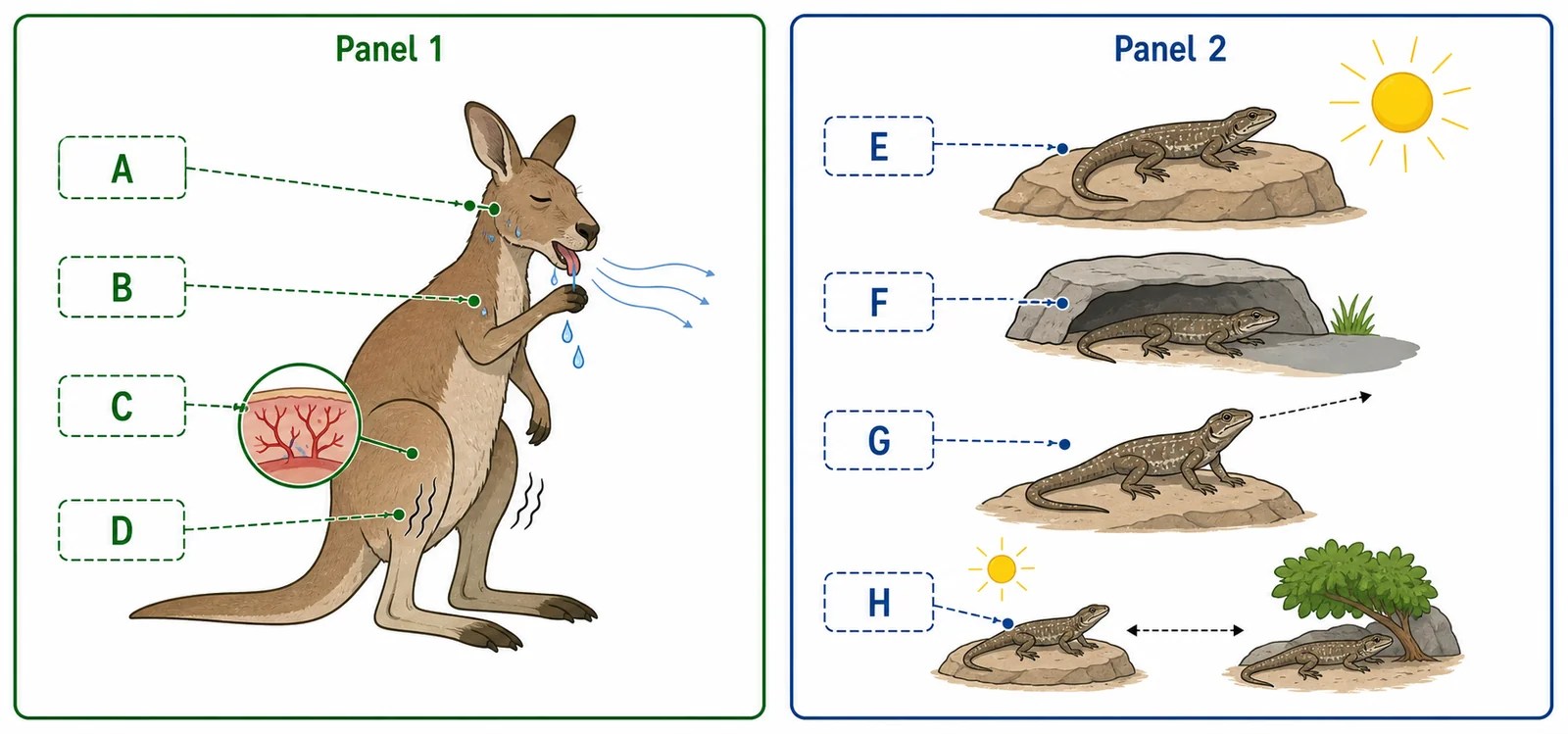
| Box | What does this label describe? | Your label |
|---|---|---|
| A | Primary heat source for Panel 1 organism | |
| B | Name for Panel 1 organism type (one word) | |
| C | Physiological cooling response labelled on the kangaroo | |
| D | Physiological heating response labelled on the kangaroo | |
| E | Primary heat source for Panel 2 organism | |
| F | Name for Panel 2 organism type (one word) | |
| G | Main thermoregulation strategy type used by Panel 2 organism | |
| H | Specific behaviour labelled on the lizard (moving to warm rock) |
2. Term–definition match
The ten definitions below are shuffled. In the right-hand column write the matching term from this list: thermoregulation, endotherm, ectotherm, vasodilation, vasoconstriction, evaporative cooling, shivering, piloerection, countercurrent heat exchange, torpor. 10 marks
| # | Definition (shuffled) | Matching term |
|---|---|---|
| 2.1 | A controlled, reversible reduction in metabolic rate and body temperature set point, used as an energy-conservation strategy in winter. | |
| 2.2 | Widening of peripheral blood vessels, increasing blood flow to the skin surface and heat loss to the environment, a cooling response. | |
| 2.3 | An organism whose body temperature is primarily determined by the surrounding environment; relies mainly on behavioural strategies. | |
| 2.4 | The homeostatic process that maintains core body temperature within a narrow range despite changing external conditions. | |
| 2.5 | Heat loss through water evaporation from sweat or respiratory surfaces; the primary cooling mechanism in humans. | |
| 2.6 | Narrowing of peripheral blood vessels, reducing blood flow to the skin and conserving core temperature, a heating response. | |
| 2.7 | A structural arrangement in limbs where arteries carrying warm blood run alongside veins carrying cool blood, transferring heat back to the core. | |
| 2.8 | An organism that generates body heat internally through metabolic processes; maintains a relatively constant core temperature. | |
| 2.9 | Contraction of arrector pili muscles raising hairs or fur erect, trapping a layer of insulating air near the skin surface. | |
| 2.10 | Rapid, uncoordinated skeletal muscle contractions coordinated by the hypothalamus to generate metabolic heat in response to cooling. |
3. True or false, with correction
For each statement, circle T or F. If the statement is false, write the corrected version on the line provided. 8 marks (1 for T/F, 1 for correction where needed)
3.1 Vasodilation is a heating response because it moves warm blood closer to the skin surface. T / F
3.2 Ectotherms cannot regulate their body temperature. T / F
3.3 Shivering is a physiological adaptation that generates heat through uncoordinated skeletal muscle contractions. T / F
3.4 Structural adaptations such as fur and blubber are passive features that require no ongoing energy cost once developed. T / F
3.5 Echidna torpor is a failure of homeostasis because the animal's body temperature falls below its normal tolerance range. T / F
4. Function recall
Answer each in 1–2 sentences using precise terms from the lesson. 8 marks (2 each)
4.1 What is the function of the hypothalamus in temperature regulation?
4.2 What is the function of vasoconstriction when core temperature drops below the set point?
4.3 What is the function of basking behaviour in an ectotherm such as an eastern blue-tongue lizard?
4.4 What is the function of forearm licking in red kangaroos during a heatwave?
5. Classify each adaptation
For each adaptation listed, complete all three columns. 9 marks (1 per cell)
| Adaptation | Physiological / Behavioural / Structural | Heating / Cooling | Endotherm / Ectotherm / Both |
|---|---|---|---|
| Emperor penguin huddling in Antarctic blizzard | |||
| Polar bear blubber layer (10–15 cm deep) | |||
| Thorny devil basking perpendicular to morning sun | |||
| Human sweating during exercise | |||
| Dog panting with tongue extended | |||
| Seal countercurrent heat exchange in flippers | |||
| Echidna entering torpor in winter | |||
| Goosebumps (piloerection) on a cold human | |||
| Desert lizard retreating underground in midday heat |
Q1, Labelled diagram
A: Internal metabolic activity (cellular respiration / metabolic heat production). B: Endotherm. C: Sweating (evaporative cooling) / vasodilation. D: Shivering (uncoordinated muscle contractions generating heat). E: External environment (solar radiation / warm surfaces). F: Ectotherm. G: Behavioural. H: Basking. Accept equivalent phrasings grounded in lesson content.
Q2, Term–definition matches
2.1 torpor • 2.2 vasodilation • 2.3 ectotherm • 2.4 thermoregulation • 2.5 evaporative cooling • 2.6 vasoconstriction • 2.7 countercurrent heat exchange • 2.8 endotherm • 2.9 piloerection • 2.10 shivering.
Q3, True / false with correction
3.1 False. Correction: vasodilation is a cooling response, it moves warm blood to the skin surface so heat can be conducted and radiated to the cooler environment. Vasoconstriction is the heating response.
3.2 False. Correction: ectotherms can regulate body temperature effectively through behavioural strategies such as basking, burrowing, and shade-seeking. What they cannot do is regulate through internal metabolic heat production.
3.3 True.
3.4 True.
3.5 False. Correction: torpor is a controlled, reversible homeostatic strategy where the set point is deliberately lowered to conserve energy. The animal is still maintaining temperature within a (lowered) tolerance range; it is a strategic modification of homeostasis, not a failure of it.
Q4.1, Function of the hypothalamus
The hypothalamus acts as the control centre in the temperature regulation stimulus-response pathway. It receives signals from thermoreceptors detecting changes in core and peripheral temperature, processes this information, and sends coordinated signals to effectors (sweat glands, blood vessels, skeletal muscle) to activate the appropriate heating or cooling responses.
Q4.2, Function of vasoconstriction
Vasoconstriction narrows peripheral arterioles, reducing blood flow to superficial capillaries near the skin. This reduces the amount of warm blood reaching the skin surface, decreasing heat conduction and radiation to the cooler environment and preserving core temperature.
Q4.3, Function of basking in an ectotherm
Basking allows the eastern blue-tongue lizard to absorb solar radiation, raising its body temperature to its preferred range (~30–35°C). Without reaching this temperature, the lizard cannot contract muscles efficiently, digest food effectively, or escape predators at full speed, all metabolic processes are slowed when body temperature is low in an ectotherm.
Q4.4, Function of forearm licking in red kangaroos
Red kangaroos lick their forearms extensively during heat stress. The forearms contain a dense network of superficial blood vessels close to the skin surface. As saliva evaporates from the wet fur, it removes latent heat from these vessels, cooling the blood returning to the core circulation, a behavioural supplement to sweating that is energetically efficient.
Q5, Classify each adaptation
Emperor penguin huddling: Behavioural / Heating / Endotherm.
Polar bear blubber: Structural / Heating (insulation, reduces heat loss) / Endotherm.
Thorny devil basking: Behavioural / Heating / Ectotherm.
Human sweating: Physiological / Cooling / Endotherm.
Dog panting: Physiological / Cooling / Endotherm.
Seal countercurrent heat exchange: Structural / Heating (conserves core heat) / Endotherm.
Echidna torpor: Behavioural (and physiological) / Accept heating or energy conservation, reduces heat expenditure in cold / Endotherm.
Goosebumps / piloerection: Physiological / Heating / Endotherm.
Desert lizard burrowing: Behavioural / Cooling (avoids overheating) / Ectotherm.