Biology • Year 12 • Module 8 • Lesson 1
Homeostasis, Stimulus-Response, Feedback Loops and the Internal Environment
Lock in the key vocabulary, the five-component stimulus-response pathway, and the fundamental distinction between negative and positive feedback.
1. Label the stimulus-response pathway diagram
The diagram below shows the five-component stimulus-response model applied to thermoregulation when core body temperature rises above 37.5°C. Write the missing labels into boxes A–H. Each label is drawn from the lesson’s Key Terms or from Card 2. 8 marks
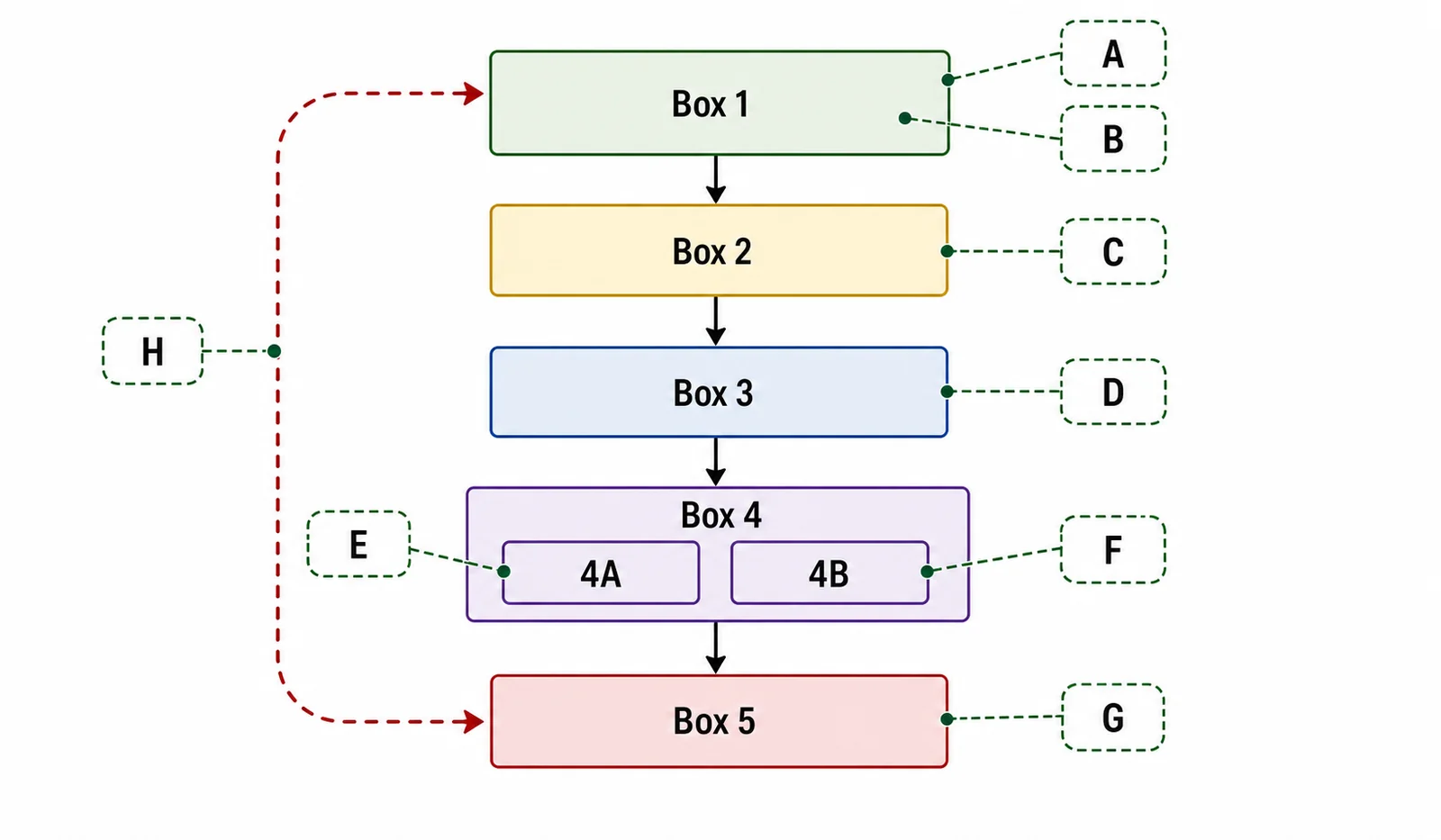
- A, name of the first component triggered (the change itself): _______________________
- B, specific example of this stimulus (describe the deviation in temperature): _______________________
- C, name of the component that detects the stimulus: _______________________
- D, name of the organ that acts as control centre for thermoregulation: _______________________
- E, first effector activated (produces sweat): _______________________
- F, second effector activated (dilates to increase heat loss): _______________________
- G, describe the overall response produced by both effectors: _______________________
- H, type of feedback operating in this pathway: _______________________
| Box | Your label |
|---|---|
| A | |
| B | |
| C | |
| D | |
| E | |
| F | |
| G | |
| H |
2. Term–definition match
The ten definitions below are shuffled. In the right-hand column write the matching term from this list: homeostasis, stimulus, receptor, control centre, effector, negative feedback, positive feedback, tolerance range, set point, osmoreceptor. 10 marks
| # | Definition (shuffled) | Matching term |
|---|---|---|
| 2.1 | The maintenance of a relatively stable internal environment despite changes in the external environment. | |
| 2.2 | A change (internal or external) that moves a variable outside its tolerance range and triggers a response. | |
| 2.3 | A cell or structure that detects the stimulus and sends a signal to the control centre. | |
| 2.4 | The organ or structure that processes the incoming signal and determines the appropriate response. | |
| 2.5 | The organ, muscle, or gland that carries out the corrective response instructed by the control centre. | |
| 2.6 | A response that opposes the original stimulus, returning the variable toward its set point. | |
| 2.7 | A response that amplifies the original stimulus, moving the variable further from its set point. | |
| 2.8 | The acceptable range of values within which the body can function optimally (e.g. 36.5–37.5°C for core temperature). | |
| 2.9 | The ideal value that homeostatic systems aim to restore after a deviation (e.g. ~37°C for body temperature). | |
| 2.10 | A specialised receptor located in the hypothalamus that detects changes in blood osmolarity. |
3. True or false, with correction
For each statement, circle T or F. If the statement is false, write the corrected version on the line provided. 10 marks (1 for T/F, 1 for each correction where needed)
3.1 Homeostasis means keeping internal variables at a single, perfectly fixed value at all times. T / F
3.2 Positive feedback is the primary mechanism by which homeostasis is maintained. T / F
3.3 The word ‘negative’ in negative feedback means the response is harmful or bad for the body. T / F
3.4 Blood clotting and childbirth contractions are examples of positive feedback, which amplify a stimulus to drive a process to rapid completion. T / F
3.5 Enzyme function is one reason why homeostatic tolerance ranges are narrow, enzymes denature if temperature or pH deviate too far from their optimum. T / F
4. Function recall
Answer each in 1–2 sentences using precise terms from the lesson. 8 marks (2 each)
4.1 What is the function of the receptor in the stimulus-response pathway?
4.2 What is the function of ADH (antidiuretic hormone) in the homeostatic regulation of blood osmolarity?
4.3 What is the function of insulin in the homeostatic regulation of blood glucose?
4.4 What is the function of the hypothalamus as a control centre in thermoregulation?
5. Fill-in-the-blank paragraph
Complete the passage using the word bank below. Each word is used once. 8 marks
Word bank: tolerance range • stimulus • negative feedback • effector • homeostasis • control centre • set point • receptor
The maintenance of a stable internal environment is called _______________. When a variable such as blood glucose moves outside its _______________, a corrective response is triggered. The change that initiates this response is called the _______________, which is detected by a specialised structure called the _______________. A signal is then sent to the _______________, which processes the information and determines the appropriate action. Instructions are relayed to the _______________, which carries out the physical response. Because this response opposes the original change and returns the variable toward its _______________, the process is described as _______________.
6. Build a concept map
Draw labelled arrows between the six terms below to show how they connect. Each arrow must carry a linking phrase (e.g. “detects”, “sends signal to”, “activates”, “opposes”). Aim for at least 5 labelled arrows. 5 marks
Supplied terms: stimulus · receptor · control centre · effector · response · set point.
Q1, Labelled stimulus-response pathway
A: Stimulus (the name of the component). B: Body temperature rises above the set point / above 37.5°C. C: Thermoreceptors (in the skin and hypothalamus). D: Hypothalamus (the control centre for thermoregulation). E: Sweat glands. F: Peripheral blood vessels (skin arterioles). G: Sweating increases evaporative heat loss; vasodilation increases blood flow to the skin surface, dissipating heat, body temperature falls back toward 37°C. H: Negative feedback (the response opposes the original rise in temperature).
Q2, Term–definition matches
2.1 homeostasis • 2.2 stimulus • 2.3 receptor • 2.4 control centre • 2.5 effector • 2.6 negative feedback • 2.7 positive feedback • 2.8 tolerance range • 2.9 set point • 2.10 osmoreceptor.
Q3, True / false with correction
3.1 False. Correction: homeostasis maintains variables within a tolerance range, not at a single fixed value. The internal environment oscillates continuously around a set point.
3.2 False. Correction: negative feedback is the primary homeostatic mechanism. Positive feedback amplifies deviations and drives processes to completion; it is not a mechanism for maintaining stability.
3.3 False. Correction: ‘negative’ refers to the direction of the response (opposing the change), not a harmful outcome. Negative feedback is the healthy, corrective mechanism.
3.4 True. Both blood clotting and childbirth contractions involve positive feedback: the response amplifies the original stimulus until an external event (wound sealed; baby delivered) stops the loop.
3.5 True. Enzymes have optimal temperature and pH ranges; denaturation outside these optima is a key reason why tolerance ranges for homeostatic variables are narrow.
Q4.1, Function of the receptor
The receptor detects the specific stimulus (the change in a variable) and sends a signal to the control centre. For example, thermoreceptors in the hypothalamus and skin detect changes in temperature and initiate the signalling cascade that activates the appropriate corrective response.
Q4.2, Function of ADH
ADH (antidiuretic hormone), released by the posterior pituitary gland, acts on the collecting duct of the kidney to increase its permeability to water. This allows more water to be reabsorbed from the filtrate back into the blood, reducing blood osmolarity and producing more concentrated urine, restoring water balance toward the set point of ~285–295 mOsm/kg.
Q4.3, Function of insulin
Insulin, released by the beta cells in the islets of Langerhans in the pancreas when blood glucose rises above ~6 mmol/L, signals body cells (muscle, adipose, liver) to increase glucose uptake. The liver also converts excess glucose to glycogen (glycogenesis). These actions lower blood glucose back toward the set point of ~5 mmol/L, negative feedback.
Q4.4, Function of the hypothalamus as control centre
The hypothalamus integrates signals from thermoreceptors (both its own internal thermoreceptors and peripheral skin receptors) and compares them against the temperature set point (~37°C). It then sends nerve impulses and hormonal signals to appropriate effectors (sweat glands, blood vessels, skeletal muscles) to produce a corrective response that returns core temperature toward the set point.
Q5, Cloze paragraph
In order: homeostasis, tolerance range, stimulus, receptor, control centre, effector, set point, negative feedback.
Q6, Sample concept map
A correct map should include arrows such as:
- stimulusis detected by → receptor
- receptorsends signal to → control centre
- control centreactivates → effector
- effectorproduces → response
- responseopposes stimulus and returns variable toward → set point
- responsefeeds back to reduce → stimulus
Award full marks for at least 5 correctly labelled arrows that respect causal direction.