Biology • Year 12 • Module 7 • Lesson 19
Historical and Cultural Disease Control
Lock in the core vocabulary, the pre-germ-theory vs post-germ-theory comparison, and the biological basis of Aboriginal and Torres Strait Islander disease management practices.
1. Label the North Head Quarantine Station diagram
The diagram below shows a schematic of how the North Head Quarantine Station (Sydney, 1832–1984) functioned as a disease control system. Write the missing labels into boxes A–H. Each label is drawn from the lesson’s Key Terms or Core Content cards. 8 marks
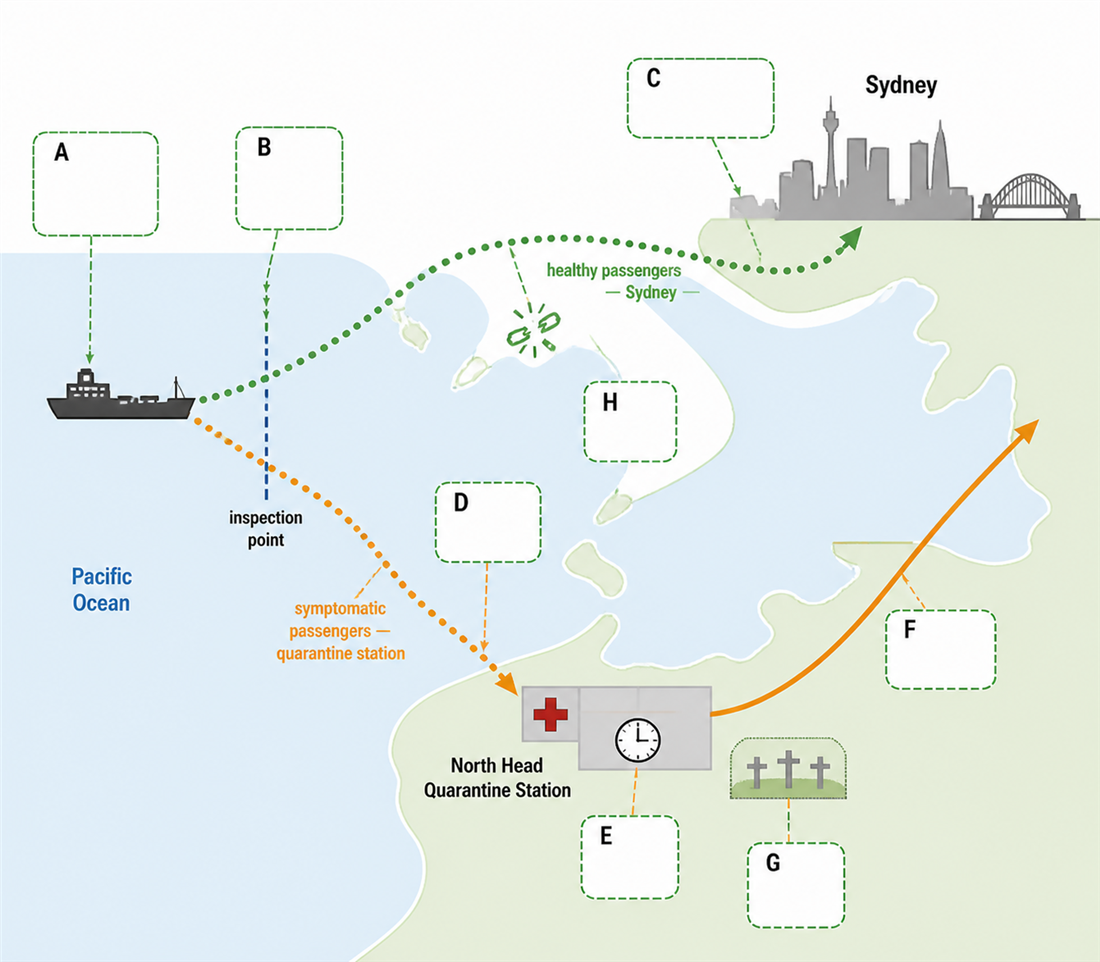
- A — source of potentially infected passengers _______________________
- B — the type of barrier applied at the harbour entrance (two-word term) _______________________
- C — disease status of passengers permitted to enter Sydney _______________________
- D — name of the facility where symptomatic passengers were sent _______________________
- E — the period monitored before release (biological term) _______________________
- F — condition required for a passenger to be discharged safely _______________________
- G — outcome for over 580 people at the station between 1832–1984 _______________________
- H — the link in the chain of infection that quarantine breaks _______________________
| Box | Your label |
|---|---|
| A | |
| B | |
| C | |
| D | |
| E | |
| F | |
| G | |
| H |
2. Term–definition match
The ten definitions below are shuffled. In the right-hand column write the matching term from this list: quarantine, variolation, miasma theory, sanitation, epidemiology, cultural health practice, immunological naivety, cordon sanitaire, incubation period, chain of infection. 10 marks
| # | Definition (shuffled) | Matching term |
|---|---|---|
| 2.1 | The study of disease patterns in populations to identify causes and control transmission. | |
| 2.2 | Separation of people or goods that may have been exposed to an infectious disease. | |
| 2.3 | Deliberate exposure to smallpox material to produce immunity before vaccination existed. | |
| 2.4 | The historical belief that disease was caused by bad air from rotting organic matter or swamps. | |
| 2.5 | Systems and practices that safely remove waste and reduce pathogen exposure. | |
| 2.6 | A community practice that supports health, wellbeing or disease prevention within a cultural knowledge system. | |
| 2.7 | The state of having no prior exposure to a pathogen and therefore no memory B or T cells specific to it. | |
| 2.8 | A line or zone established to prevent movement of potentially infected people or goods into a healthy population. | |
| 2.9 | The time between initial exposure to a pathogen and the appearance of the first signs of disease. | |
| 2.10 | The sequence linking infectious agent, reservoir, mode of transmission, portal of entry, and susceptible host. |
3. True or false — with correction
For each statement, circle T or F. If the statement is false, write the corrected version on the line provided. 10 marks (1 for T/F, 1 for correction where false)
3.1 The word “quarantine” comes from the Italian for thirty days, reflecting the duration of Venetian ship isolation. T / F
3.2 Variolation was effective because it produced a genuine primary immune response and memory cell formation against smallpox antigens. T / F
3.3 Miasma-driven sanitation reforms failed to reduce disease because the underlying theory was biologically incorrect. T / F
3.4 Aboriginal Australians before European contact had no disease management knowledge or practices. T / F
3.5 The catastrophic mortality of Aboriginal Australians from introduced diseases was the result of immunological naivety, not inherent immune weakness. T / F
4. Function recall
Answer each in 1–2 sentences using precise terms from the lesson. 8 marks (2 each)
4.1 What was the biological function of the 40-day quarantine period used by Venice during the Black Death?
4.2 What is the biological mechanism by which Aboriginal smoking ceremonies using Myrtaceae species (including eucalypts) may reduce pathogen load in a space?
4.3 What is the biological function of camp relocation after illness or death in traditional Aboriginal practice?
4.4 What was John Snow’s key method in tracing the 1854 Broad Street cholera outbreak, and how did it lead to an effective intervention without knowledge of germ theory?
5. Fill in the blanks
Complete the paragraph using the word bank below. Each word is used once only. 9 marks
Word bank: miasma, sanitation, memory, transmission, incubation, variolation, immunological naivety, germ theory, epidemiology
Before _________________________ was established, the dominant explanation for disease in Europe was _________________________ theory, which blamed bad air from rotting matter. Despite the incorrect mechanism, reforms driven by this theory — draining swamps and improving _________________________ — genuinely reduced disease by removing real vectors and pathogen sources. Quarantine worked not because it “killed bad air” but because it broke the _________________________ chain by keeping potentially infected individuals apart from the healthy population for a period exceeding the _________________________ period of the disease. Meanwhile, _________________________ deliberately introduced smallpox material to generate a primary immune response and _________________________ cells, providing protection before a safer vaccine existed. The method of mapping disease clusters used by John Snow, now called _________________________ , remains the foundation of outbreak investigation today. The devastating mortality in Aboriginal communities after 1788 was primarily the result of _________________________ : no prior exposure meant no specific memory lymphocytes.
Q1 — Labelled diagram
A: incoming ship (arriving vessel carrying passengers from an infected port). B: cordon sanitaire (the interception / inspection barrier at the harbour entrance). C: asymptomatic / healthy (those showing no signs of disease). D: quarantine station (North Head, Manly). E: incubation period (the window monitored for symptom development). F: symptom-free after the maximum incubation period (no signs of disease = cleared for release). G: death / burial (over 580 people died at the station over 152 years). H: transmission link (quarantine physically prevents potentially infectious individuals reaching susceptible hosts — the transmission link in the chain of infection).
Q2 — Term–definition matches
2.1 epidemiology • 2.2 quarantine • 2.3 variolation • 2.4 miasma theory • 2.5 sanitation • 2.6 cultural health practice • 2.7 immunological naivety • 2.8 cordon sanitaire • 2.9 incubation period • 2.10 chain of infection
Q3 — True / false with correction
3.1 False. The word quarantine comes from the Italian for forty days (quarantina), not thirty days. The Venetian system required ships to anchor for 40 days.
3.2 True. Variolation introduced live variola (smallpox) material, triggering a genuine primary immune response including clonal selection of matching B cells, plasma cell antibody production, and the formation of memory B and T cells — conferring real, lasting immunity.
3.3 False. Miasma-driven reforms did reduce disease, even though the underlying theory was wrong. Draining swamps removed mosquito breeding sites (malaria vectors); removing refuse reduced cholera and typhoid sources. The wrong mechanism led to the correct intervention.
3.4 False. Aboriginal and Torres Strait Islander peoples possessed extensive, sophisticated disease management knowledge accumulated over at least 65,000 years, including medicinal plant knowledge, social protocols around illness, seasonal movement and camp relocation practices.
3.5 True. The catastrophic mortality was the result of immunological naivety — no prior exposure meant no memory B or T cells specific to the introduced pathogens. Any geographically isolated population unexposed to a pathogen would be equally vulnerable; it was not evidence of inherent immune inferiority.
Q4.1 — Function of 40-day quarantine period
The 40-day period was set to exceed the maximum incubation period of bubonic plague (typically 2–6 days for Yersinia pestis infection via flea bite). If a person had been exposed but did not develop symptoms within 40 days, they were very unlikely to be infected and safe to release. The period was more than sufficient to detect any cases before disembarkation into the city population.
Q4.2 — Biological mechanism of smoking ceremonies
Plants in the Myrtaceae family (including eucalypts) produce volatile aromatic compounds when burned. Research has documented that these compounds have antimicrobial activity against bacteria and fungi. Smoke from burning such plant material may reduce the load of surface pathogens in a space or on the skin, providing a genuine biological sanitation effect alongside the cultural and social functions of the ceremony.
Q4.3 — Biological function of camp relocation
Moving the camp after illness or death removes the community from potential re-exposure to pathogens in the contaminated soil, water, and surfaces at the old site. It also separates the group from insect or other vectors that may have accumulated there. This disrupts transmission chains and prevents pathogen accumulation over time — functionally equivalent to modern site decontamination but achieved through movement.
Q4.4 — John Snow’s method and intervention
Snow used epidemiological mapping — plotting the locations of cholera cases on a street map and identifying spatial clusters. He traced the cluster to a shared water source: the Broad Street pump. He then had the pump handle removed, breaking access to the contaminated water supply. Cases dropped. He identified the source and broke the transmission chain through observation of case patterns, without knowing that Vibrio cholerae was the causative agent. Pattern recognition preceded mechanistic understanding.
Q5 — Cloze paragraph
In order: germ theory / miasma / sanitation / transmission / incubation / variolation / memory / epidemiology / immunological naivety