Biology • Year 12 • Module 7 • Lesson 18
Malaria and Dengue: Global Case Study
Lock in the key vocabulary, causative agents, vectors, life-cycle stages, and control strategies for malaria and dengue fever.
1. Label the Plasmodium life cycle and intervention points
The diagram below shows the three-stage life cycle of Plasmodium falciparum and the main intervention opportunities at each stage. Write the missing labels into boxes A–H using the lesson's key terms. 8 marks
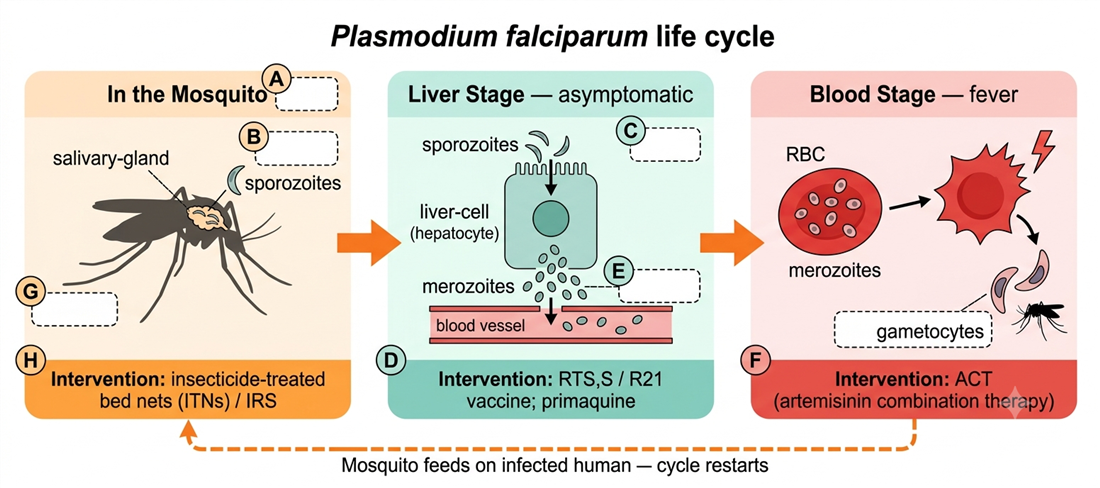
- A — mosquito genus (vector) _______________________
- B — parasite form injected during a bite _______________________
- C — name of the asymptomatic human stage (in the liver) _______________________
- D — intervention that blocks liver-stage entry (vaccine) _______________________
- E — parasite form released from the liver into blood _______________________
- F — drug intervention for the blood stage _______________________
- G — sex of the mosquito that transmits malaria _______________________
- H — vector-control intervention that prevents the mosquito bite _______________________
| Box | Your label |
|---|---|
| A | |
| B | |
| C | |
| D | |
| E | |
| F | |
| G | |
| H |
2. Term–definition match
The ten definitions below are shuffled. In the right-hand column write the matching term from this list: malaria, dengue, Plasmodium, Anopheles, Aedes aegypti, antibody-dependent enhancement, vector control, drug resistance, serotype, artemisinin combination therapy. 10 marks
| # | Definition (shuffled) | Matching term |
|---|---|---|
| 2.1 | A eukaryotic protozoan parasite — not a virus or bacterium — with life stages in both mosquito and human hosts. | |
| 2.2 | A vector-borne disease caused by Plasmodium parasites; kills approximately 608,000 people per year, 76% children under five. | |
| 2.3 | A process where antibodies from a previous dengue infection paradoxically worsen a second infection with a different dengue serotype. | |
| 2.4 | A flavivirus disease transmitted by urban daytime-biting mosquitoes; four distinct antigen variants complicate vaccination. | |
| 2.5 | The gold-standard drug treatment for blood-stage malaria; resistance is beginning to emerge in Southeast Asia and Africa. | |
| 2.6 | The mosquito genus whose females are the sole vectors of malaria; they rest indoors and bite at night. | |
| 2.7 | An antigenically distinct variant of a pathogen — dengue has four of these, complicating the vaccine challenge. | |
| 2.8 | The urban mosquito species that is the primary vector of dengue; breeds in small containers of water. | |
| 2.9 | Strategies that reduce disease transmission by targeting the mosquito population or preventing mosquito–human contact. | |
| 2.10 | The heritable ability of a pathogen to survive drug treatment; driven by natural selection pressure from drug use. |
3. True or false — with correction
For each statement, circle T or F. If the statement is false, write the corrected version on the line below. 10 marks (1 for T/F, 1 for correction where needed)
3.1 Malaria is caused by a virus called Plasmodium falciparum. T / F
3.2 Only female Anopheles mosquitoes transmit malaria because only females take blood meals. T / F
3.3 A person who has been infected with dengue serotype DENV-1 gains lifelong immunity to all four dengue serotypes. T / F
3.4 The R21/Matrix-M malaria vaccine showed approximately 75–80% efficacy in clinical trials, making it the most effective malaria vaccine approved to date. T / F
3.5 Dengue infects fewer people per year than malaria. T / F
4. Function recall
Answer each prompt in 1–2 sentences using precise terms from the lesson. 10 marks (2 each)
4.1 What is the function of insecticide-treated bed nets (ITNs) in malaria control?
4.2 What is the function of the liver stage in the Plasmodium life cycle?
4.3 What is the function of Wolbachia bacteria when introduced into Aedes aegypti mosquitoes as a dengue control strategy?
4.4 What is the function of artemisinin combination therapy (ACT) in malaria treatment?
4.5 What is the function of antibody-dependent enhancement (ADE) in explaining why dengue is difficult to vaccinate against safely?
5. Fill the gaps — malaria and dengue key facts
Complete the passage below by writing one term from the word bank in each blank. 8 marks
Word bank:
sporozoites · merozoites · haemorrhagic fever · four · sub-Saharan Africa · Aedes aegypti · seronegative · artemisinin
Malaria is caused by Plasmodium parasites transmitted by Anopheles mosquitoes.
When an infected mosquito bites a human, it injects (1) ______________ into the bloodstream.
These migrate to the liver and multiply to produce (2) ______________, which then invade red blood cells
and cause the characteristic fever. Approximately 95% of malaria cases occur in (3) ______________.
The blood-stage drug of choice is (4) ______________ combination therapy (ACT).
Dengue virus exists as (5) ______________ distinct serotypes, transmitted primarily by the urban mosquito
(6) ______________. A second dengue infection with a different serotype can trigger severe dengue
(7) ______________ via the process of antibody-dependent enhancement. The Dengvaxia vaccine controversy
arose because the vaccine was given to (8) ______________ individuals — people who had never previously
been infected with dengue — increasing their risk of severe disease.
Q1 — Labelled diagram
A: Anopheles. B: sporozoites. C: liver stage (hepatic stage). D: RTS,S or R21/Matrix-M vaccine (targets circumsporozoite protein to block liver invasion). E: merozoites. F: artemisinin combination therapy (ACT). G: female (only female mosquitoes take blood meals required for egg development; males feed only on plant sugars). H: insecticide-treated bed nets (ITNs) / indoor residual spraying (IRS).
Q2 — Term–definition matches
2.1 Plasmodium · 2.2 malaria · 2.3 antibody-dependent enhancement · 2.4 dengue · 2.5 artemisinin combination therapy · 2.6 Anopheles · 2.7 serotype · 2.8 Aedes aegypti · 2.9 vector control · 2.10 drug resistance.
Q3 — True / false with correction
3.1 False. Correction: Plasmodium falciparum is a eukaryotic protozoan parasite, not a virus. Malaria is not caused by a virus.
3.2 True. Only female Anopheles mosquitoes take blood meals (needed for egg development) and thus can transmit the parasite.
3.3 False. Correction: Infection with one dengue serotype provides lifelong immunity to that serotype only, and only short-term cross-protection against the other three. A second infection with a different serotype can cause severe dengue via ADE.
3.4 True.
3.5 False. Correction: Dengue infects approximately 390 million people per year — about four times more than malaria's ~249 million cases. Dengue causes far fewer deaths (~20,000 vs ~608,000), but it is more widely distributed globally.
Q4.1 — Function of ITNs
Insecticide-treated bed nets (ITNs) have two functions: a physical barrier that prevents Anopheles mosquitoes from biting sleeping people, and a pyrethroid insecticide coating that kills mosquitoes that land on the net. Together they reduce malaria transmission by approximately 50–60% in high-use areas.
Q4.2 — Function of the liver stage
In the liver stage, injected sporozoites invade hepatocytes (liver cells) and multiply asexually to produce large numbers of merozoites. This stage is asymptomatic — the patient has no symptoms — but the parasite is establishing its blood-stage infection. The liver stage is a key intervention point: vaccines like RTS,S and R21 target sporozoites here to prevent the infection proceeding further.
Q4.3 — Function of Wolbachia in dengue control
When Aedes aegypti mosquitoes are infected with Wolbachia bacteria, the bacteria compete intracellularly with dengue virus and dramatically reduce the mosquito's ability to replicate and transmit the dengue virus — a property called reduced vector competence. In the Yogyakarta randomised trial (2020), this reduced dengue incidence by 77%.
Q4.4 — Function of ACT
Artemisinin combination therapy (ACT) targets and rapidly kills blood-stage Plasmodium parasites inside red blood cells. The combination of artemisinin with a partner drug reduces the chance of resistance emerging. It is the gold-standard treatment for clinical malaria.
Q4.5 — Function of ADE in explaining vaccine difficulty
Antibody-dependent enhancement (ADE) occurs when antibodies from a previous dengue serotype infection bind to — but cannot neutralise — a second serotype. Instead, these antibodies facilitate entry of the second serotype into Fc-receptor-bearing immune cells, amplifying the infection and potentially causing fatal dengue haemorrhagic fever. This means any dengue vaccine must provide strong, balanced protection against all four serotypes simultaneously; uneven protection could prime vaccinated people for ADE, making them worse off than if unvaccinated.
Q5 — Cloze passage
(1) sporozoites · (2) merozoites · (3) sub-Saharan Africa · (4) artemisinin · (5) four · (6) Aedes aegypti · (7) haemorrhagic fever · (8) seronegative.