Biology • Year 12 • Module 7 • Lesson 16
Antibiotics and Antivirals
Lock in the key vocabulary, the five antibiotic mechanisms of action, why antibiotics fail against viruses, antiviral targets, and the molecular bases of antibiotic resistance.
1. Label the antibiotic target diagram
The diagram below shows a bacterial cell with arrows pointing to five key sites targeted by different antibiotic classes. Write the correct antibiotic class or mechanism label for each box A–H. 8 marks
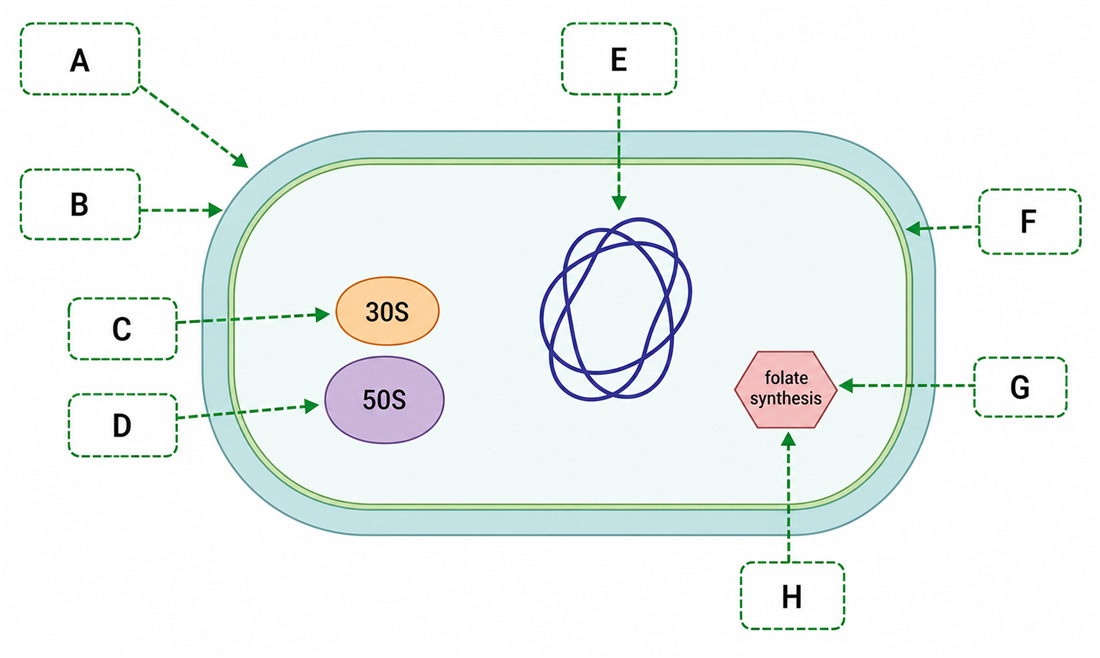
- A — structure targeted by penicillins (polymer name) _______________________
- B — antibiotic class targeting cell wall synthesis _______________________
- C — ribosome subunit targeted by tetracyclines _______________________
- D — ribosome subunit targeted by macrolides (e.g. erythromycin) _______________________
- E — antibiotic class targeting DNA gyrase/topoisomerase IV _______________________
- F — why human cells are safe from fluoroquinolones _______________________
- G — antibiotic class that disrupts the cell membrane _______________________
- H — pathway targeted by sulfonamides (bacteria must synthesise this; humans do not) _______________________
2. Term–definition match
The ten definitions below are shuffled. In the right-hand column write the matching term from this list: antibiotic, antiviral, selective toxicity, bactericidal, bacteriostatic, antibiotic resistance, neuraminidase inhibitor, nucleoside analogue, horizontal gene transfer, beta-lactamase. 10 marks
| # | Definition (shuffled) | Matching term |
|---|---|---|
| 2.1 | A drug that kills or inhibits the growth of bacteria by targeting structures or processes absent in human cells. | |
| 2.2 | The heritable ability of bacteria to survive and reproduce despite exposure to an antibiotic. | |
| 2.3 | The ability of a drug to damage a pathogen while causing minimal harm to host cells, because the drug target is absent or structurally different in the host. | |
| 2.4 | An antibiotic action that directly kills bacteria (e.g. penicillins, fluoroquinolones). | |
| 2.5 | An antibiotic action that slows or stops bacterial growth so the immune system can clear the infection (e.g. tetracyclines, macrolides). | |
| 2.6 | A drug that interferes with a specific stage of the viral replication cycle, such as genome copying or virion release. | |
| 2.7 | A drug that mimics a natural nucleoside, is incorporated into a growing viral genome, and terminates replication (e.g. aciclovir, remdesivir). | |
| 2.8 | A class of antiviral drug that blocks the surface enzyme influenza uses to release new virions from infected cells (e.g. oseltamivir/Tamiflu). | |
| 2.9 | The direct passage of resistance genes between bacterial cells (even of different species) via plasmids, without reproduction. | |
| 2.10 | An enzyme produced by some bacteria (e.g. penicillin-resistant Staphylococcus) that cleaves the beta-lactam ring of penicillins, rendering them inactive. |
3. True or false — with correction
For each statement, circle T or F. If the statement is false, write the corrected version on the line below. 10 marks (1 for T/F, 1 for each correction)
3.1 Antibiotics are effective against both bacterial and viral infections if a high enough dose is used. T / F
3.2 Human cells are not harmed by penicillin because they have no peptidoglycan cell wall. T / F
3.3 Individual bacteria deliberately mutate in response to an antibiotic to protect themselves. T / F
3.4 Viruses hijack the host cell's 80S ribosomes to manufacture viral proteins, which is why antibiotic ribosomal inhibitors do not work against viruses. T / F
3.5 MRSA is resistant to methicillin because it has an altered penicillin-binding protein (PBP2a) that penicillins cannot bind to. T / F
4. Function recall
Answer each in 1–2 sentences using precise terms from the lesson. 10 marks (2 each)
4.1 What is the function of neuraminidase in the influenza virus, and how do neuraminidase inhibitors such as oseltamivir exploit this?
4.2 What is the function of reverse transcriptase in HIV, and why does its absence in human cells make it a useful antiviral target?
4.3 What is the function of efflux pump proteins as a mechanism of antibiotic resistance in bacteria?
4.4 What is the function of HAART (highly active antiretroviral therapy) in HIV management, and why does triple therapy dramatically reduce the emergence of resistance?
4.5 What is the function of completing a full antibiotic course (rather than stopping when symptoms resolve) in preventing resistance?
5. Fill in the blanks — antibiotic resistance by natural selection
Complete the passage using the words from the box below. Each word is used once. 8 marks
Word bank: selection pressure, mutations, resistant, susceptible, population, reproduce, plasmids, pre-existing
Antibiotic resistance evolves through natural selection at the ___________ level, not within individual organisms. Before any antibiotic is introduced, random ___________ occasionally produce ___________ variants in a bacterial population. When an antibiotic is applied, it acts as a ___________, killing ___________ bacteria while the resistant variants survive and ___________. Because resistance genes are ___________ in the population before the antibiotic arrives, the antibiotic selects for them rather than creating them. Resistance genes can also spread rapidly between different bacterial species via small circular DNA molecules called ___________, a process known as horizontal gene transfer.
6. Build a concept map — antibiotic mechanisms and selective toxicity
Draw labelled arrows between the six terms below to show how they connect. Each arrow must carry a linking phrase (e.g. "targets", "lacks", "inhibits"). Aim for at least 6 labelled arrows. 6 marks
Supplied terms: penicillin · peptidoglycan cell wall · bacterial cell · human cell · selective toxicity · 70S ribosome.
Q1 — Labelled diagram
A: peptidoglycan (the polymer forming the bacterial cell wall). B: penicillins / cephalosporins / vancomycin (cell wall synthesis inhibitors). C: 30S subunit (targeted by tetracyclines and aminoglycosides). D: 50S subunit (targeted by macrolides e.g. erythromycin). E: fluoroquinolones (e.g. ciprofloxacin) — target DNA gyrase and topoisomerase IV. F: human topoisomerases are structurally different — lower binding affinity for fluoroquinolones. G: polymyxins (e.g. colistin) — disrupt membrane integrity. H: folate synthesis pathway — sulfonamides / trimethoprim target this; humans obtain folate from diet and do not synthesise it.
Q2 — Term–definition matches
2.1 antibiotic • 2.2 antibiotic resistance • 2.3 selective toxicity • 2.4 bactericidal • 2.5 bacteriostatic • 2.6 antiviral • 2.7 nucleoside analogue • 2.8 neuraminidase inhibitor • 2.9 horizontal gene transfer • 2.10 beta-lactamase.
Q3 — True / false with correction
3.1 False. Antibiotics target bacterial structures (cell walls, 70S ribosomes, DNA gyrase, folate synthesis). Viruses lack all of these targets, so no dose of antibiotic will affect a viral infection.
3.2 True.
3.3 False. Resistance is a population-level evolutionary process. Resistant variants arise by random mutation before the antibiotic is ever applied. The antibiotic selects for pre-existing resistant variants — it does not cause bacteria to mutate deliberately.
3.4 True.
3.5 True.
Q4.1 — Neuraminidase and oseltamivir
Neuraminidase is a surface enzyme that cleaves sialic acid residues tethering newly assembled influenza virions to the host cell surface, allowing virions to escape and infect new cells. Neuraminidase inhibitors such as oseltamivir block this enzyme, trapping new viral particles on the infected cell surface and preventing further spread of the infection.
Q4.2 — Reverse transcriptase and HIV
Reverse transcriptase is the enzyme HIV uses to convert its RNA genome into DNA inside the host cell — a step essential for viral replication. Human cells do not use reverse transcriptase (they do not convert RNA back to DNA as part of normal cell biology), so drugs that inhibit this enzyme (e.g. zidovudine/AZT, efavirenz) have a selective viral target with minimal host-cell effect.
Q4.3 — Efflux pumps
Efflux pumps are membrane transport proteins that actively expel antibiotic molecules from inside the bacterial cell before they can reach their intracellular target (e.g. the ribosome or DNA gyrase). This keeps the intracellular concentration of the antibiotic below the level needed to inhibit bacterial growth, rendering the antibiotic ineffective. Tetracycline resistance in many gram-negative bacteria operates via this mechanism.
Q4.4 — HAART and resistance prevention
HAART combines three or more antiretroviral drugs, each targeting a different step in the HIV replication cycle (e.g. reverse transcriptase, protease, integrase). It dramatically reduces the emergence of resistance because a single viral particle would need to simultaneously acquire resistance mutations for three different drug targets — a statistically extremely unlikely event. Targeting one mechanism at a time allows resistant variants to emerge quickly; targeting three simultaneously does not.
Q4.5 — Completing a full antibiotic course
When symptoms resolve, the bacterial population has been substantially reduced but not fully eliminated. The surviving bacteria are, on average, more resistant than the average at the start of treatment — they have persisted longer under selection pressure. Stopping the course at this point allows these more resistant survivors to repopulate, producing a new bacterial population with a higher proportion of resistance genes. Completing the full prescribed course ensures the bacterial population is eliminated, not just reduced to a level that feels manageable.
Q5 — Cloze passage
In order: population · mutations · resistant · selection pressure · susceptible · reproduce · pre-existing · plasmids.
Q6 — Sample concept map
Correct arrows include:
- penicillin — inhibits synthesis of → peptidoglycan cell wall
- bacterial cell — has → peptidoglycan cell wall
- human cell — lacks → peptidoglycan cell wall
- bacterial cell — has → 70S ribosome
- human cell — has 80S ribosome, not → 70S ribosome
- penicillin — achieves → selective toxicity (because it targets bacterial-only structures)
Award 1 mark per correctly labelled, directionally accurate arrow. Accept any biologically valid linking phrase.