Biology • Year 12 • Module 7 • Lesson 13
Primary and Secondary Immune Response
Lock in the core vocabulary, the primary-vs-secondary comparison, and the mechanism linking vaccination to immunological memory.
1. Label the antibody response diagram
The diagram below shows antibody levels in the blood after a first and second exposure to the same antigen. Write the missing labels into boxes A–H. Each label is drawn from the lesson's Key Terms or the primary/secondary comparison table. 8 marks
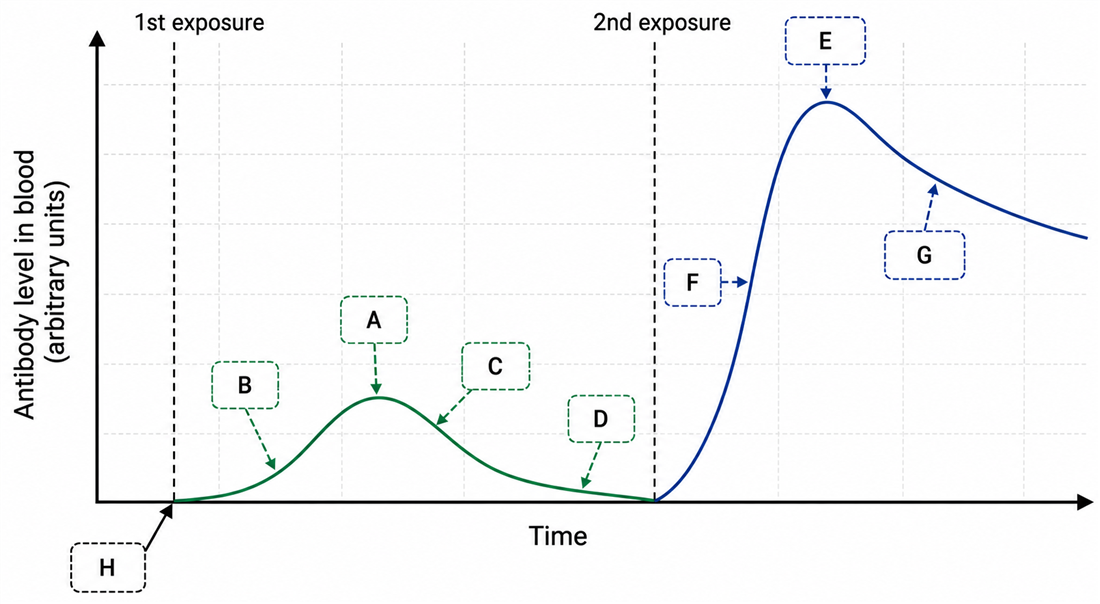
- A — name of the first adaptive response to an antigen _______________
- B — lag time from 1st exposure to peak antibody level _______________
- C — dominant antibody class produced during this first response _______________
- D — long-lived cell type formed at the end of the first response _______________
- E — name of the faster, stronger response upon re-exposure _______________
- F — lag time from 2nd exposure to peak antibody level _______________
- G — dominant antibody class produced in the second response _______________
- H — what the 1st exposure event mimics when no disease is caused _______________
| Box | Your label |
|---|---|
| A | |
| B | |
| C | |
| D | |
| E | |
| F | |
| G | |
| H |
2. Term–definition match
The ten definitions below are shuffled. In the right-hand column write the matching term from this list: primary immune response, secondary immune response, memory cell, booster, vaccination, herd immunity, IgG, IgM, clonal selection, plasma cell. 10 marks
| # | Definition (shuffled) | Matching term |
|---|---|---|
| 2.1 | The body's first adaptive immune response to a specific antigen — slow, modest peak, mainly IgM antibodies. | |
| 2.2 | A faster, stronger immune response on re-exposure to the same antigen, driven by pre-existing memory cells. | |
| 2.3 | A long-lived B or T lymphocyte that persists after a primary response and enables a rapid secondary response. | |
| 2.4 | An additional vaccine dose given to strengthen or restore waning immunological memory. | |
| 2.5 | Deliberate exposure to a safe antigen form that triggers a primary response and memory formation without causing the full disease. | |
| 2.6 | Population-level protection that arises when enough individuals are immune so that transmission chains break even in unvaccinated people. | |
| 2.7 | The dominant antibody class produced in the secondary immune response — high-affinity, long-lasting. | |
| 2.8 | The first antibody class secreted during a primary response, later replaced by higher-affinity isotypes. | |
| 2.9 | The process by which the specific lymphocyte whose receptor matches a given antigen is identified and activated. | |
| 2.10 | An antibody-secreting effector B cell produced in large numbers during the primary and secondary immune responses. |
3. True or false — with correction
For each statement, circle T or F. If the statement is false, write the corrected version on the line. 8 marks (1 for T/F, 1 for the correction where needed)
3.1 During the secondary immune response the lag period to peak antibody is 7–14 days. T / F
3.2 Vaccination works by treating the disease after infection occurs. T / F
3.3 Edward Jenner's 1796 cowpox vaccination produced cross-reactive memory cells that also recognised smallpox antigens. T / F
3.4 Herd immunity against measles is achieved when approximately 50% of the population is immune. T / F
4. Function recall
Answer each in 1–2 sentences using precise terms from the lesson. 10 marks (2 each)
4.1 What is the function of memory B cells after a primary immune response?
4.2 What is the function of a booster dose in a vaccination schedule?
4.3 What is the function of clonal selection in the primary immune response?
4.4 What is the function of herd immunity for individuals who cannot be vaccinated (e.g. newborns, immunocompromised people)?
4.5 What was the function of James Phipps's secondary immune response when Jenner exposed him to smallpox six weeks after cowpox inoculation?
5. Fill the blanks — cloze paragraph
Use the word bank below to fill each blank. Each word is used once. 8 marks (1 per blank)
Word bank: memory cells · primary · secondary · IgG · 1–3 days · plasma cells · vaccination · herd immunity
When an antigen enters the body for the first time, a (1) __________ immune response is triggered. This response is slow, with a lag period of 7–14 days to peak antibody production. At its end, two populations of cells are produced: (2) __________, which secrete antibodies, and long-lived (3) __________, which persist in lymphoid tissue. On re-exposure to the same antigen, these memory cells activate rapidly, producing a (4) __________ immune response that peaks within (5) __________ and generates predominantly high-affinity (6) __________ antibodies. The principle that a controlled first exposure produces protective memory — without causing the full disease — is the basis of (7) __________. When enough individuals in a population are immune, transmission chains break and even unvaccinated people gain indirect protection through (8) __________.
Q1 — Labelled diagram
A: primary immune response. B: 7–14 days. C: IgM. D: memory cell (memory B cell / memory T cell). E: secondary immune response. F: 1–3 days. G: IgG. H: vaccination (a vaccine mimics 1st exposure without causing disease).
Q2 — Term–definition matches
2.1 primary immune response • 2.2 secondary immune response • 2.3 memory cell • 2.4 booster • 2.5 vaccination • 2.6 herd immunity • 2.7 IgG • 2.8 IgM • 2.9 clonal selection • 2.10 plasma cell.
Q3 — True / false with correction
3.1 False. Correction: the secondary immune response has a lag period of only 1–3 days to peak antibody level. 7–14 days is the lag for the primary response.
3.2 False. Correction: vaccination works before disease occurs, by triggering a primary immune response and forming memory cells. If the real pathogen arrives later, the secondary response clears it — vaccination is preventive, not curative.
3.3 True. Cowpox and smallpox viruses share antigenic epitopes; memory cells raised against cowpox antigens also recognised smallpox antigens, enabling a cross-reactive secondary response.
3.4 False. Correction: herd immunity threshold for measles is approximately 95% — much higher than 50% — because measles is highly contagious (high basic reproduction number, R₀ ≈ 12–18).
Q4.1 — Function of memory B cells
Memory B cells are long-lived lymphocytes that persist in lymph nodes and bone marrow after the primary response. Their function is to enable a rapid, amplified secondary immune response on re-exposure to the same antigen — they can quickly differentiate into plasma cells that produce high-affinity IgG without the slow clonal selection process needing to be repeated from scratch.
Q4.2 — Function of a booster dose
A booster dose acts as a controlled second antigen exposure, triggering a secondary immune response that re-expands the memory B and T cell population and elevates antibody levels above the protective threshold. This is necessary when memory cell numbers or antibody levels have declined over time — for example, the tetanus booster is recommended every 10 years.
Q4.3 — Function of clonal selection
Clonal selection identifies the specific naive B (or T) cell — from the enormous pool of lymphocytes in lymph nodes — whose surface receptor precisely matches the antigen. Only that cell is activated, ensuring the immune response is antigen-specific rather than a non-specific attack on all cells. Once selected, that clone expands to produce plasma cells and memory cells.
Q4.4 — Function of herd immunity for non-vaccinated individuals
Herd immunity breaks transmission chains: if the pathogen cannot find enough susceptible hosts in the population to spread, it cannot reach unvaccinated individuals even if those individuals themselves lack immunity. This indirectly protects newborns (too young to vaccinate), immunocompromised patients, and those with vaccine contraindications who cannot develop their own protective response.
Q4.5 — Function of Phipps's secondary immune response
When Jenner challenged Phipps with smallpox six weeks after cowpox inoculation, the cross-reactive memory B and T cells formed during the cowpox primary response recognised shared antigens and mounted a secondary immune response within 1–3 days. Antibody levels rose to 10–100× higher than the primary peak, neutralising the smallpox virus before it could replicate to disease-causing levels — Phipps showed no smallpox symptoms.
Q5 — Cloze paragraph answers
(1) primary (2) plasma cells (3) memory cells (4) secondary (5) 1–3 days (6) IgG (7) vaccination (8) herd immunity