Biology • Year 12 • Module 7 • Lesson 12
T Cells and Cell-Mediated Immunity
Apply cell-mediated immunity to real CD4+ count data, a cause-and-effect chain, a flawed student diagram, and a perturbation scenario set in an Australian context.
1. Interpret CD4+ T cell count data over untreated HIV infection
The graph below is adapted from the natural history of untreated HIV infection, showing mean CD4+ T cell count (cells per µL) and plasma viral load (copies/mL) over approximately 11 years. The dashed horizontal line at 200 cells/µL represents the threshold below which AIDS is diagnosed. 8 marks
Adapted from Fauci & Lane, in Harrison’s Principles of Internal Medicine. Illustrative of natural-history data.
1.1 Describe the trend in CD4+ T cell count from Year 0 to Year 11. Use figures from the graph in your answer. 2 marks
1.2 Using your understanding of T helper cell function, explain why the viral load rises steeply at Year 9–11, at the same time as CD4+ count falls below 200. 3 marks
1.3 Modern antiretroviral therapy (ART) can suppress viral replication to undetectable levels in patients with HIV. Predict what would happen to CD4+ T cell count if ART successfully eliminated viral replication at Year 5. Justify your prediction using lesson content. 3 marks
2. Cause-and-effect chain — HIV attacking the CD4+ T helper cell
Complete the effect boxes to trace the consequence of HIV destroying CD4+ T helper cells on each arm of adaptive immunity. 6 marks (1 per correctly completed box + 1 for the overall outcome)
| Cause | → | Effect (complete this) |
|---|---|---|
| HIV gp120 protein binds to the CD4 receptor on T helper cells | → | |
| T helper cells are destroyed; co-stimulatory signals to B cells cease | → | |
| IL-2 from T helper cells is no longer released to cytotoxic T cells | → | |
| Without CTL expansion, virus-infected host cells are not eliminated | → | |
| T helper cytokines that activate macrophages are absent | → | |
| Overall outcome (so…) | → |
3. Diagram critique — what’s wrong with this student’s diagram?
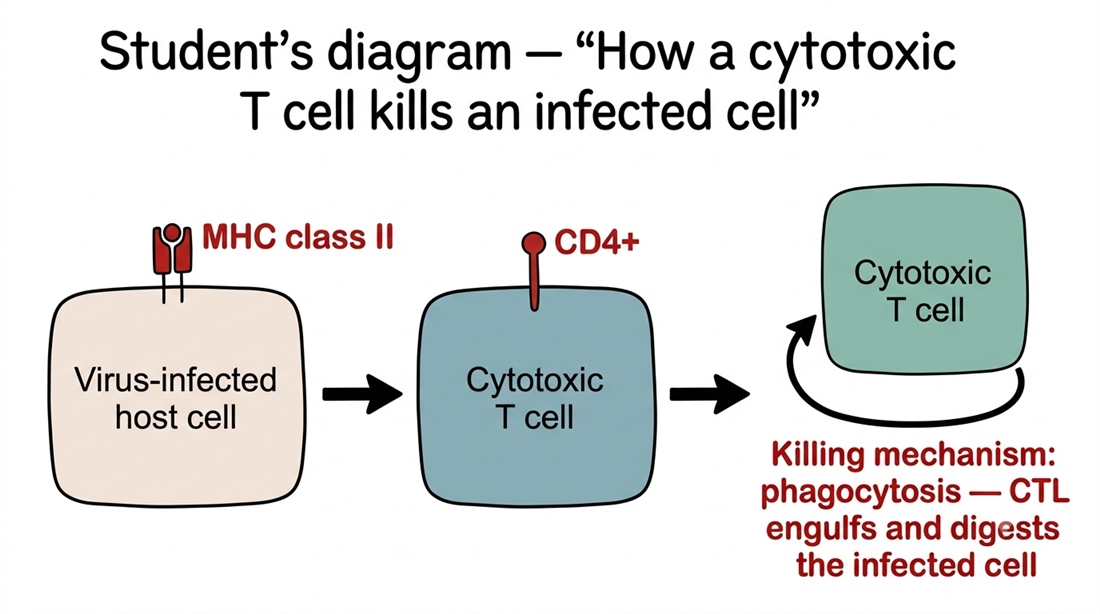
A Year 12 student has drawn the diagram below to explain how a cytotoxic T cell kills an infected cell. There are three biological errors in the diagram. Identify each error and write the correction. 6 marks (2 per error: 1 identify, 1 correct)
3.1 Error 1: What is wrong?
Correction:
3.2 Error 2: What is wrong?
Correction:
3.3 Error 3: What is wrong?
Correction:
4. Apply to a new scenario — organ transplant rejection in Australia
In Australia, kidney transplant recipients are given immunosuppressive drugs (e.g. cyclosporin) that inhibit IL-2 production by T helper cells. Without this treatment, transplant rejection occurs rapidly. 5 marks
4.1 Explain why suppressing IL-2 production reduces the risk of transplant rejection. In your answer, refer to the role of IL-2 in activating cytotoxic T cells. 3 marks
4.2 Explain why immunosuppressive treatment also increases the patient’s susceptibility to opportunistic infections such as Pneumocystis jirovecii pneumonia. 2 marks
Q1.1 — CD4+ trend description (2 marks)
CD4+ T cell count begins at approximately 1000 cells/µL at infection. It dips briefly during the acute phase (to ~700), partially recovers to ~800–820 by Year 1, then declines progressively through the chronic phase, reaching ~600 by Year 3, ~480 by Year 5, and falling below the AIDS threshold of 200 by Year 9, continuing to decline to approximately 120 by Year 11. Overall the trend is a sustained progressive decline across 11 years [1 mark for describing the overall decline; 1 mark for quoting at least two supporting data points].
Q1.2 — Viral load rise linked to CD4+ collapse (3 marks)
T helper cells (CD4+) provide the co-stimulatory signals required for full B cell activation and antibody production [1 mark]. They also provide IL-2 that drives clonal expansion of cytotoxic T cells, which kill virus-infected host cells [1 mark]. When CD4+ count falls below 200, both the antibody response and the cytotoxic T cell response are severely impaired — the virus can replicate in infected cells without being cleared, and new virions spread without neutralising antibody; hence viral load rises steeply [1 mark].
Q1.3 — Prediction: ART at Year 5 (3 marks)
If viral replication is suppressed at Year 5, the rate of CD4+ T helper cell destruction would slow markedly because HIV cannot infect and kill new T helper cells without replicating [1 mark]. The existing CD4+ count (~480 cells/µL at Year 5) would stabilise and, over time, the immune system can partially reconstitute — CD4+ counts typically recover toward normal range in patients on long-term ART [1 mark]. The consequence for immunity would be partial restoration of both humoral and cell-mediated immune coordination, reducing susceptibility to opportunistic infections [1 mark]. Accept also: count stabilises at ~480 and may improve as the existing T helper cells are no longer being destroyed.
Q2 — Cause-and-effect chain (6 marks)
Row 1: HIV enters and destroys T helper cells / CD4+ count progressively declines.
Row 2: B cells cannot receive the co-stimulatory signal needed for full activation; antibody class switching to IgG is impaired; antibody responses weaken.
Row 3: Cytotoxic T cells cannot proliferate (clonal expansion fails); the CTL killing response is insufficient to clear virus-infected host cells.
Row 4: Virus-infected cells continue to produce new virions; viral load rises; infection spreads within the body.
Row 5: Macrophages are less effectively activated; phagocytic clearance of pathogens and debris declines.
Overall outcome: Both arms of adaptive immunity are impaired simultaneously; the patient becomes susceptible to opportunistic pathogens (e.g. Pneumocystis jirovecii, Toxoplasma gondii) that a healthy immune system clears routinely — clinical AIDS.
Q3 — Diagram critique (6 marks)
3.1 Error 1 (MHC class II on infected body cell): Infected body cells display antigen on MHC class I, not class II. MHC class II is found only on professional antigen-presenting cells (dendritic cells, macrophages, B cells). Correction: label the infected cell as displaying antigen on MHC class I. [1 + 1]
3.2 Error 2 (CTL labelled CD4+): Cytotoxic T cells carry the CD8 surface marker, not CD4. CD4+ is the marker on T helper cells. Correction: relabel the cytotoxic T cell as CD8+. [1 + 1]
3.3 Error 3 (killing via phagocytosis): Cytotoxic T cells do not engulf infected cells by phagocytosis. Phagocytosis is performed by macrophages and neutrophils. Correction: CTLs kill target cells by releasing perforin (which forms pores in the target cell membrane) and granzymes (which enter through the pores and trigger apoptosis — programmed cell death). [1 + 1]
Q4.1 — Why suppressing IL-2 reduces rejection (3 marks)
The transplanted kidney contains cells expressing foreign MHC molecules, which cytotoxic T cells (CD8+) would normally recognise as non-self on MHC class I and target for destruction [1 mark]. Full activation and clonal expansion of these cytotoxic T cells requires IL-2 from T helper cells [1 mark]. Cyclosporin inhibits IL-2 production, so CTLs cannot proliferate into a large clone army of killers, and the transplanted tissue is not destroyed [1 mark].
Q4.2 — Why susceptibility to infection increases (2 marks)
Because IL-2 is suppressed, cytotoxic T cells cannot mount effective killing responses against virus-infected host cells [1 mark]. Additionally, T helper cell signalling is impaired, weakening both the antibody response (B cell activation) and the macrophage response — leaving the patient unable to clear normally manageable pathogens such as Pneumocystis jirovecii, which causes pneumonia only in immunocompromised individuals [1 mark].