Biology • Year 12 • Module 7 • Lesson 12
T Cells and Cell-Mediated Immunity
Lock in the vocabulary, T cell types, surface markers, MHC classes, and the perforin–granzyme killing mechanism before tackling application questions.
1. Label the cell-mediated immunity pathway
The diagram below shows the activation and killing sequence in cell-mediated immunity. Write the missing labels into boxes A–H. Each label is drawn from the lesson Key Terms or from the T cell types table. 8 marks
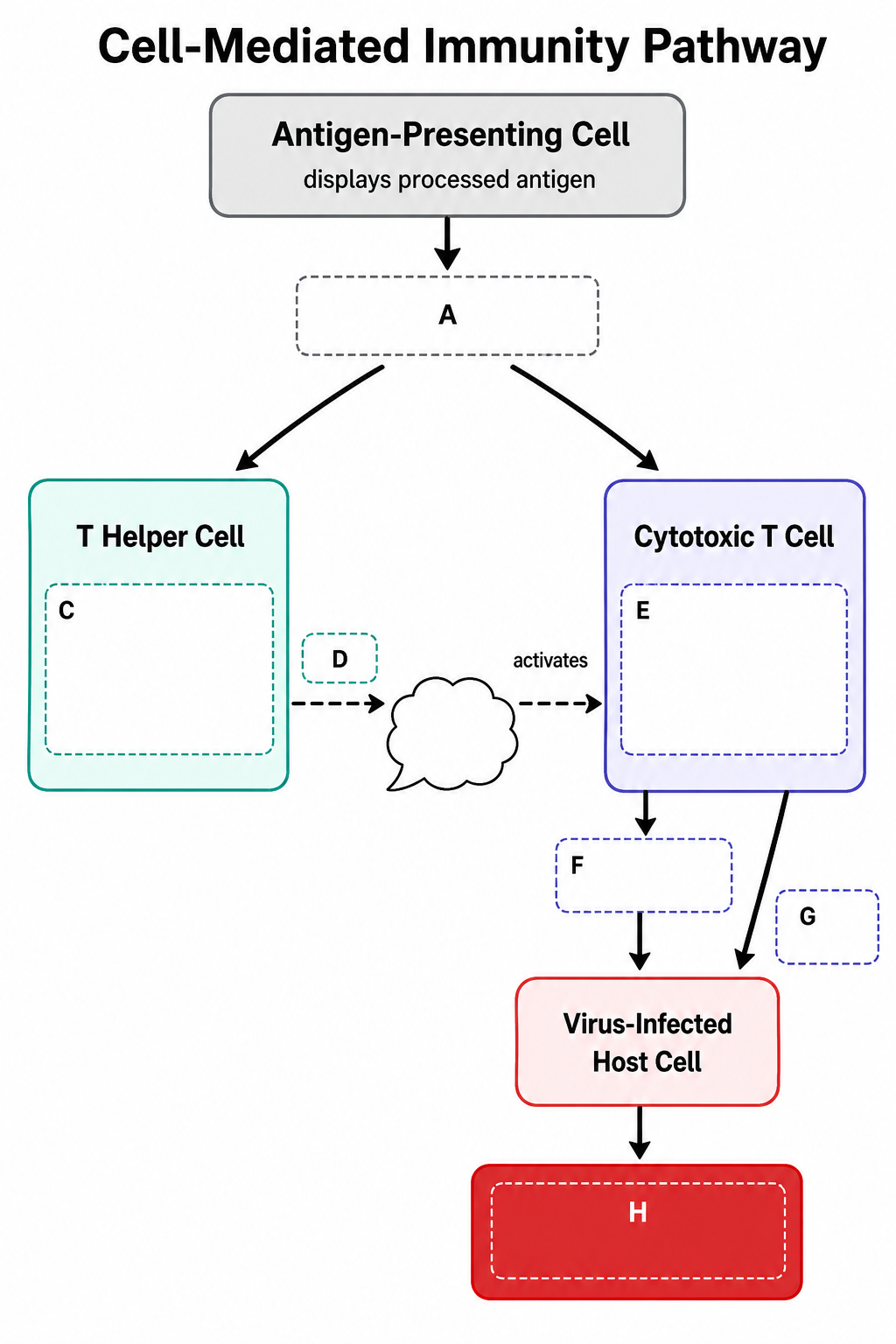
- A — type of antigen-presenting cell shown ___________________________
- B — MHC class on the antigen-presenting cell's surface ___________________________
- C — T cell type directly activated by the APC ___________________________
- D — chemical signals released by the T helper cell ___________________________
- E — surface marker on the cytotoxic T cell ___________________________
- F — molecule on infected body cells that the CTL recognises ___________________________
- G — molecule that punches pores in the target cell membrane ___________________________
- H — the fate of the infected target cell after CTL attack ___________________________
2. Term–definition match
Ten definitions are shuffled below. In the right-hand column write the matching term from this list: cell-mediated immunity, T helper cell, cytotoxic T cell, MHC class I, MHC class II, perforin, granzymes, apoptosis, cytokines, clonal expansion. 10 marks
| # | Definition (shuffled) | Matching term |
|---|---|---|
| 2.1 | The branch of adaptive immunity that uses T cells to target and destroy infected host cells and cancer cells. | |
| 2.2 | A CD4+ T lymphocyte that coordinates immune responses by releasing cytokines; does not kill directly. | |
| 2.3 | A CD8+ T lymphocyte that kills virus-infected, cancerous, or transplanted cells via perforin and granzymes. | |
| 2.4 | A molecule found on all nucleated body cells that displays internally produced peptides (including viral) to cytotoxic T cells. | |
| 2.5 | A molecule found only on professional antigen-presenting cells that displays extracellular antigen fragments to T helper cells. | |
| 2.6 | A protein released by cytotoxic T cells that inserts into the target cell membrane and polymerises to form pores. | |
| 2.7 | Proteolytic enzymes released by cytotoxic T cells that enter target cells through membrane pores and activate the caspase cascade. | |
| 2.8 | Programmed cell death; the controlled self-destruction of a cell activated by granzymes entering through perforin pores. | |
| 2.9 | Chemical signalling molecules secreted by T helper cells that activate B cells, cytotoxic T cells, and macrophages. | |
| 2.10 | The process by which an activated lymphocyte rapidly divides to produce a large population of identical effector cells. |
3. True or false — with correction
For each statement, circle T or F. If the statement is false, write the corrected version on the line provided. 10 marks (1 for T/F, 1 for the correction where needed)
3.1 Cytotoxic T cells kill free-floating viruses directly by releasing antibodies. T / F
3.2 MHC class I molecules are found on all nucleated body cells and display internal peptides to cytotoxic T cells. T / F
3.3 T helper cells carry the CD8 surface marker and are activated when their TCR binds antigen on MHC class II. T / F
3.4 HIV targets CD4+ T helper cells because the viral surface protein gp120 binds specifically to the CD4 receptor. T / F
3.5 After an infection is cleared, all activated T cells die; no memory is formed in cell-mediated immunity. T / F
4. Function recall
Answer each in 1–2 sentences using precise terms from the lesson. 8 marks (2 each)
4.1 What is the function of perforin in the cytotoxic T cell killing sequence?
4.2 What is the function of MHC class II molecules in activating T helper cells?
4.3 What is the function of interleukin-2 (IL-2), released by T helper cells, in the immune response?
4.4 What is the function of memory T cells formed after clonal expansion?
5. Cloze passage — complete the mechanism
Complete the passage by selecting the correct word from the word bank. Each word is used only once. 8 marks
When a virus infects a body cell, viral peptide fragments are loaded onto _______________ molecules displayed on the cell surface. A cytotoxic T cell (carrying the _______________ surface marker) whose T cell receptor matches this peptide–MHC complex binds to the infected cell. However, full activation also requires a signal from a T helper cell, which carries the _______________ surface marker. T helper cells are first activated by _______________ and macrophages, which present processed antigen on _______________ molecules. Once activated, T helper cells release _______________ such as IL-2, driving clonal expansion of cytotoxic T cells. The activated cytotoxic T cell then releases perforin and _______________ into the target cell, triggering _______________ (programmed cell death).
6. Build a concept map
Draw labelled arrows between the six terms below to show how they connect in the cell-mediated immune response. Each arrow must carry a linking phrase (e.g. “activates”, “releases”, “kills”). Aim for at least 6 labelled arrows. 6 marks
Supplied terms: T helper cell (CD4+) · cytotoxic T cell (CD8+) · infected host cell · cytokines (IL-2) · perforin & granzymes · apoptosis
Q1 — Labelled pathway diagram
A: Dendritic cell (also accept macrophage or antigen-presenting cell / APC). B: MHC class II. C: T helper cell (CD4+). D: Cytokines (accept IL-2 / interleukin-2 as examples). E: CD8 (surface marker on cytotoxic T cells). F: MHC class I. G: Perforin. H: Apoptosis (programmed cell death).
Q2 — Term–definition matches
2.1 cell-mediated immunity • 2.2 T helper cell • 2.3 cytotoxic T cell • 2.4 MHC class I • 2.5 MHC class II • 2.6 perforin • 2.7 granzymes • 2.8 apoptosis • 2.9 cytokines • 2.10 clonal expansion.
Q3 — True / false with correction
3.1 False. Correction: cytotoxic T cells kill virus-infected host cells — not free-floating viruses. They do not release antibodies; they release perforin and granzymes to trigger apoptosis in the infected cell. Antibodies are produced by B cells (humoral immunity).
3.2 True.
3.3 False. Correction: T helper cells carry the CD4 surface marker (not CD8). They are activated when their TCR binds antigen on MHC class II — that part is correct. CD8 is the marker on cytotoxic T cells.
3.4 True.
3.5 False. Correction: after clonal expansion, a subset of activated T cells differentiate into long-lived memory T cells. These persist and respond faster and more vigorously upon re-exposure to the same antigen.
Q4.1 — Function of perforin
Perforin is released by the cytotoxic T cell when it contacts the infected target cell. It inserts into the target cell’s plasma membrane and polymerises to form pores (holes). These pores allow granzymes to enter the cell and initiate apoptosis.
Q4.2 — Function of MHC class II
MHC class II molecules are found only on professional antigen-presenting cells (dendritic cells, macrophages, and B cells). They display processed extracellular antigen fragments on the cell surface, where they are recognised by the T cell receptor (TCR) of CD4+ T helper cells, triggering their activation.
Q4.3 — Function of IL-2
Interleukin-2 (IL-2) is a cytokine released by activated T helper cells. It drives the clonal expansion of cytotoxic T cells — stimulating them to divide rapidly and produce a large clone army of identical, antigen-specific killers. Without IL-2, cytotoxic T cells cannot be fully activated and do not proliferate adequately.
Q4.4 — Function of memory T cells
Memory T cells are long-lived cells that persist after the primary immune response clears the infection. On re-exposure to the same antigen, they respond faster and more vigorously than naive T cells because they have already undergone clonal expansion and differentiation — they provide the cellular component of immunological memory.
Q5 — Cloze answers (in order)
MHC class I • CD8 • CD4 • dendritic cells • MHC class II • cytokines • granzymes • apoptosis.
Q6 — Sample concept map
A correct map should include arrows such as:
- T helper cell (CD4+) — releases → cytokines (IL-2)
- cytokines (IL-2) — drive clonal expansion of → cytotoxic T cell (CD8+)
- cytotoxic T cell (CD8+) — recognises antigen on MHC I of → infected host cell
- cytotoxic T cell (CD8+) — releases → perforin & granzymes
- perforin & granzymes — enter → infected host cell
- perforin & granzymes — trigger → apoptosis
Any biologically valid linking phrases are accepted. Award 1 mark per correctly labelled arrow that respects causal direction, to a maximum of 6.