Biology • Year 12 • Module 7 • Lesson 9
Physical and Chemical Responses in Animals
Lock in the key terms, physical barriers, the four signs of inflammation, and the major chemical mediators of the innate immune response.
1. Label the physical defence diagram
The diagram below shows a cross-section of the external and internal surfaces of the human body, highlighting sites where physical barriers act as the first line of defence against pathogen entry. Write the correct label for each site A–H from the word bank below. 8 marks
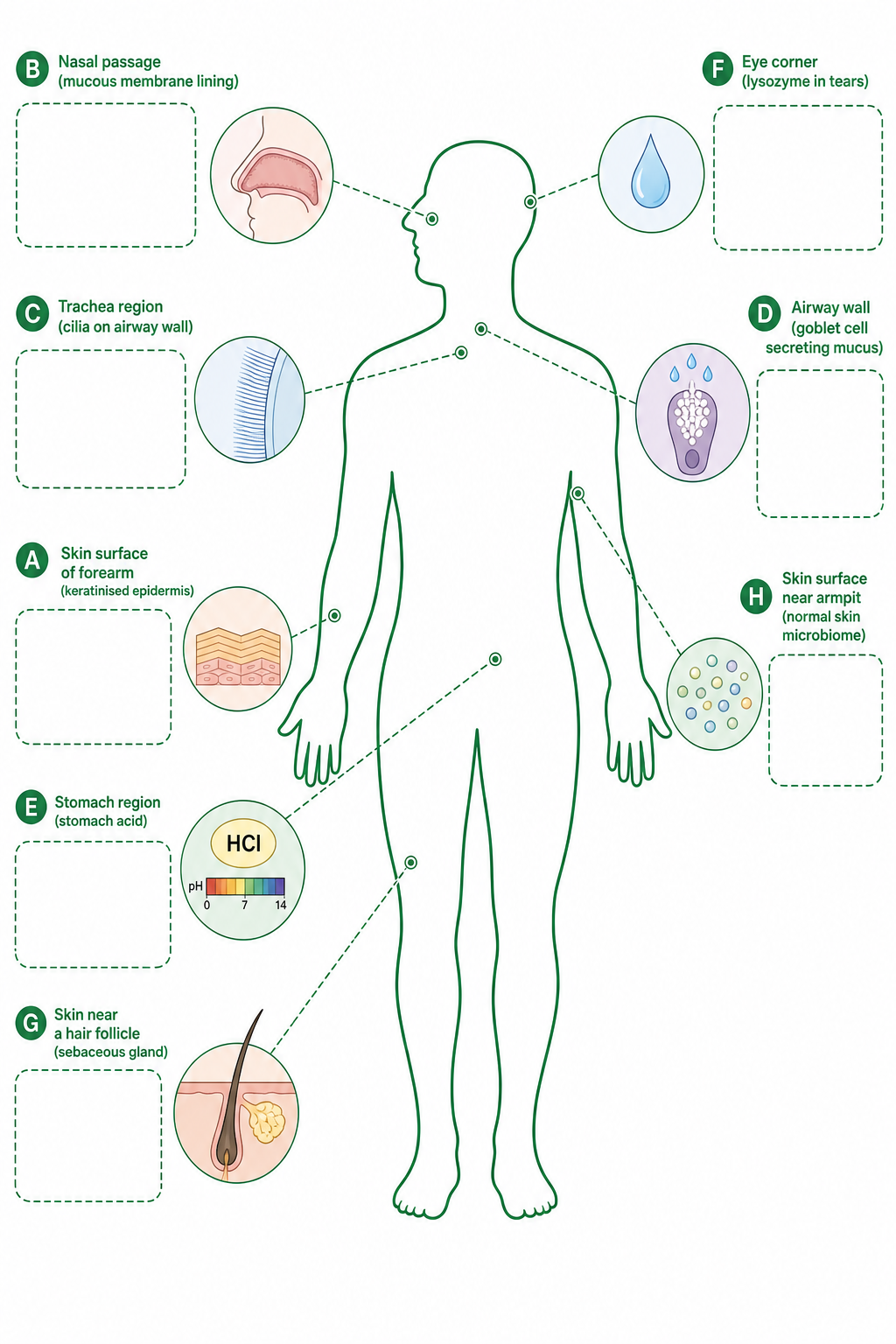
Word bank: cilia, goblet cells, keratinised epidermis, lysozyme, mucous membrane, normal microbiome, sebaceous glands, stomach acid (HCl)
| Label | Your answer | How this barrier prevents infection |
|---|---|---|
| A | ||
| B | ||
| C | ||
| D | ||
| E | ||
| F | ||
| G | ||
| H |
2. Term–definition match
Match each term to its definition by writing the correct term in the right-hand column. Choose from: complement, cytokine, fever, histamine, inflammation, interferons, lysozyme, mast cell, nociceptor, opsonisation, prostaglandin, vasodilation. 10 marks (1 each — 10 definitions provided)
| # | Definition | Matching term |
|---|---|---|
| 2.1 | A local non-specific immune response characterised by redness, swelling, heat and pain at a site of infection or tissue damage. | |
| 2.2 | Widening of blood vessels, increasing blood flow to an affected area — triggered by histamine during the early inflammatory response. | |
| 2.3 | A chemical mediator released by mast cells that causes vasodilation and increases capillary permeability. | |
| 2.4 | A chemical mediator produced by most cell types at a damage site; sensitises pain receptors and promotes fever. | |
| 2.5 | A signalling protein produced by macrophages and T cells that recruits immune cells and stimulates fever; IL-1, IL-6, and TNF-α are examples. | |
| 2.6 | An enzyme present in tears, saliva and nasal secretions that degrades peptidoglycan in bacterial cell walls. | |
| 2.7 | A group of blood proteins produced by the liver that coat pathogens for easier phagocytosis and can form membrane attack complexes. | |
| 2.8 | An elevated body temperature set point coordinated by the hypothalamus in response to pyrogens; can slow pathogen replication. | |
| 2.9 | A connective tissue cell that releases histamine and other chemical mediators when it detects pathogen entry or tissue damage. | |
| 2.10 | Proteins produced by virus-infected cells that signal neighbouring cells to produce antiviral proteins and activate natural killer cells. |
3. True or false — with correction
Circle T or F for each statement. If the statement is false, write the corrected version on the line below. 10 marks (1 for T/F, 1 for correction where needed)
3.1 The redness and warmth of an inflamed wound are caused by increased capillary permeability, which allows plasma to leak into the tissue. T / F
3.2 Pus is composed of dead neutrophils, pathogen material, and tissue fluid — its presence indicates the innate immune system has actively responded to the infection. T / F
3.3 Fever is a failure of homeostasis in which the body loses control of its temperature regulation. T / F
3.4 NSAIDs such as ibuprofen work by inhibiting the COX enzyme, which reduces prostaglandin synthesis and therefore reduces pain, fever, and some vasodilation. T / F
3.5 Interferons are produced by healthy uninfected cells as a preventive measure before any virus enters the body. T / F
4. Function recall
Answer each in 1–2 sentences using precise terms from the lesson. 8 marks (2 each)
4.1 What is the defensive function of swelling during the inflammatory response at a wound site?
4.2 What is the function of chemokines in directing the immune response to an infection site?
4.3 What is the function of the mucociliary escalator as a physical barrier in the respiratory tract?
4.4 What is the function of the hypothalamus in coordinating the fever response?
5. Fill in the blanks — the inflammatory cascade
Complete the paragraph by filling in each blank with the correct word or phrase from the word bank. Each term is used once. 8 marks (1 per blank)
Word bank: bradykinin, chemokines, cytokines, histamine, hypothalamus, mast cells, neutrophils, prostaglandins
When bacteria breach the skin, resident (1) ______________ in the surrounding connective tissue detect the invasion and release (2) ______________. This chemical causes vasodilation and increases capillary permeability, producing the redness and swelling of early inflammation. Simultaneously, damaged cells release (3) ______________ and (4) ______________, which sensitise pain receptor nerve endings and cause the throbbing characteristic of infected tissue. Within the first hour, macrophages begin releasing (5) ______________ — including IL-1, IL-6 and TNF-α — which travel via the bloodstream to the (6) ______________, triggering systemic fever. These signals also establish (7) ______________ gradients that attract (8) ______________ from the bloodstream to the infection site, where they engulf and destroy bacteria by phagocytosis.
Q1 — Physical defence diagram labels
A: Keratinised epidermis (skin) — tough, multilayered, slightly acidic; shed dead outer cells remove surface microbes. B: Mucous membrane — traps pathogens in sticky mucus layer; continuously replenished by goblet cells. C: Cilia — coordinated beating sweeps mucus and trapped pathogens upward (mucociliary escalator) toward throat for swallowing or expulsion. D: Goblet cells — continuously secrete the mucus layer lining the respiratory tract. E: Stomach acid (HCl, pH 1.5–3.5) — destroys most ingested pathogens before they reach the intestine. F: Lysozyme — enzyme in tears, saliva and nasal secretions that degrades peptidoglycan in bacterial cell walls. G: Sebaceous glands — secrete sebum, a slightly acidic oil that makes the skin surface inhospitable to many pathogens. H: Normal microbiome — commensal bacteria compete with pathogens for nutrients and attachment sites; some produce antimicrobial compounds.
Q2 — Term–definition matches
2.1 inflammation · 2.2 vasodilation · 2.3 histamine · 2.4 prostaglandin · 2.5 cytokine · 2.6 lysozyme · 2.7 complement · 2.8 fever · 2.9 mast cell · 2.10 interferons
Q3 — True / false with correction
3.1 False. Correction: Redness and warmth are caused by vasodilation — the widening of blood vessels triggered by histamine, which increases blood flow to the affected area. Increased capillary permeability is what causes swelling (oedema), as plasma leaks into the tissue.
3.2 True. Pus is a mixture of dead neutrophils, destroyed pathogen material, cellular debris, and fluid leaked from blood vessels. Its presence confirms neutrophils migrated to the site and carried out phagocytosis.
3.3 False. Correction: Fever is an adaptive, deliberate response initiated by the immune system — the hypothalamus raises its temperature set point in response to pyrogens (e.g. IL-1, prostaglandins). It is the body running a defensive programme, not a loss of control.
3.4 True. NSAIDs inhibit COX (cyclooxygenase), reducing prostaglandin synthesis. This lowers pain, fever, and some inflammation without eliminating the underlying infection.
3.5 False. Correction: Interferons are produced by cells that have already been infected by a virus. They are released by virus-infected cells to warn neighbouring healthy cells and activate natural killer cells — they are a response, not a preventive measure by uninfected cells.
Q4.1 — Function of swelling
Swelling (oedema) occurs when increased capillary permeability, triggered by histamine, allows plasma to leak from blood vessels into the surrounding tissue. This delivers plasma proteins — including antibodies, complement proteins, and clotting factors — directly to the infection site, enhancing the local immune response.
Q4.2 — Function of chemokines
Chemokines are small signalling proteins produced by infected and damaged cells that create a chemical concentration gradient. Phagocytes (neutrophils and macrophages) detect this gradient and migrate directionally toward the infection site via chemotaxis, ensuring immune cells reach exactly the right location rather than accumulating randomly.
Q4.3 — Function of the mucociliary escalator
The mucociliary escalator is the coordinated system of mucus-secreting goblet cells and ciliated epithelial cells lining the respiratory tract. Pathogens and particles are trapped in the sticky mucus layer; cilia beat in coordinated waves to move this mucus upward toward the throat, where it is swallowed and exposed to stomach acid. This physically removes pathogens from the airways before they can penetrate deeper into the lungs.
Q4.4 — Function of the hypothalamus in fever
The hypothalamus acts as the body's thermostat. During infection, pyrogens (primarily IL-1 from macrophages, and prostaglandins) travel via the bloodstream to the hypothalamus, which responds by raising its temperature set point. This triggers physiological responses (shivering, peripheral vasoconstriction) that raise core body temperature, creating an environment that can slow pathogen replication and enhance immune cell enzyme activity.
Q5 — Cloze answers (in order)
(1) mast cells · (2) histamine · (3) prostaglandins · (4) bradykinin · (5) cytokines · (6) hypothalamus · (7) chemokines · (8) neutrophils