Biology · Year 12 · Module 7 · Lesson 8
How Plants Respond to Pathogens
Lock in the vocabulary and basic structure of plant defences — physical barriers, chemical weapons, the hypersensitive response, systemic acquired resistance, and the Banksia–Phytophthora case study.
1. Label the plant defence overview
The diagram below summarises the two layers of plant defence and the key defences within each layer. Write the missing labels into boxes A–H. Each label is drawn from the lesson's Key Terms or core content. 8 marks
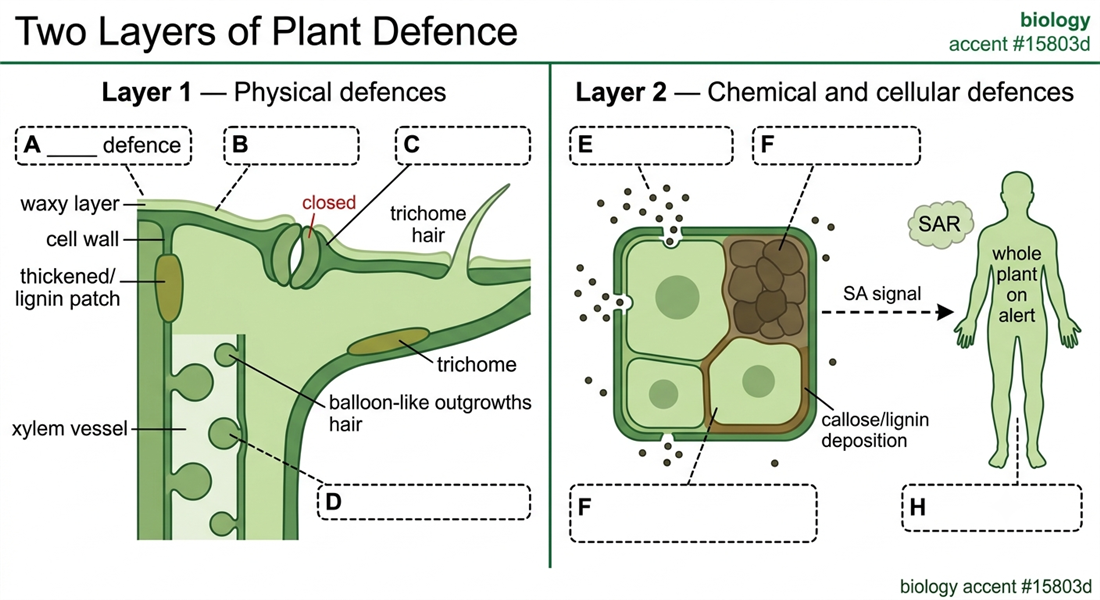
- A — type of defence this layer represents (physical / ___________)
- B — waxy layer on leaf surface that prevents spore entry ___________
- C — what stomata do when a pathogen is detected ___________
- D — outgrowths from xylem parenchyma that block vascular spread ___________
- E — antimicrobial compounds produced at infection sites ___________
- F — programmed death of infected cells to create a containment zone ___________
- G — plant hormone that signals whole-plant defence ___________
- H — whole-plant defensive priming after a local infection signal ___________
| Box | Your label |
|---|---|
| A | |
| B | |
| C | |
| D | |
| E | |
| F | |
| G | |
| H |
2. Term–definition match
The definitions below are shuffled. In the right-hand column write the matching term from this list: physical defence, chemical defence, hypersensitive response, systemic acquired resistance (SAR), phytoalexin, pathogenesis-related (PR) protein, reactive oxygen species (ROS), salicylic acid, constitutive defence, induced defence. 10 marks
| # | Definition (shuffled) | Matching term |
|---|---|---|
| 2.1 | A structural barrier that helps prevent pathogen entry, such as the cuticle, bark or cell wall. | |
| 2.2 | An antimicrobial compound produced rapidly at infection sites, directly toxic to fungal and bacterial pathogens (e.g. resveratrol in grapes). | |
| 2.3 | Localised programmed cell death that creates a necrotic zone to help prevent pathogen spread. | |
| 2.4 | Whole-plant defensive priming activated by salicylic acid signals after a local infection; broad-spectrum, lasts days to weeks. | |
| 2.5 | An antimicrobial compound or signal produced by a plant to inhibit pathogens — the broad category name for any chemical defence. | |
| 2.6 | A protein produced after pathogen detection; examples include chitinases, glucanases and protease inhibitors. | |
| 2.7 | Hydrogen peroxide and superoxide produced at infection sites; directly toxic to pathogens and triggers cell wall reinforcement. | |
| 2.8 | The plant hormone that travels through the phloem to activate systemic acquired resistance throughout the plant. | |
| 2.9 | A defence that is always present in healthy tissue, whether or not infection is occurring (e.g. cuticle, tannins). | |
| 2.10 | A defence activated only after the plant detects pathogen presence; more targeted but metabolically expensive. |
3. True or false — with correction
For each statement, circle T or F. If the statement is false, write the corrected version on the line below. 10 marks (1 for T/F, 1 for each correction where needed)
3.1 The cuticle is an example of an induced defence because it is produced only after pathogen attack. T / F
3.2 The hypersensitive response involves deliberate death of infected plant cells to create a zone that biotrophic pathogens cannot exploit. T / F
3.3 Systemic acquired resistance is pathogen-specific, like the antibody response in animals, providing targeted defence against the exact strain that triggered it. T / F
3.4 Phytophthora cinnamomi is a true fungus with chitin cell walls that can be treated effectively with standard antifungal drugs. T / F
3.5 A visible necrotic lesion on a plant leaf after pathogen attack is evidence that the hypersensitive response has successfully contained the infection. T / F
4. Function recall
Answer each in 1–2 sentences using precise terms from the lesson. 8 marks (2 each)
4.1 What is the function of tyloses in plant defence against vascular pathogens?
4.2 What is the function of the reactive oxygen species (ROS) burst in the hypersensitive response?
4.3 What is the function of salicylic acid after a localised infection in a plant?
4.4 What is the function of callose and lignin deposition around a necrotic zone created by the hypersensitive response?
5. Fill the blanks — the Banksia–Phytophthora encounter
Complete the passage using words from the word bank below. Each word is used once. 8 marks
Word bank: zoospores · callose · oomycete · phytoalexins · root cortex · hypersensitive response · wilting · phosphonate · xylem · cellulose
Phytophthora cinnamomi is an _____________ (not a true fungus) because its cell walls contain _____________ rather than chitin. It spreads through soil water as motile swimming spores called _____________, which attach to Banksia roots, germinate, and penetrate root cells. Hyphae then grow through the _____________, destroying cells and blocking _____________ vessels. Above ground, the first visible symptom is _____________ of leaves due to impaired water uptake. Resistant Banksia individuals respond by depositing _____________ in root cell walls and producing antimicrobial _____________ at infection sites. In severely infected individuals, programmed cell death via the _____________ may form necrotic containment zones. The management chemical _____________ can suppress the pathogen and boost plant SAR, but cannot eradicate it from soil.
6. Build a concept map — plant defence cascade
Draw labelled arrows between the six terms below to show how they connect in a defence cascade. Each arrow must carry a linking phrase (e.g. "triggers", "produces", "activates", "travels via phloem to"). Aim for at least 6 labelled arrows. 6 marks
Supplied terms: R-protein recognition · ROS burst · programmed cell death · callose/lignin reinforcement · salicylic acid signal · systemic acquired resistance.
Q1 — Labelled diagram
A: physical defence (structural). B: cuticle. C: close (stomatal closure). D: tyloses. E: phytoalexins. F: hypersensitive response (programmed cell death / necrotic zone). G: salicylic acid. H: systemic acquired resistance (SAR).
Q2 — Term–definition matches
2.1 physical defence · 2.2 phytoalexin · 2.3 hypersensitive response · 2.4 systemic acquired resistance (SAR) · 2.5 chemical defence · 2.6 pathogenesis-related (PR) protein · 2.7 reactive oxygen species (ROS) · 2.8 salicylic acid · 2.9 constitutive defence · 2.10 induced defence.
Q3 — True / false with correction
3.1 False. Correction: the cuticle is a constitutive defence — it is always present in healthy plants, not activated only after pathogen attack.
3.2 True.
3.3 False. Correction: SAR is broad-spectrum, not pathogen-specific. It provides resistance against a wide range of pathogens via PR gene expression, unlike animal immunological memory which targets the specific antigen that triggered it.
3.4 False. Correction: Phytophthora cinnamomi is an oomycete (water mould), not a true fungus. Its cell walls contain cellulose rather than chitin, so antifungal drugs that target chitin are ineffective against it.
3.5 True.
Q4.1 — Function of tyloses
Tyloses are balloon-like outgrowths from xylem parenchyma cells that physically block xylem vessels. This prevents vascular wilt pathogens (e.g. Fusarium spp.) from spreading through the plant's water transport system, effectively sealing off the vessel and limiting the pathogen's access to new tissue.
Q4.2 — Function of the ROS burst
The reactive oxygen species (ROS) burst — hydrogen peroxide and superoxide produced at the infection site — has two functions. First, it is directly toxic to pathogen cells, inhibiting or killing them. Second, it acts as a local alarm signal that amplifies the defence cascade, including triggering programmed cell death and cell wall reinforcement.
Q4.3 — Function of salicylic acid
After a localised infection, salicylic acid travels through the phloem to uninfected parts of the plant, activating systemic acquired resistance (SAR). In those tissues, SAR turns on pathogenesis-related (PR) gene expression, producing PR proteins that prime the plant's defences against future infection across the whole plant, not just at the original infection site.
Q4.4 — Function of callose/lignin deposition
After the hypersensitive response creates a necrotic zone of dead cells, surviving adjacent cells rapidly deposit callose and lignin in their walls. This physically seals off the dead zone, preventing the pathogen from moving from the necrotic area into adjacent healthy tissue, making the containment more effective.
Q5 — Cloze answers (in order of blanks)
oomycete · cellulose · zoospores · root cortex · xylem · wilting · callose · phytoalexins · hypersensitive response · phosphonate.
Q6 — Sample concept map
A correct map should include arrows such as:
- R-protein recognition — triggers → ROS burst
- R-protein recognition — initiates → programmed cell death
- ROS burst — amplifies signal for → programmed cell death
- programmed cell death — is sealed by → callose/lignin reinforcement
- programmed cell death — stimulates production of → salicylic acid signal
- salicylic acid signal — travels via phloem to activate → systemic acquired resistance
Any biologically valid linking phrases are accepted. Award full marks for at least 6 correctly labelled arrows that respect causal direction.