Biology • Year 12 • Module 7 • Lesson 6
Disease in Agriculture — Plants
Lock in the four types of plant pathogen, their named examples, spread routes and economic effects — the core recall layer for this topic.
1. Label the plant disease impact pathway
The diagram below traces how a single plant pathogen moves from infection to economic consequence. Write the missing labels into boxes A–H. Labels are drawn from the lesson’s key terms and content cards. 8 marks
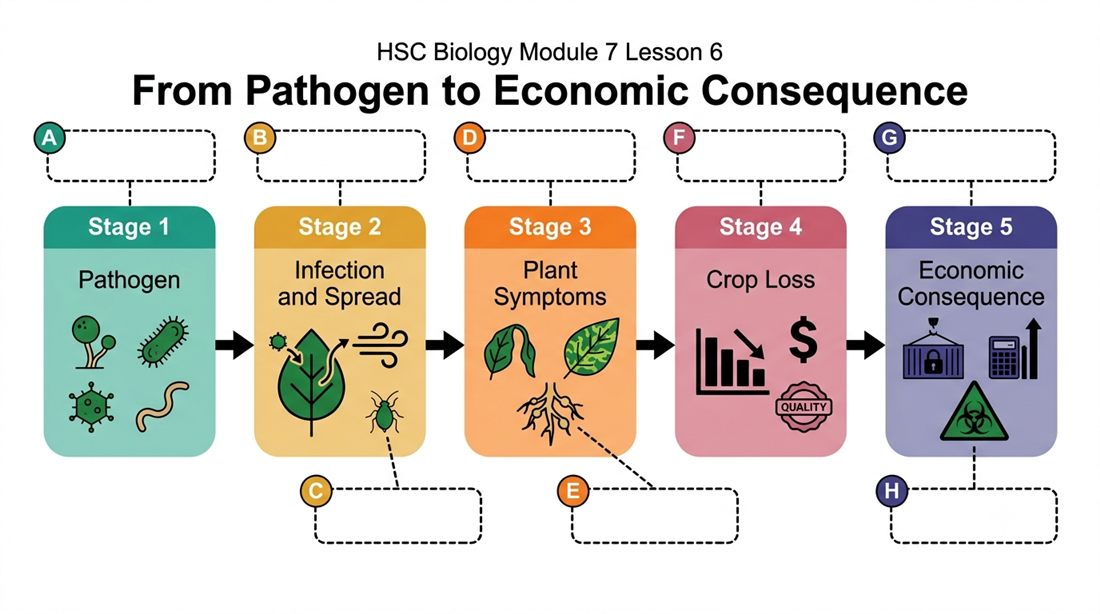
- A — the four categories of plant pathogen type (list all four) _______________________
- B — the primary spread route for Austropuccinia psidii (myrtle rust) _______________________
- C — the visible symptom myrtle rust causes on young tissue _______________________
- D — direct production effect: fewer harvestable units per hectare _______________________
- E — the indirect economic effect when importing countries refuse produce _______________________
- F — costs of fungicides, resistant varieties and replanting (two words) _______________________
- G — the term for prevention of pest and disease entry into a country _______________________
- H — the ability of a plant variety to limit damage caused by a pathogen _______________________
| Box | Your label |
|---|---|
| A | |
| B | |
| C | |
| D | |
| E | |
| F | |
| G | |
| H |
2. Term–definition match
The ten definitions below are shuffled. In the right-hand column write the matching term from this list: plant pathogen, biosecurity, myrtle rust, crop loss, spores, host resistance, fire blight, crown gall, Tobacco mosaic virus, root-knot nematode. 10 marks
| # | Definition (shuffled) | Matching term |
|---|---|---|
| 2.1 | A microorganism, virus, nematode or other agent that causes disease in plants. | |
| 2.2 | A bacterial disease of apple and pear trees caused by Erwinia amylovora; causes blackening of shoots and blossoms and spreads via insects and rain splash. | |
| 2.3 | A fungal disease caused by Austropuccinia psidii that infects the new growth of Myrtaceae plants including eucalypts, paperbarks and tea trees. | |
| 2.4 | Reduction in yield, quality or market value of a crop caused by disease or other stressors. | |
| 2.5 | Measures used to prevent the introduction and spread of pests and diseases into a region or country. | |
| 2.6 | Reproductive structures produced by fungi that can spread through air, water or physical contact. | |
| 2.7 | The ability of a plant variety to reduce infection or limit damage caused by a pathogen. | |
| 2.8 | A viral disease that causes mosaic mottling and leaf distortion in tobacco, tomatoes and capsicum; cannot be cured once established. | |
| 2.9 | A bacterial disease caused by Agrobacterium tumefaciens that produces tumour-like growths on the roots and stems of grapevines, stone fruits and roses. | |
| 2.10 | A soil-dwelling parasitic worm (Meloidogyne spp.) that invades plant roots and forms characteristic galls, blocking water and nutrient uptake. |
3. True or false — with correction
For each statement, circle T or F. If the statement is false, write the corrected version. 8 marks (1 for T/F, 1 for the correction where needed)
3.1 Plant viruses can be treated with antiviral medications once infection is established. T / F
3.2 Myrtle rust arrived in Australia in 2010 and has since infected more than 350 species in the Myrtaceae family. T / F
3.3 Introduced plant pathogens are more dangerous than native ones simply because they are foreign. T / F
3.4 Bacterial wilt caused by Ralstonia solanacearum blocks xylem vessels in host plants, causing rapid wilting. T / F
4. Function recall
Answer each in 1–2 sentences using precise terms from the lesson. 8 marks (2 each)
4.1 What is the primary mechanism by which Puccinia graminis (wheat stem rust) damages wheat plants?
4.2 Why do fungal pathogens like myrtle rust spread rapidly over long distances without human assistance?
4.3 State the primary mechanism by which insect vectors spread viral plant diseases such as Banana bunchy top virus.
4.4 What is the economic significance of an export ban on agricultural produce, and which disease type most commonly triggers such bans?
5. Fill in the blanks — plant pathogen summary
Complete the passage below using words from the word bank. Each word is used once. 8 marks
Fungal plant pathogens spread via (i) _______________________ that can travel hundreds of kilometres on wind currents. Once a spore lands on susceptible tissue, it germinates and sends out (ii) _______________________ that penetrate plant cells and break down cell walls. Fungal diseases are typically managed with (iii) _______________________, although these cannot eliminate established infections of every type. Bacterial pathogens such as Ralstonia solanacearum block (iv) _______________________ tissue, cutting off water supply to leaves. Viral pathogens cannot survive long without a host and rely on insect (v) _______________________ such as aphids to move between plants. Root-knot nematodes cause the plant to form abnormal root swellings called (vi) _______________________, which impede nutrient uptake. The economic effects of plant disease extend to (vii) _______________________ market loss, when importing countries ban produce from affected regions. Introduced pathogens are especially dangerous because Australian plants have not (viii) _______________________ with them and therefore lack natural resistance. Prevention through strong (ix) _______________________ laws is considered the most cost-effective strategy.
6. Build a concept map
Draw labelled arrows between the six terms below to show how they connect. Each arrow must carry a linking phrase (e.g. “spreads via”, “causes”, “prevented by”). Aim for at least 6 labelled arrows. 6 marks
Supplied terms: plant pathogen · spores / vectors · crop loss · economic effect · host resistance · biosecurity.
Q1 — Labelled diagram
A: Fungal, bacterial, viral, nematode (all four types required). B: Wind-dispersed spores / airborne spores. C: Orange-yellow pustules / necrosis of young growth / leaf distortion. D: Yield reduction (reduced yield / crop loss). E: Export market loss / export ban. F: Control costs / increased costs. G: Biosecurity. H: Host resistance.
Q2 — Term–definition matches
2.1 plant pathogen • 2.2 fire blight • 2.3 myrtle rust • 2.4 crop loss • 2.5 biosecurity • 2.6 spores • 2.7 host resistance • 2.8 Tobacco mosaic virus • 2.9 crown gall • 2.10 root-knot nematode.
Q3 — True / False with correction
3.1 False. Once a plant is infected with a virus there is no cure — management relies entirely on prevention (vector control, certified virus-free planting material, removal of infected plants).
3.2 True.
3.3 False. Introduced pathogens are more dangerous not simply because they are foreign, but because the host plants have had no evolutionary exposure to them and therefore have no co-evolved resistance. South American Myrtaceae have some resistance to myrtle rust; Australian Myrtaceae do not, because they never co-evolved with this fungus.
3.4 True.
Q4.1 — Mechanism of wheat stem rust damage
Puccinia graminis hyphae penetrate the stem vascular tissue of wheat, destroying it and blocking the transport of water and nutrients to developing grain. This reduces grain fill, decreasing both the quantity and quality of the harvest — severe outbreaks can cause up to 70% yield loss.
Q4.2 — Long-distance spread of fungal pathogens
Fungi produce millions of lightweight urediniospores per pustule that are dispersed by air currents; myrtle rust spores can travel hundreds of kilometres on wind, landing on new susceptible Myrtaceae tissue wherever moisture allows germination. This wind-dispersal mechanism makes containment without human movement restrictions extremely difficult.
Q4.3 — Vector transmission of plant viruses
The banana aphid (Pentalonia nigronervosa) acquires Banana bunchy top virus when feeding on phloem sap of an infected plant; the virus replicates in the aphid and is injected into healthy plants during subsequent feeding. Controlling the insect vector is therefore the primary management strategy, as there is no cure for infected plants.
Q4.4 — Economic significance of export bans
An export ban is an indirect economic effect in which an importing country prohibits produce from a region where a notifiable plant disease has been detected, regardless of whether individual shipments carry the pathogen. Fire blight (Erwinia amylovora) is one example — its detection can trigger export restrictions on Australian apple exports to markets with zero-tolerance policies, causing revenue losses without any additional plant damage.
Q5 — Cloze passage
(i) airborne • (ii) hyphae • (iii) fungicides • (iv) vascular • (v) vectors • (vi) galls • (vii) export • (viii) co-evolved • (ix) biosecurity. (The unused word from the bank is spores.)
Q6 — Sample concept map
A correct map must include at least 6 arrows. Core chains:
- plant pathogen — spreads via → spores / vectors
- spores / vectors — infect plants causing → crop loss
- crop loss — produces → economic effect
- biosecurity — prevents entry of → plant pathogen
- host resistance — reduces → crop loss
- plant pathogen — overcome by → host resistance
Award 1 mark per biologically valid arrow with a correct linking phrase; maximum 6.