Biology • Year 12 • Module 7 • Lesson 4
Modes of Transmission
Lock in the three transmission modes, key vocabulary, fomite vs vector distinctions, and epidemic-curve shapes before moving to data analysis.
1. Label the transmission-pathways diagram
The diagram below shows four transmission scenarios for the same pathogen moving between two hosts (or from an environment to a host). Write the correct label into boxes A–H from the lesson's Key Terms and Card 1. 8 marks
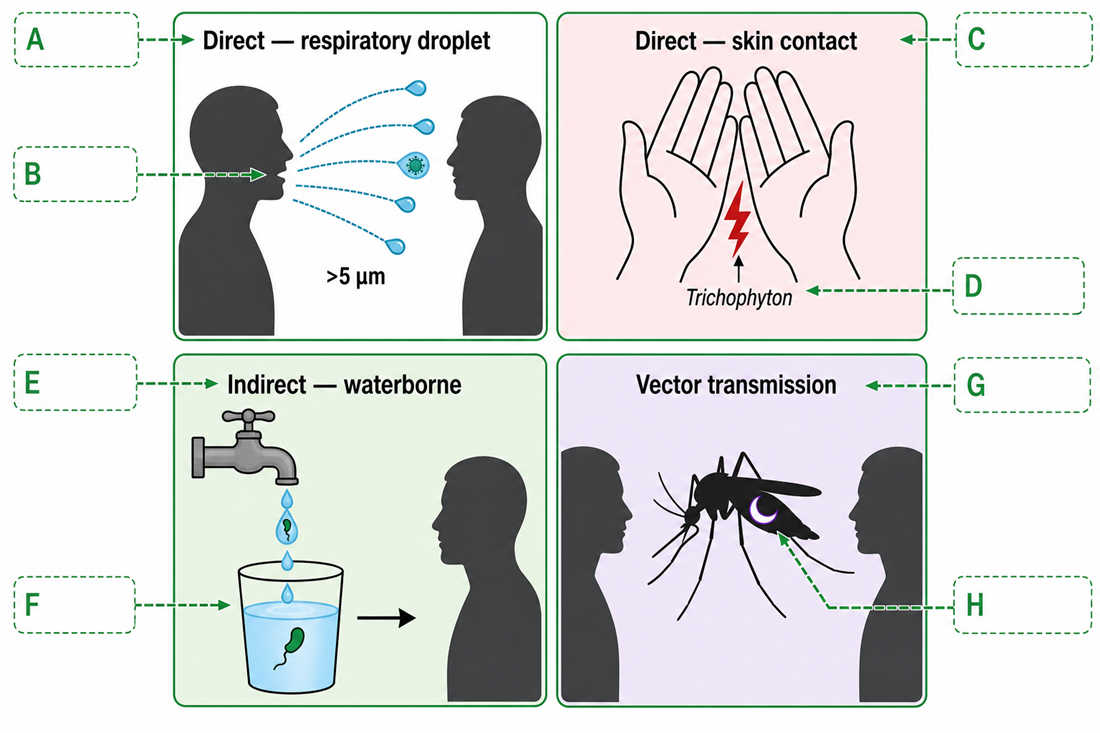
- A — transmission mode shown in Panel 1 _______________________
- B — droplet size that stays in air briefly and requires close contact _______________________
- C — transmission mode shown in Panel 2 _______________________
- D — fungal pathogen shown in Panel 2 (named species) _______________________
- E — transmission mode shown in Panel 3 _______________________
- F — technical term for the contaminated non-living cup/water _______________________
- G — transmission mode shown in Panel 4 _______________________
- H — word describing how the pathogen relates to a biological vector (e.g. Plasmodium in a mosquito) _______________________
2. Term–definition match
The ten definitions below are shuffled. In the right-hand column write the matching term from this list: direct contact, indirect contact, vector, fomite, epidemic curve, point source outbreak, biological vector, mechanical vector, droplet nucleus, vertical transmission. 10 marks
| # | Definition (shuffled) | Matching term |
|---|---|---|
| 2.1 | An outbreak caused by a single, common exposure at one point in time, producing a sharp peak in the epidemic curve. | |
| 2.2 | Transmission where a pathogen passes directly from one host to another without an intermediate object or organism. | |
| 2.3 | A non-living contaminated object or surface capable of transmitting a pathogen (e.g. a door handle, shared towel). | |
| 2.4 | A living organism that carries and transmits a pathogen between hosts; usually an arthropod. | |
| 2.5 | A bar graph that plots the number of new disease cases against the date or time of symptom onset. | |
| 2.6 | A type of vector in which the pathogen completes part of its life cycle and multiplies inside the vector organism (e.g. Anopheles mosquito for malaria). | |
| 2.7 | Transmission through a contaminated intermediate — object, food, water, soil, or airborne particles — rather than between hosts directly. | |
| 2.8 | A type of vector that carries the pathogen on its body surface without hosting its development (e.g. a housefly carrying Salmonella). | |
| 2.9 | A tiny airborne respiratory particle (<5 µm) that remains suspended in air for extended periods and can carry TB or measles. | |
| 2.10 | Transmission of a pathogen from a mother to her offspring — during pregnancy, childbirth or breastfeeding (e.g. HIV, rubella). |
3. True or false — with correction
For each statement, circle T or F. If the statement is false, write the corrected version on the line below it. 8 marks (1 for T/F, 1 for correction where false)
3.1 Tuberculosis is transmitted by respiratory droplets greater than 5 µm in diameter that fall quickly due to gravity. T / F
3.2 A fomite is a living organism that carries a pathogen between hosts. T / F
3.3 The Anopheles mosquito is a biological vector for malaria because Plasmodium completes part of its life cycle inside the mosquito. T / F
3.4 A propagated epidemic curve showing successive waves indicates a point-source exposure to contaminated food. T / F
4. Classify each disease by its primary transmission mode
Complete the table below. For each disease, write the primary transmission mode (direct contact / indirect contact / vector) and name the specific route within that mode. 10 marks (1 per row, all three columns required)
| Disease (pathogen) | Primary transmission mode | Specific route (e.g. respiratory droplet, contaminated water, mosquito bite) |
|---|---|---|
| Cholera (Vibrio cholerae) | ||
| HIV | ||
| Tuberculosis (Mycobacterium tuberculosis) | ||
| Malaria (Plasmodium spp.) | ||
| Salmonellosis (Salmonella spp.) | ||
| Dengue fever (DENV) | ||
| Influenza (Influenza A virus) | ||
| Tetanus (Clostridium tetani) | ||
| Ross River virus | ||
| Scabies (Sarcoptes scabiei) |
5. Build a concept map — transmission chain
Draw labelled arrows between the six terms below to show how they connect during a waterborne outbreak. Each arrow must carry a linking phrase (e.g. “contaminates”, “is classified as”, “can be broken by”). Aim for at least 6 labelled arrows. 6 marks
Supplied terms: reservoir (contaminated water source) · fomite · indirect contact · pathogen (Vibrio cholerae) · new host · water treatment.
6. Complete the paragraph — epidemic curves
Fill each blank with the correct term from the word bank below. Use each term only once. 8 marks
Word bank: point source • epidemic curve • propagated • incubation period • continuous common source • onset • waterborne • person-to-person
An is a bar graph that plots the number of new cases of a disease on the y-axis against the date or time of symptom on the x-axis. Epidemiologists use the shape of the curve to identify the probable transmission pattern before laboratory results are available.
A curve rises sharply to a single tall peak and then falls quickly, with all cases falling within approximately one of each other. This pattern indicates that all affected individuals shared a single common exposure at one time — for example, a contaminated meal at a school camp.
When contamination persists over days or weeks — such as a supply — the curve shows a gradual rise to a plateau rather than a peak. This is a pattern.
A curve produces successive waves of cases, each separated by roughly one incubation period and typically larger than the previous wave. This pattern indicates spread — for example, influenza moving through a classroom.
Q1 — Labelled diagram (image pending)
A: direct contact (respiratory droplet). B: >5 µm (large droplets). C: direct contact (skin-to-skin). D: Trichophyton (causes tinea). E: indirect contact (waterborne). F: fomite (the contaminated cup/water). G: vector transmission. H: biological (the pathogen develops/multiplies within the vector — distinguishing biological from mechanical).
Q2 — Term–definition matches
2.1 point source outbreak • 2.2 direct contact • 2.3 fomite • 2.4 vector • 2.5 epidemic curve • 2.6 biological vector • 2.7 indirect contact • 2.8 mechanical vector • 2.9 droplet nucleus • 2.10 vertical transmission.
Q3 — True / false with correction
3.1 False. Correction: TB is transmitted by airborne droplet nuclei (<5 µm) that remain suspended in air for extended periods — they are too small to fall quickly under gravity. Large droplets (>5 µm) are associated with influenza and COVID-19, not TB.
3.2 False. Correction: a fomite is a non-living contaminated object or surface (e.g. a door handle, shared towel). A living organism that carries a pathogen is called a vector.
3.3 True. The Anopheles mosquito is correctly described as a biological vector because Plasmodium undergoes sexual reproduction and part of its sporogonic (sexual) life cycle inside the mosquito.
3.4 False. Correction: a propagated curve (successive waves) indicates person-to-person spread, not point-source exposure. A point source is indicated by a single sharp peak (all cases within one incubation period).
Q4 — Disease classification table
Cholera: indirect contact / waterborne. HIV: direct contact / blood, sexual, or vertical. TB: indirect contact / airborne droplet nuclei (<5 µm). Malaria: vector / Anopheles mosquito bite. Salmonellosis: indirect contact / contaminated food (poultry, eggs). Dengue fever: vector / Aedes aegypti mosquito bite. Influenza: direct contact / respiratory droplets (>5 µm, close contact). Tetanus: indirect contact / soil (C. tetani spores enter via wound). Ross River virus: vector / mosquito bite (several Aedes and Culex species). Scabies: direct contact / skin-to-skin contact.
Q5 — Sample concept map (waterborne outbreak)
Acceptable arrows include: pathogen (V. cholerae) — lives in → reservoir; reservoir — contaminates a → fomite (e.g. a cup of untreated water); fomite — is the intermediate in → indirect contact; indirect contact — allows pathogen to reach → new host; water treatment — removes pathogen from the → reservoir; water treatment — breaks the chain of → indirect contact. Award 1 mark per biologically correct labelled arrow, maximum 6.
Q6 — Cloze paragraph (in order of blanks)
epidemic curve • onset • point source • incubation period • waterborne • continuous common source • propagated • person-to-person.