Biology • Year 12 • Module 7 • Lesson 3
Koch and Pasteur — Germ Theory
Apply Koch's postulates to novel disease scenarios, interpret real experimental data, and critique a student diagram for errors about germ theory.
1. Interpret Koch's original tuberculosis data
The table below is adapted from Koch's 1882 investigation into tuberculosis. He examined lung tissue from both healthy and diseased individuals, cultured isolates, and tested them in healthy guinea pigs. 7 marks
| Group | Sample examined | Rod-shaped bacterium present? | Pure culture obtained? | Guinea pig outcome after inoculation |
|---|---|---|---|---|
| TB patients (n = 36) | Lung tissue | Yes — all 36 | Yes — grew on coagulated blood serum | All developed TB-like disease; bacterium re-isolated from each |
| Healthy individuals (n = 12) | Lung tissue | No — 0 of 12 | N/A | N/A (no bacterium to inoculate) |
| Positive control (culture only) | Pure culture broth | Yes | Yes | Developed TB-like disease; bacterium re-isolated |
| Negative control (sterile broth) | Sterile broth (no bacterium) | No | N/A | No disease developed |
Adapted from Koch, R. (1882). Die Aetiologie der Tuberculose. Berliner Klinische Wochenschrift, 19, 221–230.
1.1 Identify which of Koch's four postulates is satisfied by the finding that the rod-shaped bacterium was present in all 36 TB patients and absent from all 12 healthy individuals. Explain the significance of testing both groups. 3 marks
1.2 State the purpose of the negative control (sterile broth inoculation). What does its result eliminate as an alternative explanation? 2 marks
1.3 Using all four rows of the table, explain whether Koch's data are sufficient to establish causation. Identify which postulate closure step (re-isolation) is shown in the table, and why it is necessary. 2 marks
2. Interpret graph — microbial growth in Pasteur's three flask conditions
The graph below shows optical density (a measure of microbial turbidity) in three nutrient-broth flasks over 28 days: an unsterilised open flask (positive control), an intact swan-neck flask, and a swan-neck flask whose neck was snapped off at Day 14. 6 marks
Stylised model of Pasteur's 1859 flask experiment results. Optical density is a proxy for microbial growth. Data based on Pasteur's original published observations.
2.1 Describe the difference between the unsterilised open flask and the intact swan-neck flask over the 28 days. What does this comparison demonstrate about the origin of microorganisms? 2 marks
2.2 Explain what the graph shows happened after the neck was snapped off on Day 14. Why does this result act as an internal control, confirming that microorganisms came from outside the broth? 2 marks
2.3 Estimate the optical density of the broken swan-neck flask on Day 28. Using this value, predict what the optical density would likely be by Day 35 if the experiment continued, and justify your prediction. 2 marks
3. Diagram critique — what's wrong with this student's poster?
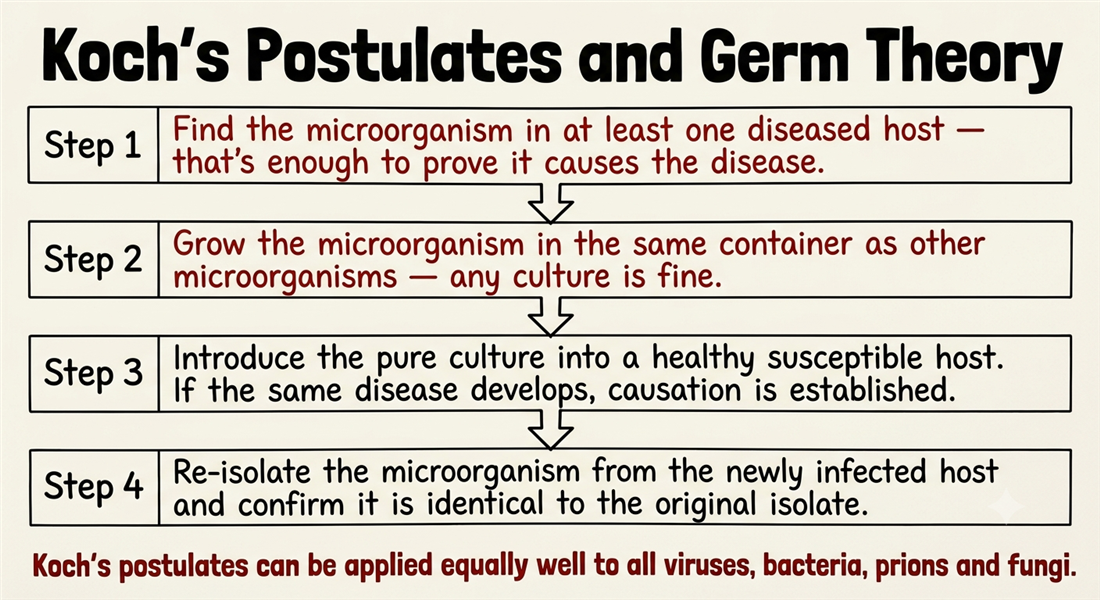
A Year 12 student drew the diagram below to explain germ theory and Koch's postulates. There are three biological errors. Identify each error and write the correction. 6 marks (2 per error: 1 identify, 1 correct)
3.1 Error 1: What is wrong?
Correction:
3.2 Error 2: What is wrong?
Correction:
3.3 Error 3: What is wrong?
Correction:
4. Apply to a new scenario — Helicobacter pylori and peptic ulcers
In 1982 Australian scientists Barry Marshall and Robin Warren proposed that peptic ulcers — long thought to be caused by stress or excess stomach acid — were actually caused by a bacterium, Helicobacter pylori. The medical establishment was deeply sceptical. In 1984, Marshall drank a culture of H. pylori, developed gastritis within days, took antibiotics, and recovered. The organism was re-isolated from his stomach lining after he became ill. Marshall and Warren were awarded the Nobel Prize in Physiology or Medicine in 2005. 5 marks
4.1 Identify which three of Koch's four postulates Marshall and Warren satisfied in this investigation. For each, state what specific step in the scenario fulfils it. 3 marks
4.2 Explain one limitation of the Marshall self-experiment when applying Koch's postulates, and describe how this limitation could have been addressed in a full clinical trial. 2 marks
Q1.1 — Postulate identification and significance (3 marks)
This satisfies postulate 1: the microorganism must be found in all diseased organisms and absent from healthy ones [1]. Testing diseased individuals confirms consistent association; testing healthy individuals confirms the organism is not simply a normal commensal or contaminant [1]. Without the healthy-individual comparison, the presence of the bacterium could be a coincidental finding rather than a specific association with disease [1].
Q1.2 — Purpose of the negative control (2 marks)
The purpose of the negative control (sterile broth, no bacterium) is to demonstrate that the inoculation procedure itself — the handling, injection, and housing of guinea pigs — does not cause disease [1]. Its result (no disease) eliminates procedural contamination or stress as alternative explanations for disease in the positive inoculation group [1].
Q1.3 — Causation and re-isolation (2 marks)
Yes, all four rows together do establish causation [1]. The re-isolation step is shown in Row 1 ("bacterium re-isolated from each" infected guinea pig) and satisfies postulate 4: confirming the re-isolated bacterium is identical to the original isolate closes the causal loop, ruling out that disease was caused by a contaminant or a different organism introduced during the experiment [1].
Q2.1 — Trend description and interpretation (2 marks)
The unsterilised open flask rises steeply from Day 0 and reaches near-maximum optical density (~0.9–1.0 a.u.) by Day 14, while the intact swan-neck flask remains flat near zero throughout all 28 days [1]. This demonstrates that microorganisms require physical access to the broth from outside (via airborne particles) — not spontaneous generation from the broth — because the identical broth in the swan-neck flask shows no growth when particles cannot reach it [1].
Q2.2 — Effect of snapping the neck / internal control (2 marks)
After the neck is snapped off on Day 14, the broken swan-neck flask begins to show rapid microbial growth, rising steeply from Day 14 onwards [1]. This acts as an internal control because the same broth — already demonstrated to support no growth when intact — shows growth the moment airborne particles can reach it directly; this confirms that growth is caused by external particles, not by anything inherent in the broth or a flaw in the sterilisation step [1].
Q2.3 — Estimation and prediction (2 marks)
On Day 28 the broken swan-neck flask optical density is approximately 0.7–0.8 a.u. (accept any value 0.65–0.85) [1]. By Day 35, the optical density would likely approach or plateau near 0.9–1.0 a.u. (similar to the unsterilised open flask), because the broth would have been exposed to airborne particles for a further 7 days and microbial growth typically follows a logistic (S-shaped) growth curve that flattens as nutrients are depleted [1].
Q3 — Diagram critique (6 marks)
3.1 Error 1 ("find in at least one" / "enough to prove causation"): Postulate 1 requires the microorganism to be present in all diseased organisms and absent from healthy ones — not merely in some cases. And postulate 1 alone is insufficient to establish causation: it only establishes association. Correction: "The microorganism must be found in all organisms suffering from the disease and must be absent from healthy organisms. This establishes association, not causation." [1 identify + 1 correct]
3.2 Error 2 ("any culture is fine"): Postulate 2 specifically requires a pure culture — containing only the single suspected pathogen, free of all other organisms. Growing the microorganism alongside other organisms would make it impossible to know which organism caused disease when inoculated into a healthy host. Correction: "The microorganism must be isolated from the diseased organism and grown in pure culture (single-species, no contaminants)." [1 identify + 1 correct]
3.3 Error 3 ("equally well to all viruses, bacteria, prions and fungi"): Koch's postulates cannot be applied unchanged to viruses (cannot be grown in pure culture on artificial media — require living host cells) or to prions (no nucleic acid; cannot be cultured in any conventional sense). They were designed for bacterial pathogens. Correction: "Koch's postulates have significant limitations for viruses, prions, and unculturable pathogens. Modified molecular approaches are required for these." [1 identify + 1 correct]
Q4.1 — Which postulates were satisfied (3 marks)
Postulate 1: H. pylori was found consistently in the stomach lining of patients with peptic ulcers and gastritis, and not in healthy stomachs [1]. Postulate 3: Marshall drank a pure culture of H. pylori and developed gastritis within days — the cultured organism caused the same disease in a healthy host (Marshall himself) [1]. Postulate 4: The organism was re-isolated from Marshall's stomach lining after he became ill, confirming identity with the original isolate [1]. (Note: Postulate 2 — pure culture — was also satisfied prior to Marshall's self-experiment; accept this as a fourth postulate if clearly articulated.)
Q4.2 — Limitation and resolution (2 marks)
One limitation is the lack of a control: Marshall was a single individual and it is impossible to establish definitively whether his gastritis was caused solely by the H. pylori culture or partly by the procedure (e.g. fasting, the vehicle broth) or individual susceptibility [1]. This could be addressed in a clinical trial by having a randomly assigned group of consenting healthy participants receive either the H. pylori culture or an identical-appearing sterile broth (blind placebo control), comparing rates of gastritis between groups to isolate the effect of the bacterium [1]. (Also accept: ethical constraint — infecting humans is only justifiable in very limited self-experiment contexts; the full trial would require randomised controlled design with ethical oversight.)