Biology • Year 12 • Module 7 • Lesson 3
Koch and Pasteur — Germ Theory
Lock in the vocabulary of germ theory, the steps of Pasteur's swan-neck experiment, and Koch's four postulates before moving to application and analysis.
1. Label the swan-neck flask experiment
The diagram below shows Pasteur's 1859 swan-neck flask experiment. Write the correct label for each callout box A–H using terms from the Key Terms panel and lesson Cards 1–2. 8 marks
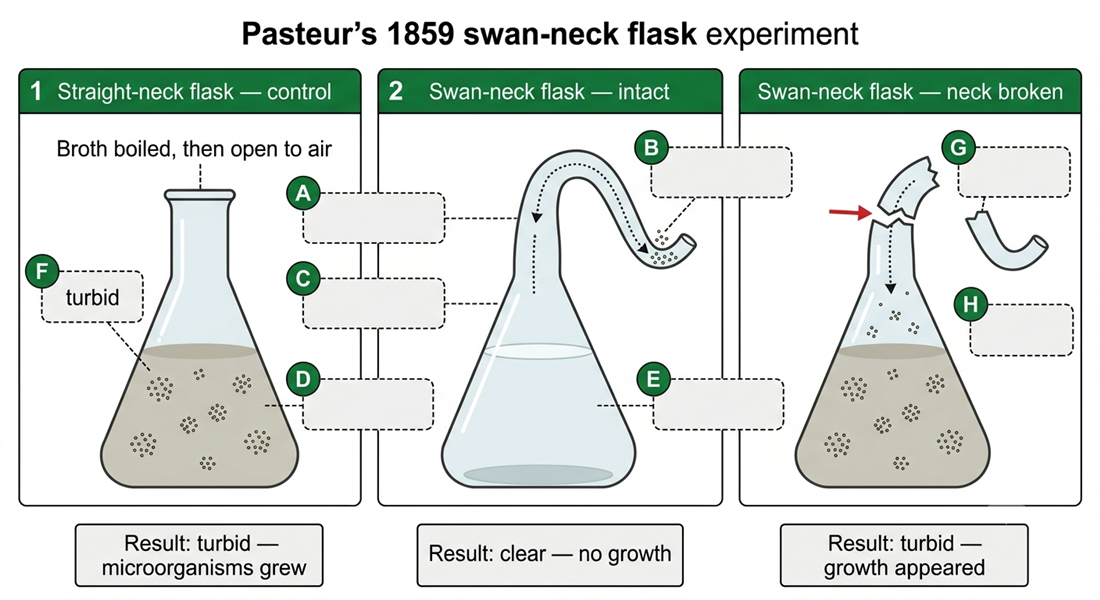
- A — the independent variable (what Pasteur deliberately changed) _______________________
- B — what the curved neck prevents from reaching the broth _______________________
- C — dependent variable (what was measured / observed) _______________________
- D — result in the straight-neck flask (what it showed about microorganisms) _______________________
- E — result in the intact swan-neck flask (what this disproves) _______________________
- F — what "turbid" (cloudy) broth indicates _______________________
- G — what snapping off the neck confirmed _______________________
- H — name of the idea that Pasteur's experiment overturned _______________________
2. Term–definition match
Match each definition to its correct term. Write the term in the right-hand column. Choose from: miasma theory, spontaneous generation, germ theory, pure culture, Koch's postulates, causation, pathogen, correlation. 8 marks
| # | Definition | Matching term |
|---|---|---|
| 2.1 | The historical belief that disease was caused by bad air arising from decaying organic matter. | |
| 2.2 | The disproven idea that living organisms could arise spontaneously from non-living matter. | |
| 2.3 | The theory that infectious diseases are caused by specific microorganisms or other pathogens. | |
| 2.4 | A culture containing only one identified, isolated microorganism — no other organisms present. | |
| 2.5 | Four criteria developed by Robert Koch to test whether a microorganism causes a specific disease. | |
| 2.6 | Evidence that one factor directly produces an outcome — not merely appears alongside it. | |
| 2.7 | A biological agent capable of causing disease in a host organism. | |
| 2.8 | A statistical relationship between two variables that does not necessarily mean one causes the other. |
3. True or false — with correction
Circle T or F. If false, write the corrected version on the line provided. 8 marks (1 for T/F, 1 for correction when false)
3.1 Pasteur's swan-neck flask experiment proved that specific microorganisms cause specific diseases. T / F
3.2 Finding a microorganism in every diseased organism (postulate 1) is enough to establish causation. T / F
3.3 Koch's postulates require that the microorganism be isolated and grown in pure culture before being introduced into a healthy host. T / F
3.4 Viruses can be grown in pure culture on artificial (cell-free) media, so Koch's postulates apply to them without modification. T / F
4. Sequence Koch's postulates
The five events below describe applying Koch's postulates to a novel bacterial disease. Write the correct order number (1–5) in the "Order" column. One step is already done as an example. 4 marks
| Event | Your order (1–5) | Already done? |
|---|---|---|
| The same bacterium is re-isolated from the newly infected guinea pig and confirmed identical to the original isolate. | ||
| The bacterium is cultured on nutrient agar until a pure single-species culture is obtained. | ||
| A pure culture of the bacterium is injected into a healthy, susceptible guinea pig, which then develops the same disease. | ||
| Lung tissue from every TB patient examined is found to contain the same rod-shaped bacterium; the bacterium is absent from healthy individuals. | 1 | Example |
| The bacterium is extracted from the diseased lung tissue of a TB patient. |
5. Cloze — complete the paragraph
Fill in each blank with the correct word from the word bank below. Each word is used once. 8 marks
Word bank: miasma, spontaneous generation, particles, airborne, turbid, causation, postulate, re-isolated
Before germ theory, most physicians accepted _____________ theory — the idea that disease came from bad air. Alongside this sat the belief in _____________, the idea that life could arise from non-living matter. Pasteur's 1859 swan-neck flask experiment showed that broth became _____________ (cloudy) only when _____________ particles were able to reach it; the curved neck trapped these _____________ before they could enter. This disproved spontaneous generation because the agent causing growth came from outside. Koch extended this work by requiring that an isolated microorganism must cause disease in a healthy host (the third _____________) and must then be _____________ from the new host to confirm the organism's identity. Together these requirements move evidence from correlation to _____________.
6. Connect the concepts
Draw labelled arrows between the five terms below to show how they are related. Each arrow must carry a linking phrase (e.g. "was disproved by", "established", "requires"). Aim for at least 5 labelled arrows. 5 marks
Supplied terms: spontaneous generation · Pasteur's swan-neck experiment · germ theory · Koch's postulates · causation.
Q1 — Labelled diagram
A: Whether airborne particles could reach the broth (flask neck design: swan-neck vs straight-neck). B: Airborne particles (microorganism-carrying particles from the air). C: Microbial growth — turbidity (cloudiness) of the broth. D: Microorganisms were present in the air / came from outside the broth. E: Spontaneous generation (the broth did not generate microorganisms on its own). F: Microbial growth has occurred. G: Microorganisms came from airborne particles, not from the broth itself. H: Spontaneous generation (also accept: miasma theory as an indirect answer).
Q2 — Term–definition matches
2.1 miasma theory • 2.2 spontaneous generation • 2.3 germ theory • 2.4 pure culture • 2.5 Koch's postulates • 2.6 causation • 2.7 pathogen • 2.8 correlation.
Q3 — True / false with correction
3.1 False. Correction: Pasteur's experiment disproved spontaneous generation by showing that microorganisms came from airborne particles, not from the broth itself. It was Koch who developed the method for proving that specific microorganisms cause specific diseases.
3.2 False. Correction: postulate 1 establishes association (correlation) only. All four postulates must be satisfied — particularly postulate 3 (inoculation of a healthy host) — to establish causation.
3.3 True.
3.4 False. Correction: viruses cannot be grown in pure culture on artificial (cell-free) media because they require living host cells to replicate. This is one of the major limitations of Koch's postulates.
Q4 — Sequence of Koch's postulates
1. Lung tissue from every TB patient examined… (given). 2. The bacterium is extracted from the diseased lung tissue. 3. The bacterium is cultured on nutrient agar (pure culture). 4. A pure culture is injected into a healthy guinea pig, which develops the disease. 5. The same bacterium is re-isolated from the newly infected guinea pig and confirmed identical.
Q5 — Cloze answers (in order of blanks)
miasma / spontaneous generation / turbid / airborne / particles / postulate / re-isolated / causation.
Q6 — Sample concept map
Correct arrows include:
- Pasteur's swan-neck experiment — disproved → spontaneous generation
- Pasteur's swan-neck experiment — supported / provided evidence for → germ theory
- Koch's postulates — strengthened / operationalised → germ theory
- Koch's postulates — established → causation
- germ theory — depends on evidence of → causation
- spontaneous generation — was the alternative to → germ theory
Award 1 mark per correctly labelled arrow that respects causal or historical direction (max 5).