Biology • Year 12 • Module 7 • Lesson 2
Classifying Pathogens
Apply pathogen classification and adaptation knowledge to real outbreak data, a case study, and a diagram critique.
1. Interpret treatment success data across pathogen types
A clinical audit reviewed 120 confirmed infectious disease cases in Australian hospitals between 2019 and 2022. Cases were grouped by the pathogen type responsible. The table shows the percentage of cases successfully resolved using the first-line treatment prescribed, and the percentage that required escalation after the initial prescription failed. 7 marks
| Pathogen type | First-line treatment | Cases resolved on first treatment (%) | Cases requiring escalation after treatment failure (%) |
|---|---|---|---|
| Bacterial (susceptible strains) | Amoxicillin (antibiotic) | 84 | 16 |
| Viral (influenza A) | Oseltamivir (antiviral) | 71 | 29 |
| Viral (influenza A) | Amoxicillin (antibiotic) | 8 | 92 |
| Fungal (tinea — Trichophyton) | Clotrimazole (antifungal) | 89 | 11 |
| Helminth (Taenia solium) | Mebendazole (anthelmintic) | 91 | 9 |
| Helminth (Taenia solium) | Amoxicillin (antibiotic) | 3 | 97 |
Source: Hypothetical audit data; pathogen classifications from NHMRC treatment guidelines.
1.1 Describe the trend in treatment success when amoxicillin is prescribed for viral influenza A infections compared with when it is prescribed for bacterial infections. 2 marks
1.2 Using lesson content, explain why amoxicillin resolves only 3% of helminth infections but 84% of susceptible bacterial infections. Your answer must refer to the structural difference between the two pathogen types. 3 marks
1.3 Predict what would happen to the escalation rate for viral influenza cases if all hospitals switched from oseltamivir to amoxicillin as first-line treatment. Justify using one structural feature of viruses. 2 marks
2. Interpret graph — TMV transmission stability vs temperature
Tobacco mosaic virus (TMV) infects tobacco, tomato, and capsicum plants across Australia. A laboratory study tested the infectivity of TMV particles after storage at different temperatures for 48 hours. The graph shows the percentage of particles that remained infectious at each temperature. 6 marks
Adapted from Gooding (1986), Phytopathology, illustrative model values.
2.1 Describe the trend in TMV infectivity as temperature increases from 0 °C to 100 °C. Identify the approximate temperature at which infectivity begins to fall sharply. 2 marks
2.2 Using lesson content, explain why TMV remains infectious over such a wide temperature range. Refer to the structural feature of TMV that accounts for this stability. 2 marks
2.3 A grower leaves contaminated tools in a 75 °C greenhouse for 48 hours. Using the graph, estimate the percentage of TMV particles that would remain infectious. Is this an effective decontamination strategy? Justify. 2 marks
3. Diagram critique — what is wrong with this student's pathogen classification table?
A student drew the table below to summarise pathogen classification for a class activity. The table contains three biological errors. Identify each error and write the correction. 6 marks: 2 per error
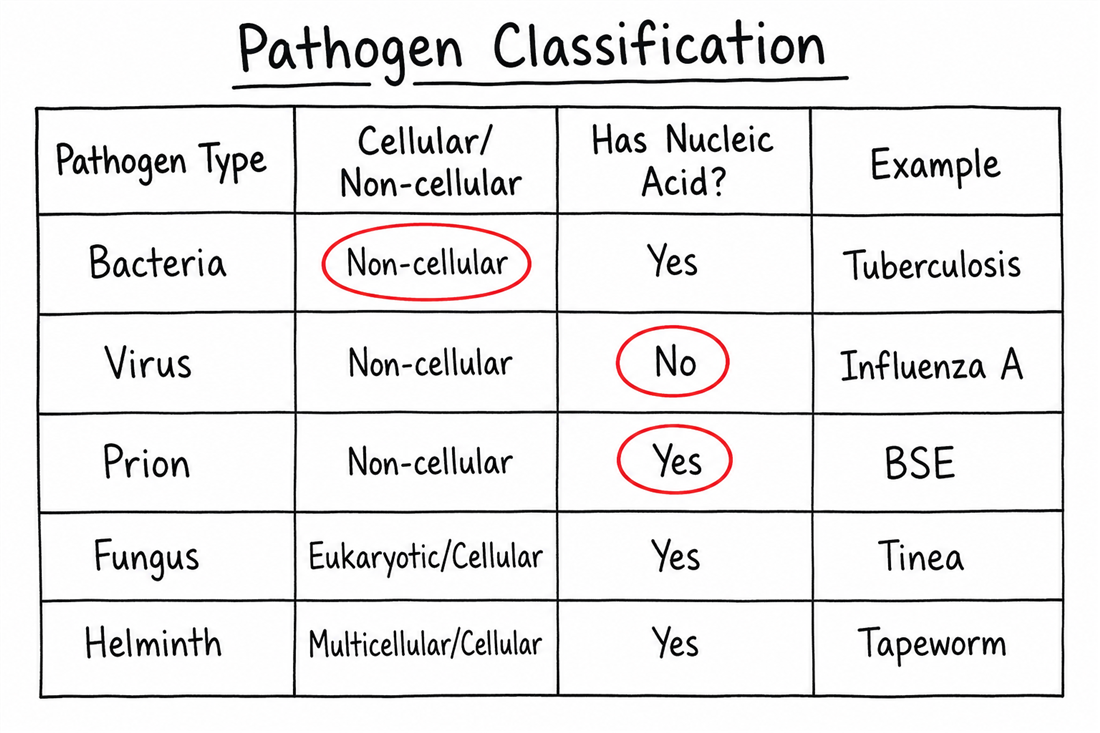
3.1 Error 1: What is wrong?
Correction:
3.2 Error 2: What is wrong?
Correction:
3.3 Error 3: What is wrong?
Correction:
4. Apply to a new scenario — henipavirus outbreak response, northern Queensland
In 2022, Australian health authorities responded to a cluster of fatal Hendra virus (HeV) cases in horses in the Atherton Tablelands, Queensland. Hendra virus is a single-stranded RNA virus transmitted from flying foxes to horses, and occasionally to humans. Veterinarians who treated unvaccinated horses were instructed to use antiviral personal protective equipment protocols, not antibiotic prophylaxis. 5 marks
4.1 Classify Hendra virus and justify the classification by naming two structural or biological features consistent with this pathogen type. 2 marks
4.2 Explain why antibiotic prophylaxis would be ineffective in preventing Hendra virus infection in exposed veterinarians. Refer to two specific structural targets of antibiotics. 2 marks
4.3 Flying foxes are the reservoir host for Hendra virus. State one specific adaptation of Hendra virus that would assist its transmission from flying foxes to horses. 1 mark
Q1.1 — Amoxicillin: viral vs bacterial (2 marks)
When amoxicillin is prescribed for viral influenza A, only 8% of cases are resolved and 92% require escalation. In contrast, when prescribed for susceptible bacterial infections, 84% are resolved on first treatment. The success rate is approximately 10 times lower for viral infections, and the escalation rate is nearly 6 times higher. [1 — identifies the direction and scale of the difference; 1 — uses specific figures from both rows to support the comparison]
Q1.2 — Why amoxicillin fails against helminths (3 marks)
Amoxicillin (a penicillin-class antibiotic) works by inhibiting peptidoglycan cross-linking in bacterial cell walls. [1 — correct mechanism of amoxicillin] Bacteria have a cell wall made of peptidoglycan, so amoxicillin disrupts their structural integrity and kills the cell. [1 — why it works on bacteria] Helminths (Taenia solium) are multicellular animals — they have no cell wall and no peptidoglycan; there is no structural target for amoxicillin to bind. [1 — explains structural basis of failure for helminths]
Q1.3 — Prediction for influenza switched to amoxicillin (2 marks)
The escalation rate would rise dramatically (approaching ~92% as shown in row 3). Viruses have no cell wall and no bacterial ribosomes — the two primary targets of amoxicillin — so the antibiotic has no mechanism by which to inhibit viral replication. [1 — correct prediction with data support; 1 — structural justification naming one antibiotic target absent in viruses]
Q2.1 — TMV infectivity trend (2 marks)
TMV infectivity remains near 100% from 0 °C up to approximately 50 °C, then falls sharply between 50 °C and 80 °C, reaching near-zero by 100 °C. [1 — correct description of stable zone and then decline; 1 — identifies approximately 50–55 °C as the onset of the sharp drop]
Q2.2 — Why TMV is so thermally stable (2 marks)
TMV has an extremely stable rod-shaped protein coat (capsid) that encases its RNA genome. [1 — identifies the capsid as the structural feature] The tightly packed protein subunits protect the RNA from denaturing agents including moderate heat, allowing the virus to survive drying and temperatures up to ~50 °C on tools, soil and plant surfaces for extended periods. [1 — explains mechanism of protection and links to the data]
Q2.3 — Grower scenario at 75 °C (2 marks)
From the graph, approximately 10–15% of TMV particles remain infectious after 48 hours at 75 °C. This is not an effective decontamination strategy because a substantial minority of particles remain infectious. [1 — reads value within ±5% from graph; 1 — correctly judges ineffectiveness because infectivity is not reduced to zero and gives a number to support this]
Q3 — Diagram critique (6 marks)
3.1 Error 1 — Bacteria labelled “non-cellular”: Bacteria are cellular pathogens — they are single-celled prokaryotes with a cell membrane, cytoplasm and ribosomes. Correction: bacteria should be classified as cellular, not non-cellular. [1 + 1]
3.2 Error 2 — Viruses listed as having no nucleic acid: Viruses DO contain nucleic acid — either a DNA or RNA genome enclosed in the capsid. It is prions (not viruses) that lack nucleic acid entirely. Correction: change “No” for viruses to “Yes (DNA or RNA)”. [1 + 1]
3.3 Error 3 — Fungi classified as prokaryotic: Fungi are eukaryotic organisms — they have a membrane-bound nucleus, mitochondria and other membrane-bound organelles. Prokaryotic applies only to bacteria (and archaea). Correction: replace “prokaryotic” with “eukaryotic” for fungi. [1 + 1]
Q4.1 — Classify Hendra virus (2 marks)
Hendra virus is a non-cellular pathogen, specifically a virus. Two features consistent with this classification: (1) it has a single-stranded RNA genome (nucleic acid present); (2) it has a protein coat (capsid) and lipid envelope derived from the host cell membrane — it cannot replicate outside a living host cell. [1 per feature correctly named and identified as viral]
Q4.2 — Why antibiotics would not prevent Hendra infection (2 marks)
Antibiotics target bacterial structures absent in viruses. Specifically: (1) penicillins/amoxicillin target peptidoglycan cell wall synthesis — viruses have no cell wall; (2) aminoglycosides target bacterial 70S ribosomes — viruses have no ribosomes at all. Without these structures, antibiotics have no mechanism to inhibit viral replication. [1 per structural target correctly named and explained]
Q4.3 — Transmission adaptation (1 mark)
Accept any one: surface proteins (envelope glycoproteins) that bind to specific receptors on equine respiratory or endothelial cells, allowing the virus to fuse with and enter host cells [1]. Alternatively: Hendra virus replicates in respiratory epithelium, triggering secretions that may carry viral particles in close-contact settings. [1]