Biology • Year 12 • Module 7 • Lesson 2
Classifying Pathogens
Lock in the seven pathogen types, their structural features, and the core vocabulary needed to justify a classification decision in HSC answers.
1. Label the pathogen classification diagram
The diagram below sorts pathogens into cellular and non-cellular groups and shows which organisms each type can infect. Write the missing labels into boxes A–H. Each label comes from the lesson's Key Terms or classification table. 8 marks
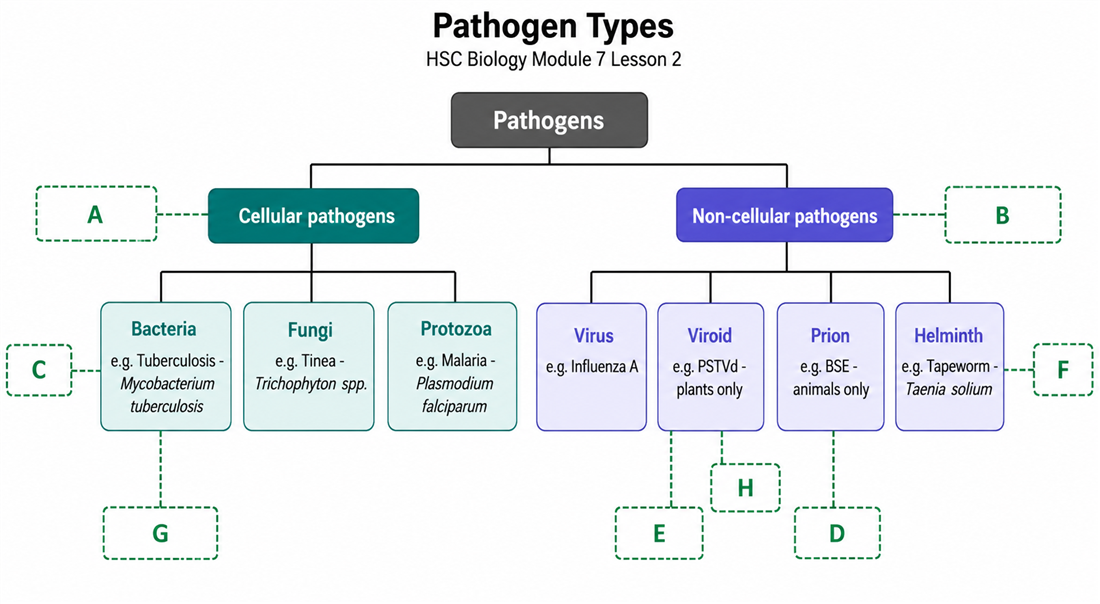
- A — branch name (left side: ___ pathogens) _______________________
- B — branch name (right side: ___ pathogens) _______________________
- C — type that has peptidoglycan cell wall _______________________
- D — type that is a misfolded protein only (no nucleic acid) _______________________
- E — type that is single-stranded circular RNA; plants only _______________________
- F — type that is a multicellular animal parasite _______________________
- G — correct treatment class for bacteria (e.g. penicillin) _______________________
- H — host range of viroids (animals / plants / both?) _______________________
| Box | Your label |
|---|---|
| A | |
| B | |
| C | |
| D | |
| E | |
| F | |
| G | |
| H |
2. Term–definition match
The twelve definitions below are shuffled. In the right-hand column write the matching term from this list: bacteria, virus, fungus, protozoan, helminth, viroid, prion, capsid, peptidoglycan, chitin, fimbriae, anthelmintic. 12 marks
| # | Definition (shuffled) | Matching term |
|---|---|---|
| 2.1 | A protein coat that encloses the nucleic acid genome of a virus. | |
| 2.2 | A single-celled prokaryotic pathogen that reproduces by binary fission; has no membrane-bound nucleus. | |
| 2.3 | An infectious protein particle with no nucleic acid; causes neurodegenerative disease by inducing normal proteins to misfold. | |
| 2.4 | A eukaryotic, unicellular heterotrophic pathogen often with a complex multi-host life cycle (e.g. Plasmodium). | |
| 2.5 | A non-cellular pathogen consisting only of single-stranded circular RNA; infects plants only. | |
| 2.6 | A multicellular animal parasite (worm); a macroorganism visible to the naked eye. | |
| 2.7 | A eukaryotic pathogen with a cell wall of chitin; spreads via spores; includes tinea and wheat stem rust. | |
| 2.8 | A non-cellular pathogen containing a DNA or RNA genome inside a protein coat; replicates only inside a host cell. | |
| 2.9 | The drug class used to treat parasitic worm infections (e.g. mebendazole, albendazole). | |
| 2.10 | The structural polysaccharide that forms the cell wall of fungi. | |
| 2.11 | Hair-like projections on bacterial surfaces that attach to host cell receptors, enabling colonisation. | |
| 2.12 | The polymer that cross-links to form the cell wall of bacteria; the target of penicillin. |
3. True or false — with correction
For each statement, circle T or F. If false, write the corrected version on the line below. 10 marks (1 T/F, 1 correction where needed)
3.1 Viruses, viroids and prions are all non-cellular pathogens. T / F
3.2 Prions are small pieces of RNA that cause neurodegenerative diseases such as BSE and CJD. T / F
3.3 Viroids infect plants only; prions infect animals only. T / F
3.4 Fungi are prokaryotic organisms whose cell walls contain peptidoglycan. T / F
3.5 Antibiotics cannot treat viral infections because viruses have no cell wall and no ribosomes to target. T / F
4. Function recall
Answer each in 1–2 sentences using precise terms from the lesson. 10 marks (2 each)
4.1 What is the function of fimbriae in a bacterial pathogen?
4.2 What is the function of the capsule surrounding some bacterial cells?
4.3 What is the function of keratinases produced by dermatophytic fungi such as Trichophyton?
4.4 What is the function of haemagglutinin on the surface of influenza A virus?
4.5 What is the function of hooks and suckers in a tapeworm such as Taenia solium?
5. Fill in the blanks
Use the word bank to complete the passage. Each word is used once. 8 marks
Word bank: peptidoglycan • antifungals • capsid • eukaryotic • prion • viroid • anthelmintics • binary fission
Bacteria are prokaryotic cells that reproduce by (5.1) _______________ and have a cell wall made of (5.2) _______________. Fungi are (5.3) _______________ organisms treated with (5.4) _______________ such as fluconazole. A virus carries its genome inside a protein coat called a (5.5) _______________. A (5.6) _______________ is a non-cellular pathogen consisting of single-stranded circular RNA with no protein coat, found only in plants. A (5.7) _______________ is a misfolded protein that cannot be inactivated by standard heat sterilisation. Helminth infections are treated with (5.8) _______________ such as mebendazole, which disrupt tubulin polymerisation in the worm.
Q1 — Labelled diagram
A: cellular. B: non-cellular. C: bacteria. D: prion. E: viroid. F: helminth. G: antibiotics. H: plants only.
Q2 — Term–definition matches
2.1 capsid • 2.2 bacteria • 2.3 prion • 2.4 protozoan • 2.5 viroid • 2.6 helminth • 2.7 fungus • 2.8 virus • 2.9 anthelmintic • 2.10 chitin • 2.11 fimbriae • 2.12 peptidoglycan.
Q3 — True / false with correction
3.1 True. All three are non-cellular (they have no cell membrane, cytoplasm or ribosomes).
3.2 False. Correction: prions are misfolded proteins; they contain no nucleic acid (no RNA or DNA). It is viroids that are RNA-based. Prions cause BSE and CJD by inducing normal host proteins to adopt the misfolded conformation.
3.3 True. Viroids are plant-only pathogens; prions cause disease in animals only (no known plant infection by prions).
3.4 False. Correction: fungi are eukaryotic (not prokaryotic), and their cell walls contain chitin (not peptidoglycan). Peptidoglycan is the bacterial cell wall polymer.
3.5 True. Antibiotics target bacterial-specific structures — primarily peptidoglycan cell wall synthesis or bacterial 70S ribosomes — neither of which viruses possess.
Q4.1 — Fimbriae
Fimbriae are hair-like protein projections that bind to specific receptor molecules on the surface of host epithelial cells. By anchoring the bacterium to the host cell surface, fimbriae prevent it from being washed away by fluid flow or mucus, allowing colonisation before invasion.
Q4.2 — Bacterial capsule
The polysaccharide capsule surrounds the bacterial cell and resists phagocytosis by the host's immune cells (macrophages and neutrophils). By preventing engulfment and destruction, the capsule allows the bacterium to survive in host tissues and continue replicating.
Q4.3 — Keratinases
Keratinases are enzymes secreted by dermatophytic fungi (such as Trichophyton, the cause of tinea) that break down keratin, the structural protein in skin, nails and hair. This enzymatic digestion allows the fungus to penetrate the host's surface barriers and access nutrients in the keratinised tissue.
Q4.4 — Haemagglutinin
Haemagglutinin is a surface glycoprotein on influenza A virus that binds specifically to sialic acid receptors on the surface of respiratory epithelial cells. This receptor–ligand interaction is the first step in viral attachment; once bound, the host cell internalises the virus by endocytosis, enabling the viral genome to enter and initiate replication.
Q4.5 — Hooks and suckers in tapeworm
The hooks and suckers on the scolex (head) of Taenia solium anchor the tapeworm to the wall of the host's small intestine. This mechanical attachment prevents the worm from being expelled by peristalsis, allowing it to remain in position and absorb digested nutrients directly through its body wall.
Q5 — Cloze paragraph
5.1 binary fission • 5.2 peptidoglycan • 5.3 eukaryotic • 5.4 antifungals • 5.5 capsid • 5.6 viroid • 5.7 prion • 5.8 anthelmintics.