Biology • Year 11 • Module 4 • Lesson 12
Abiotic and Biotic Factors Synthesis — Predicting Distribution
Recall and lock in the vocabulary and framework behind the multi-factor prediction model: Shelford’s Law, Liebig’s Law, biotic interactions, carrying capacity, and why K is not fixed.
1. Label the multi-factor prediction framework
The diagram below shows the three-step framework used to predict species distribution. Write the missing labels into boxes A–H. Each answer is drawn from the lesson’s key terms or the framework described in Card 1. 8 marks
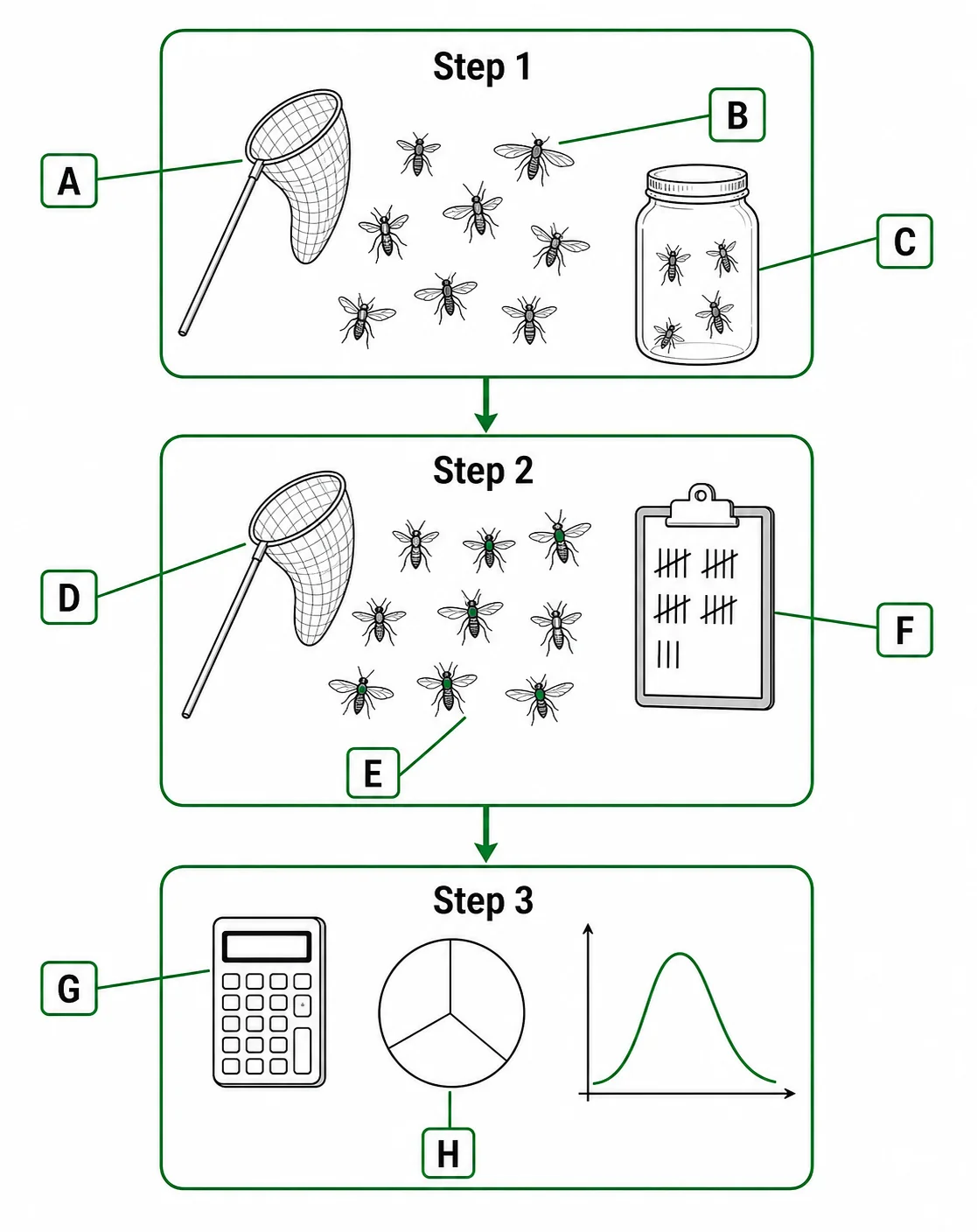
- A — name of Step 1 (identify physical and chemical limits) _______________________
- B — law applied in Step 1 _______________________
- C — name of Step 2 (map relationships between organisms) _______________________
- D — law applied in Step 2 _______________________
- E — one example of a relationship mapped in Step 2 _______________________
- F — name of Step 3 (how the population responds) _______________________
- G — type of growth that shows S-shaped curve in Step 3 _______________________
- H — symbol for the population size ceiling in Step 3 _______________________
| Box | Your label |
|---|---|
| A | |
| B | |
| C | |
| D | |
| E | |
| F | |
| G | |
| H |
2. Term–definition match
The ten definitions below are shuffled. In the right-hand column write the matching term from this list: Shelford’s Law of Tolerance, Liebig’s Law of the Minimum, carrying capacity (K), abiotic factor, biotic factor, competitive exclusion, resource partitioning, logistic growth, mutualism, parasitism. 10 marks
| # | Definition (shuffled) | Matching term |
|---|---|---|
| 2.1 | Organisms survive only within a certain range of a physical factor; below the minimum or above the maximum they die. | |
| 2.2 | The growth of a population that slows as it approaches the maximum size the environment can support. | |
| 2.3 | A non-living component of the environment such as temperature, rainfall, or soil pH that influences organisms. | |
| 2.4 | The principle that population growth is controlled by the single scarcest resource, not by the average of all resources. | |
| 2.5 | The maximum population size that can be sustained by the available resources in a habitat at a given time. | |
| 2.6 | A symbiotic relationship in which one organism benefits at the expense of the other (the host). | |
| 2.7 | A living component of the environment such as competition, predation, or disease that influences organisms. | |
| 2.8 | Gause’s principle: two species occupying identical niches cannot coexist indefinitely; the inferior competitor will be locally excluded. | |
| 2.9 | A symbiotic relationship in which both species benefit from a close, long-term interaction. | |
| 2.10 | The evolutionary or behavioural differentiation of niches that reduces direct competition between species by using different resources. |
3. True or false — with correction
For each statement, circle T or F. If the statement is false, write the corrected version on the line below it. 10 marks (1 for T/F, 1 for correction where needed)
3.1 Carrying capacity (K) is a permanent, fixed number for any given ecosystem. T / F
3.2 Shelford’s Law of Tolerance describes how population growth slows near a resource limit imposed by a single scarce factor. T / F
3.3 A species within its abiotic tolerance range may still be excluded from a habitat by a superior competitor. T / F
3.4 Competitive exclusion (Gause’s principle) always leads to the global extinction of the inferior competitor. T / F
3.5 Parasitism is purely destructive at the population level because host populations would always be better off without parasites. T / F
4. Fill in the blanks — the multi-factor prediction sentence
Complete the paragraph using the word bank below. Each word is used once. 8 marks
Word bank: abiotic, biotic, carrying capacity, conditional, Liebig’s Law, logistic, resource partitioning, Shelford’s Law
To predict where a species will be found, start with (1) _______________________ thresholds using (2) _______________________ of Tolerance: if temperature, salinity or pH shifts outside the optimal range, the species cannot survive there. Next, map the (3) _______________________ interactions. Apply (4) _______________________ of the Minimum: the scarcest resource or strongest interaction limits the population. Even within tolerance limits, a superior competitor can prevent establishment. Then model population dynamics: populations typically follow (5) _______________________ growth, levelling off at the (6) _______________________ (K). Note that K is not fixed — it changes with resource availability and disturbance. Where two species would otherwise be excluded from coexisting, (7) _______________________ can allow both to persist. A Band 6 prediction is always (8) _______________________ (“if X, then Y”), not absolute.
5. Build a concept map
Draw labelled arrows between the six terms below to show how they connect. Each arrow must carry a linking phrase (e.g. “is limited by”, “determines”, “fluctuates with”). Aim for at least 6 labelled arrows. 6 marks
Supplied terms: abiotic factors · biotic interactions · carrying capacity (K) · species distribution · resource partitioning · logistic growth.
Q1 — Framework diagram labels
A: Abiotic thresholds (Step 1 name). B: Shelford’s Law of Tolerance. C: Biotic interactions (Step 2 name). D: Liebig’s Law of the Minimum. E: Any one of: competition, predation, mutualism, parasitism (accept any correct biotic interaction). F: Population dynamics (Step 3 name). G: Logistic growth. H: K (carrying capacity).
Marking criteria: 1 mark per correct label. Accept reasonable synonyms (e.g. “physical limits” for A, “Shelford’s tolerance law” for B).
Q2 — Term–definition matches
2.1 Shelford’s Law of Tolerance • 2.2 logistic growth • 2.3 abiotic factor • 2.4 Liebig’s Law of the Minimum • 2.5 carrying capacity (K) • 2.6 parasitism • 2.7 biotic factor • 2.8 competitive exclusion • 2.9 mutualism • 2.10 resource partitioning.
Q3 — True / false with correction
3.1 False. Correction: Carrying capacity (K) is NOT fixed; it fluctuates with resource availability, predation pressure, competition, climate and disturbance. During the Millennium Drought, kangaroo K in the Murray-Darling Basin dropped over 60%.
3.2 False. Correction: Shelford’s Law of Tolerance describes how organisms survive only within a range of a physical/chemical factor — outside the range they die. It is Liebig’s Law of the Minimum that identifies population growth as limited by the scarcest resource.
3.3 True.
3.4 False. Correction: Competitive exclusion leads to local exclusion, not necessarily global extinction. The inferior competitor may persist in microhabitats where the superior competitor is absent, or avoid exclusion through resource partitioning (e.g. red and eastern grey kangaroos coexist via habitat partitioning).
3.5 False. Correction: While parasitism harms individual hosts, at the population level parasites can regulate host numbers below carrying capacity (preventing overexploitation) and coevolution can reduce virulence over time. The myxoma virus – rabbit case in Australia shows that both host and parasite evolve, reaching a dynamic equilibrium rather than simple destruction.
Q4 — Cloze paragraph
(1) abiotic • (2) Shelford’s Law • (3) biotic • (4) Liebig’s Law • (5) logistic • (6) carrying capacity • (7) resource partitioning • (8) conditional.
Q5 — Sample concept map
A correct map should include arrows such as:
- abiotic factors — set tolerance limits for → species distribution
- biotic interactions — further restrict or enable → species distribution
- abiotic factors — fluctuate with, altering → carrying capacity (K)
- biotic interactions — influence → carrying capacity (K)
- logistic growth — levels off at → carrying capacity (K)
- resource partitioning — reduces intensity of → biotic interactions
Any biologically valid linking phrase accepted. Award 1 mark per correctly labelled, directionally accurate arrow (max 6).