Biology • Year 11 • Module 4 • Lesson 9
Symbiotic Relationships
Apply mutualism, commensalism and parasitism to real Australian data, graphical comparisons and scenario-based reasoning tasks.
1. Interpret post-fire seedling growth data
A research team measured eucalypt seedling growth after a controlled bushfire in a phosphorus-poor sandplain soil. Half the seedlings were grown in sterilised soil (mycorrhizal fungi removed). The other half were grown in unsterilised soil (fungi intact). Seedling height was measured at monthly intervals. 7 marks
| Month after germination | Height — no fungi (mm) | Height — fungi present (mm) | Growth difference (mm) |
|---|---|---|---|
| 1 | 12 | 14 | |
| 2 | 18 | 28 | |
| 3 | 20 | 48 | |
| 4 | 21 | 74 | |
| 5 | 23 | 102 | |
| 6 | 24 | 130 |
1.1 Complete the “Growth difference” column in the table (fungi present − no fungi). 1 mark
1.2 Describe the trend in the growth difference between the two groups across the six months. 2 marks
1.3 Using lesson content, explain why the fungi-present seedlings show such a large growth advantage in phosphorus-poor post-fire soil. 3 marks
1.4 Identify which type of symbiotic relationship this data illustrates, and justify your answer. 1 mark
2. Interpret a graph — cost–benefit of parasitic load on host fitness
The graph below shows a model of how increasing parasite burden (number of parasites per host individual) affects host survival rate and parasite transmission rate. 6 marks
Stylised model — illustrative of the parasite evolution principles in Card 3.
2.1 At what level of parasite burden does transmission rate reach its peak? What is happening to host survival at this point? 2 marks
2.2 At high parasite burden, both curves converge toward zero. Explain why parasite transmission declines when host survival is very low. 2 marks
2.3 Use this graph to explain the lesson statement: “Successful parasites typically do not kill their hosts immediately.” 2 marks
3. Diagram critique — what’s wrong with this classification?
A Year 11 student has drawn a table to classify five Australian examples into symbiotic relationship types. There are three biological errors in the table. Identify each error and write the correction. 6 marks, 2 per error: 1 identify, 1 correct
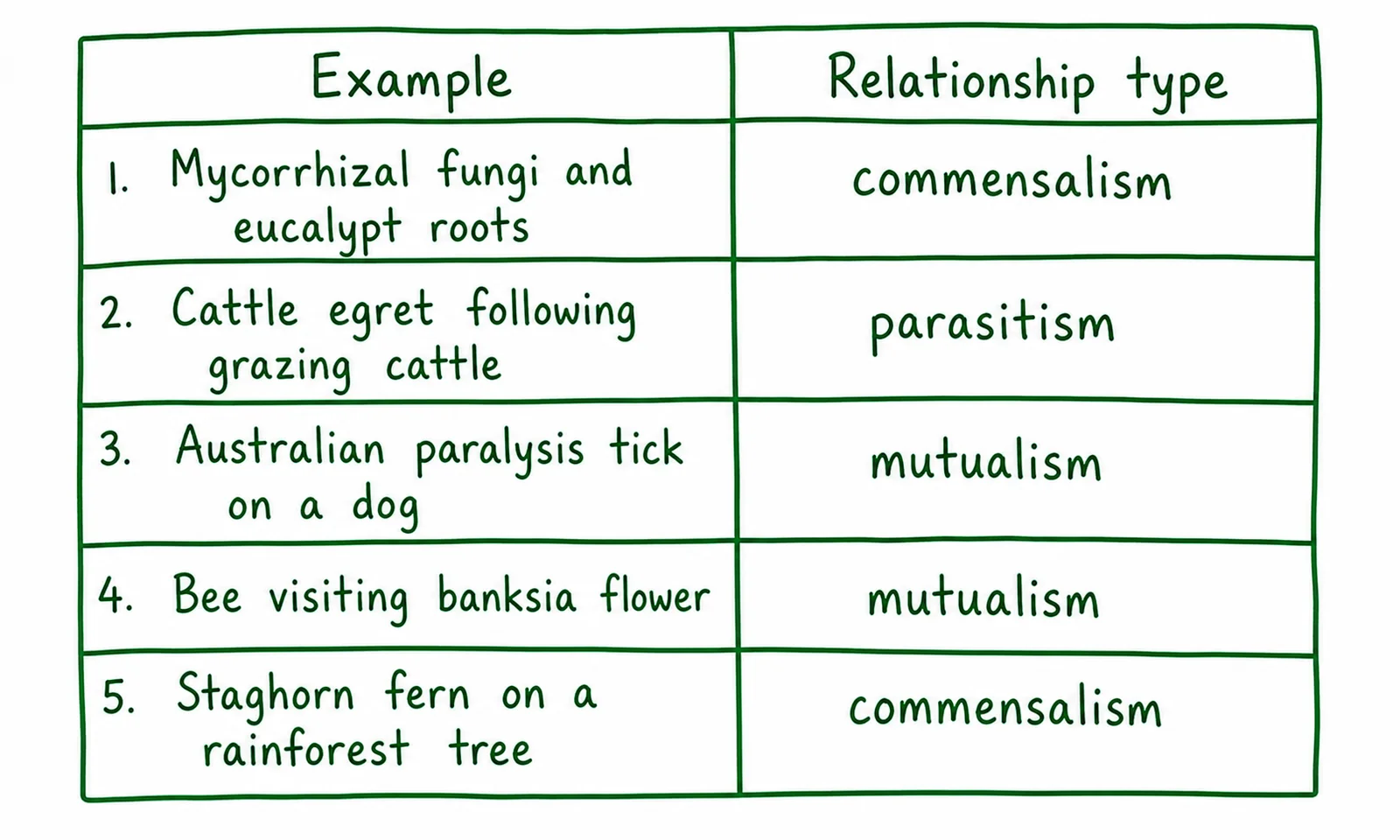
3.1 Error 1: What is wrong?
Correction:
3.2 Error 2: What is wrong?
Correction:
3.3 Error 3: What is wrong?
Correction:
4. Apply to a new scenario — post-fire wattle colonisation
After a bushfire in a mallee woodland, botanists observe that wattles (Acacia species, which host Rhizobium bacteria) colonise the burnt ground much faster than the eucalypts. By the end of the first year, wattles are up to twice as tall as eucalypt seedlings growing in the same patch. 5 marks
4.1 Identify the type of symbiotic relationship between wattle and Rhizobium. Justify your answer. 2 marks
4.2 Explain why this mutualism gives the wattle a competitive advantage over eucalypts in the nitrogen-depleted post-fire soil. 2 marks
4.3 Predict whether the wattle’s competitive advantage would be as large in a nitrogen-rich garden bed. Give a reason. 1 mark
Q1.1 — Growth difference column (1 mark)
Month 1: 2 mm • Month 2: 10 mm • Month 3: 28 mm • Month 4: 53 mm • Month 5: 79 mm • Month 6: 106 mm. Award 1 mark for all six values correct (accept ±1 mm for rounding).
Q1.2 — Trend in growth difference (2 marks)
The growth difference between fungi-present and no-fungi seedlings increases steadily each month [1 mark]. By month 6 the gap has widened to 106 mm, indicating that the mycorrhizal benefit accumulates and compounds over time rather than being a fixed advantage [1 mark].
Q1.3 — Why fungi benefit seedlings in post-fire soil (3 marks)
Post-fire soils in Australia are already phosphorus-poor, and combustion further depletes surface nutrients [1 mark]. Mycorrhizal fungal hyphae extend 10–100 times further than roots alone into the soil, absorbing phosphorus and other minerals that the seedling cannot access independently [1 mark]. This extra mineral supply directly fuels photosynthesis and cell growth, producing the compounding height advantage visible in the data [1 mark].
Q1.4 — Relationship type (1 mark)
Mutualism (+/+). Both partners benefit: the eucalypt gains minerals and water; the fungus gains sugars from the tree’s photosynthesis.
Q2.1 — Peak transmission and host survival (2 marks)
Parasite transmission peaks at moderate parasite burden [1 mark]. At this point, host survival is approximately 50% and still declining but has not collapsed — the host is alive and mobile enough to spread the parasite to new hosts [1 mark].
Q2.2 — Why transmission falls when host survival is very low (2 marks)
A dead or dying host cannot move to encounter new potential hosts, so the parasite loses its means of spreading [1 mark]. Once the host dies, the parasite loses its habitat and food source as well, so both curves approach zero together [1 mark].
Q2.3 — Parasites do not kill hosts immediately (2 marks)
The graph shows that transmission is highest while the host is still alive and mobile (moderate burden) [1 mark]. A parasite that kills its host immediately (extreme high burden) drives both survival and transmission to zero, eliminating its own reproductive success. Natural selection therefore favours parasites that keep hosts alive long enough to maximise spread [1 mark].
Q3 — Diagram critique (6 marks)
3.1 Error 1 (mycorrhizal fungi labelled “commensalism”): Mycorrhizal fungi and eucalypt roots is mutualism, not commensalism. Both partners benefit: the tree gains minerals; the fungus gains sugars. Commensalism requires one partner to be unaffected — the eucalypt is clearly benefited. [1 + 1]
3.2 Error 2 (cattle egret labelled “parasitism”): A cattle egret following grazing cattle is commensalism, not parasitism. The egret benefits (easier insect capture); the cattle are unaffected. Parasitism requires the host to be harmed. [1 + 1]
3.3 Error 3 (Australian paralysis tick labelled “mutualism”): A tick feeding on a dog is parasitism, not mutualism. The tick (ectoparasite) benefits (blood meal); the dog (host) is harmed (blood loss, toxin injection, potential disease). Mutualism requires both partners to benefit. [1 + 1]
Q4.1 — Relationship type + justification (2 marks)
Mutualism (+/+) [1 mark]. The wattle benefits by receiving fixed nitrogen (ammonia) from Rhizobium, enabling growth in nitrogen-poor soil; the bacteria benefit by receiving carbohydrates and a protected nodule environment from the wattle [1 mark].
Q4.2 — Competitive advantage in post-fire soil (2 marks)
Fire depletes soil nitrogen through combustion and volatilisation [1 mark]. Wattles can fix their own atmospheric nitrogen via Rhizobium nodules, so they are independent of soil nitrogen levels. Eucalypts must wait for nitrogen to rebuild through decomposition and other processes, giving wattles a massive head start in nitrogen-limited conditions [1 mark].
Q4.3 — Prediction in nitrogen-rich garden bed (1 mark)
The advantage would be smaller. In nitrogen-rich soil, all plants can obtain adequate nitrogen directly from the substrate, removing the Rhizobium mutualism’s key benefit. The wattle would lose its competitive edge over eucalypts for this particular resource. [1 mark]