Biology • Year 11 • Module 4 • Lesson 9
Symbiotic Relationships
Lock in the core vocabulary and classification of mutualism, commensalism and parasitism before you apply them to real Australian examples.
1. Label the symbiosis overview diagram
The diagram below shows three types of symbiotic relationship. Write the missing labels A–H into the answer table. Each answer is drawn from the lesson’s Key Terms panel or Cards 1–3. 8 marks
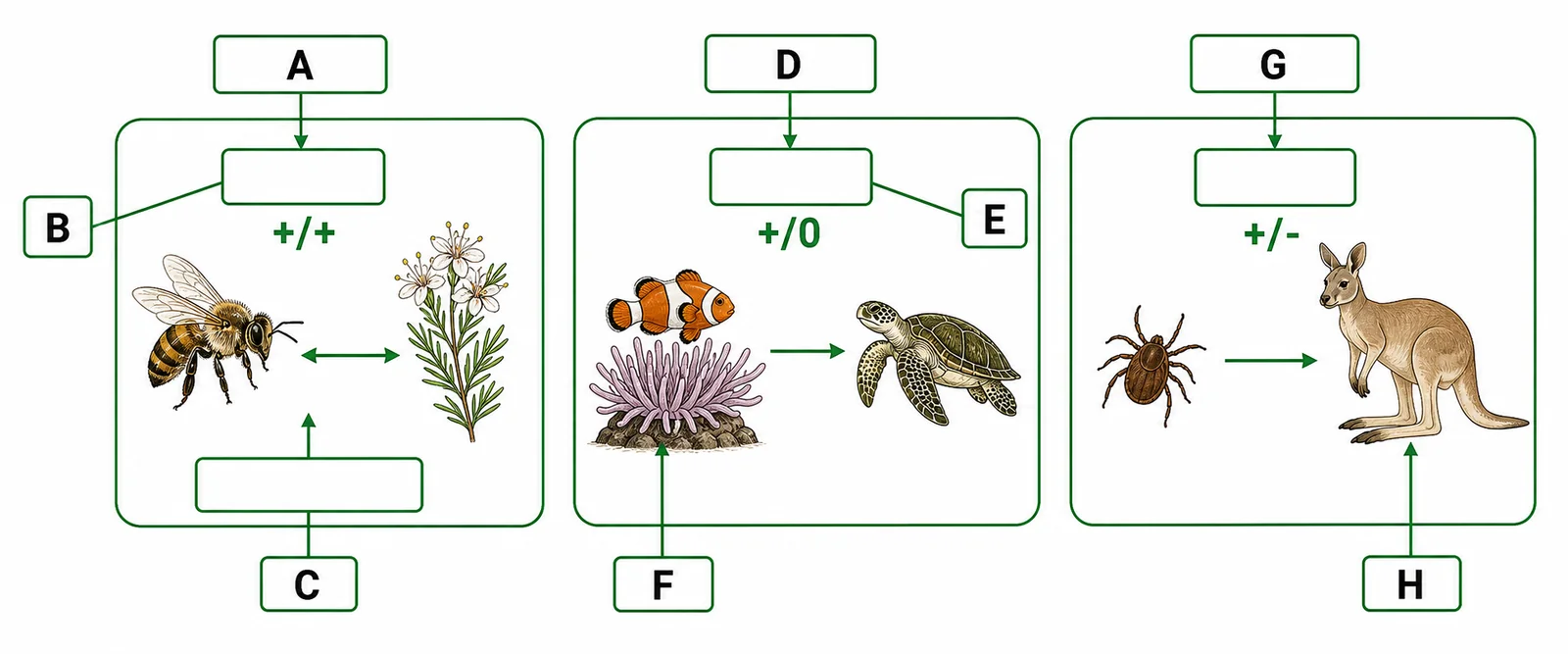
- A — name of the first relationship type _______________________
- B — sign notation for the first relationship (+/?) _______________________
- C — one named Australian example of this relationship _______________________
- D — name of the second relationship type _______________________
- E — sign notation for the second relationship (+/?) _______________________
- F — the term for the organism that benefits in the second relationship _______________________
- G — name of the third relationship type _______________________
- H — the term for the organism that is harmed in the third relationship _______________________
| Box | Your label |
|---|---|
| A | |
| B | |
| C | |
| D | |
| E | |
| F | |
| G | |
| H |
2. Term–definition match
The ten definitions below are shuffled. In the right-hand column write the matching term from this list: symbiosis, mutualism, commensalism, parasitism, host, parasite, ectoparasite, endoparasite, vector, mycorrhiza. 10 marks
| # | Definition (shuffled) | Matching term |
|---|---|---|
| 2.1 | Any close, long-term interaction between two different species living in direct association. | |
| 2.2 | A symbiotic relationship in which both species benefit. | |
| 2.3 | A symbiotic relationship in which one species benefits and the other is neither helped nor harmed. | |
| 2.4 | A symbiotic relationship in which one species benefits at the expense of another, which is harmed. | |
| 2.5 | The organism that harbours a parasite and is harmed by it. | |
| 2.6 | The organism that benefits at the expense of its host in a parasitic relationship. | |
| 2.7 | A parasite that lives on the surface of its host (e.g. a tick on a kangaroo). | |
| 2.8 | A parasite that lives inside the body of its host (e.g. a tapeworm in a dingo’s intestine). | |
| 2.9 | An organism that transmits a parasite from one host to another (e.g. a mosquito transmitting malaria). | |
| 2.10 | A mutualistic association between fungal hyphae and plant roots, critical in phosphorus-poor Australian soils. |
3. True or false — with correction
For each statement, circle T or F. If the statement is false, write the corrected version on the line below it. 8 marks (1 for T/F, 1 for correction where needed)
3.1 In a mutualistic relationship, one species benefits and the other is unaffected. T / F
3.2 A tapeworm living in a dingo’s intestine is an example of an endoparasite. T / F
3.3 Commensalism is the easiest type of symbiosis to demonstrate because the neutral partner is obviously unaffected. T / F
3.4 Successful parasites typically evolve to kill their host as quickly as possible to maximise nutrient extraction. T / F
4. Function recall
Answer each in 1–2 sentences using precise terms from the lesson. 10 marks (2 each)
4.1 What does a mycorrhizal fungus provide for a eucalypt tree?
4.2 What does the eucalypt tree provide in return for the fungus?
4.3 What is the function of Rhizobium bacteria inside a wattle root nodule?
4.4 Why is Australian soil especially dependent on mycorrhizal fungi compared to soils in other parts of the world?
4.5 What distinguishes a vector from a host in the context of parasitism?
5. Build a concept map
Draw labelled arrows between the five terms below to show how they connect. Each arrow must carry a linking phrase (e.g. “is a type of”, “harms”, “benefits both”). Aim for at least 5 labelled arrows. 5 marks
Supplied terms: symbiosis · mutualism · commensalism · parasitism · host.
Q1 — Labelled diagram (8 marks)
A: Mutualism. B: +/+ (both benefit). C: Any valid Australian example: mycorrhizal fungi and eucalypt roots; Rhizobium and wattle; honeyeaters and banksias; clownfish and sea anemone (Great Barrier Reef). D: Commensalism. E: +/0 (one benefits, one unaffected). F: The species that benefits (no standard single-word term; accept “the commensal” or the specific benefiting organism). G: Parasitism. H: Host.
Marking notes. 1 mark per correct label. For C, accept any valid named Australian example from the lesson.
Q2 — Term–definition matches (10 marks, 1 each)
2.1 symbiosis • 2.2 mutualism • 2.3 commensalism • 2.4 parasitism • 2.5 host • 2.6 parasite • 2.7 ectoparasite • 2.8 endoparasite • 2.9 vector • 2.10 mycorrhiza.
Q3 — True / false with correction (8 marks)
3.1 False. Correction: In mutualism, both species benefit (+/+). The relationship where one benefits and the other is unaffected is commensalism (+/0). [1 T/F + 1 correction]
3.2 True. A tapeworm lives inside the host’s body (intestine) = endoparasite. No correction needed. [2 marks]
3.3 False. Correction: Commensalism is the hardest type of symbiosis to demonstrate because it requires proving one organism is truly unaffected — not subtly helped or harmed. [1 T/F + 1 correction]
3.4 False. Correction: Successful parasites typically evolve to become less virulent over time. A parasite that kills its host too quickly destroys its own habitat and reduces transmission to new hosts. The most successful parasites keep hosts alive and mobile. [1 T/F + 1 correction]
Q4.1 — What the fungus provides (2 marks)
The mycorrhizal fungus extends hyphae far beyond the root zone, absorbing water and minerals (especially phosphorus) from the soil and transferring them to the tree [1 mark]. This increases the tree’s absorptive surface area by 10–100 times [1 mark].
Q4.2 — What the tree provides (2 marks)
The tree supplies sugars (products of photosynthesis) to the fungus [1 mark]. Up to 20% of the carbon fixed by a eucalypt may be transferred to its fungal partners [1 mark].
Q4.3 — Function of Rhizobium (2 marks)
Rhizobium bacteria fix atmospheric nitrogen (N₂), converting it into ammonium (NH₄&sup+;) [1 mark], which the host plant can absorb and use for growth [1 mark]. In return, the plant provides carbohydrates and a protected root-nodule environment for the bacteria.
Q4.4 — Why Australian soils need mycorrhizae (2 marks)
Australian soils are among the oldest and most heavily weathered on Earth [1 mark], meaning they are extremely low in phosphorus and other minerals. Without mycorrhizal fungi to extend the root’s absorptive reach, plants cannot access enough nutrients for growth [1 mark].
Q4.5 — Vector vs host (2 marks)
A host is the organism that harbours the parasite and is directly harmed by it [1 mark]. A vector is an organism that transmits the parasite from one host to another (e.g. a mosquito transmitting Plasmodium malaria between human hosts) without necessarily being harmed itself [1 mark].
Q5 — Sample concept map (5 marks)
A correct map should include arrows such as:
- symbiosis — includes → mutualism
- symbiosis — includes → commensalism
- symbiosis — includes → parasitism
- parasitism — harms → host
- commensalism — does not affect → host
Any biologically valid linking phrases are accepted. Award 1 mark per correctly labelled arrow that respects causal direction (max 5).