Biology • Year 11 • Module 4 • Lesson 1
Introduction to Ecosystems
Lock in the key vocabulary, the levels of biological organisation, and the distinction between biotic and abiotic components before moving to applied questions.
1. Label the levels-of-biological-organisation diagram
The diagram below shows five nested levels of ecological organisation, from the smallest to the largest. Write the correct level name and a brief definition into boxes A–E. Each name comes from the lesson's Key Terms or Card 2 table. 10 marks (1 name + 1 definition per level)
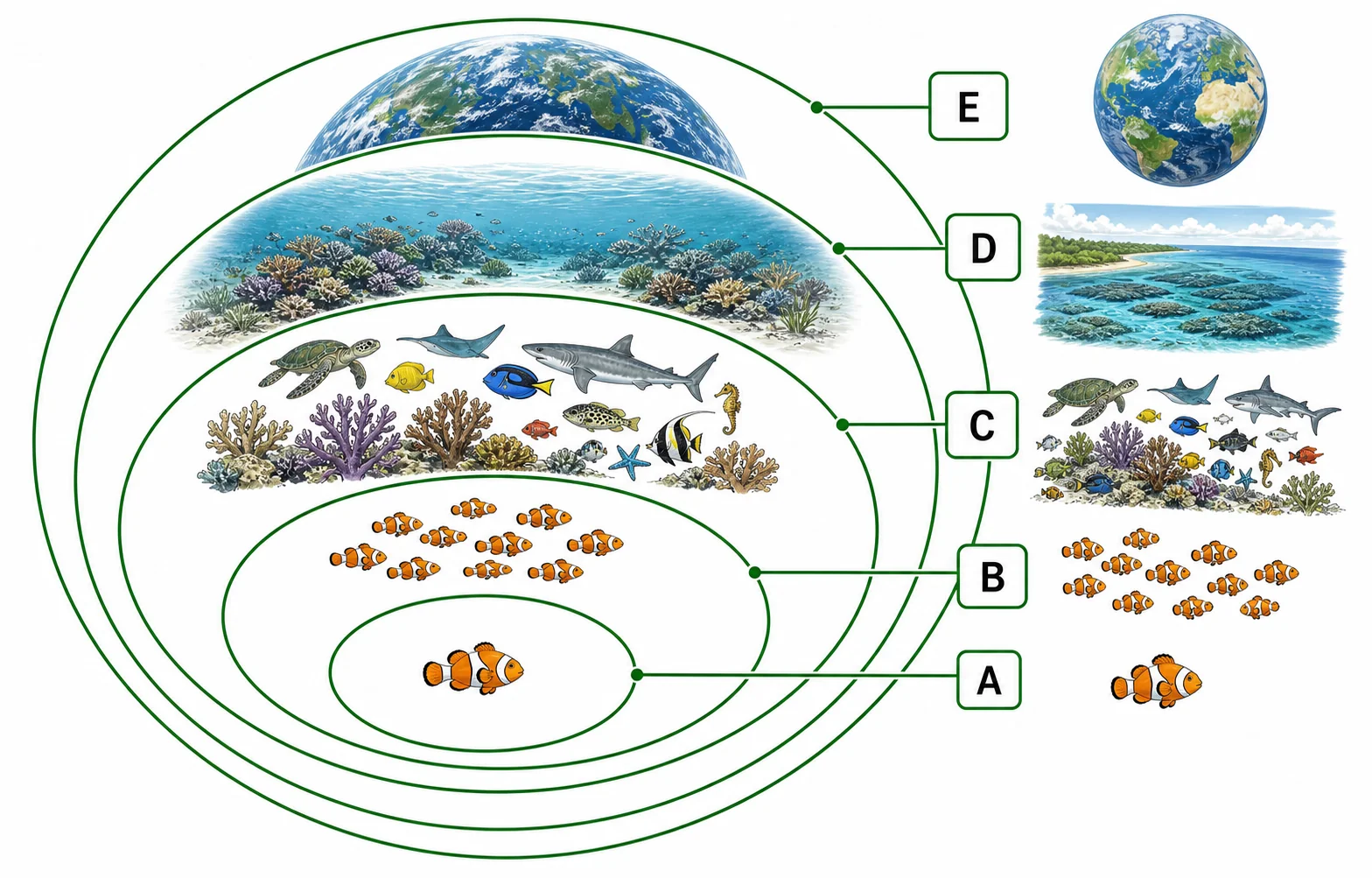
- A — Level name: _______________________ Definition: _______________________
- B — Level name: _______________________ Definition: _______________________
- C — Level name: _______________________ Definition: _______________________
- D — Level name: _______________________ Definition: _______________________
- E — Level name: _______________________ Definition: _______________________
| Box | Level name | One-sentence definition |
|---|---|---|
| A | ||
| B | ||
| C | ||
| D | ||
| E |
2. Term–definition match
The ten definitions below are shuffled. In the right-hand column, write the matching term from this list: ecosystem, biotic factor, abiotic factor, producer, consumer, decomposer, detritivore, photoautotroph, biosphere, community. 10 marks
| # | Definition (shuffled) | Matching term |
|---|---|---|
| 2.1 | The global sum of all ecosystems — the zone of all life on Earth. | |
| 2.2 | A living or once-living component of an ecosystem (e.g. plants, animals, bacteria). | |
| 2.3 | An organism that synthesises organic compounds from inorganic sources using light energy via photosynthesis. | |
| 2.4 | A non-living physical or chemical component of an ecosystem (e.g. sunlight, temperature, pH). | |
| 2.5 | An organism that breaks down dead organic matter by secreting digestive enzymes externally and absorbing the resulting nutrients. | |
| 2.6 | All populations of different species living and interacting in a defined area (no abiotic factors included). | |
| 2.7 | A community of organisms interacting with each other and with their non-living environment. | |
| 2.8 | An organism that obtains energy by eating other organisms rather than synthesising its own food. | |
| 2.9 | An organism that ingests dead organic matter whole, physically fragmenting it to increase surface area for microbial breakdown. | |
| 2.10 | An organism that uses light energy to fix carbon dioxide into organic compounds via photosynthesis. |
3. True or false — with correction
For each statement, circle T or F. If the statement is false, write the corrected version on the line provided. 10 marks (1 for T/F, 1 for correction where needed)
3.1 An ecosystem consists only of the living organisms in a given area. T / F
3.2 Energy is recycled through ecosystems in the same way that carbon and nitrogen are cycled. T / F
3.3 A population is all the individuals of the same species in a defined area. T / F
3.4 Decomposers and detritivores are interchangeable terms referring to the same organism type. T / F
3.5 Nearly all ecosystems on Earth are ultimately powered by sunlight captured by photoautotrophs. T / F
4. Function recall
Answer each question in 1–2 sentences using precise terms from the lesson. 8 marks (2 each)
4.1 What is the role of producers in making an ecosystem function?
4.2 What is the role of decomposers in the cycling of matter?
4.3 Why must an ecosystem receive a continuous input of energy but does not require a continuous input of matter?
4.4 What is the defining feature that separates an ecosystem from a community?
5. Build a concept map
Draw labelled arrows between the six terms below to show how they connect. Each arrow must carry a linking phrase (e.g. “feeds on”, “releases nutrients to”, “captures energy from”). Aim for at least 6 labelled arrows. 6 marks
Supplied terms: sunlight · producers · consumers · decomposers · abiotic environment · heat.
Q1 — Levels of biological organisation
A: Individual — A single living organism (e.g. one staghorn coral colony).
B: Population — All individuals of the same species in a defined area (e.g. all staghorn coral colonies on a reef flat).
C: Community — All populations of different species in a defined area (e.g. corals, fish, turtles, algae and microbes on a reef flat). Note: no abiotic factors.
D: Ecosystem — The community plus its abiotic environment (e.g. reef flat community + sunlight, water temperature, salinity, dissolved gases).
E: Biosphere — All ecosystems on Earth combined — the global zone of life.
Q2 — Term–definition matches
2.1 biosphere · 2.2 biotic factor · 2.3 photoautotroph · 2.4 abiotic factor · 2.5 decomposer · 2.6 community · 2.7 ecosystem · 2.8 consumer · 2.9 detritivore · 2.10 photoautotroph.
Note: 2.3 and 2.10 are both correct for photoautotroph; accept either ordering.
Q3 — True / False with corrections
3.1 False. Correction: An ecosystem consists of all the organisms in a given area (biotic component) and their non-living environment (abiotic component). Listing only living organisms defines a community, not an ecosystem.
3.2 False. Correction: Energy is not recycled through ecosystems — it flows in one direction (sun → producers → consumers) and is lost as heat at each trophic transfer via cellular respiration. Only matter (carbon, nitrogen, etc.) is cycled between biotic and abiotic components.
3.3 True.
3.4 False. Correction: Decomposers (bacteria and fungi) secrete digestive enzymes externally and absorb nutrients — this is extracellular digestion. Detritivores (e.g. earthworms, woodlice) ingest dead organic matter whole and fragment it internally — this is intracellular digestion. They are different organism types with different feeding mechanisms, though both contribute to nutrient recycling.
3.5 True.
Q4.1 — Role of producers
Producers (autotrophs) synthesise organic compounds from inorganic sources using an external energy input (sunlight for photoautotrophs, or chemical energy for chemoautotrophs). They are the entry point for energy into almost all ecosystems and the foundation of every food chain — without producers there is no energy base to support consumers or decomposers.
Q4.2 — Role of decomposers in matter cycling
Decomposers (bacteria and fungi) break down dead organic matter by secreting extracellular enzymes and absorbing the resulting small molecules. This releases mineral nutrients — such as nitrates, phosphates and carbon dioxide — back into the soil or water, where they can be absorbed again by producers. Without decomposers, nutrients would remain locked in dead biomass and the cycle would stop.
Q4.3 — Continuous energy input but not continuous matter input
Energy flows through an ecosystem in one direction and is lost as heat at every trophic transfer via cellular respiration; it cannot be recovered or reused, so a continuous supply from sunlight is required to maintain the ecosystem. Matter (carbon, nitrogen, phosphorus), by contrast, is not destroyed — the same atoms are rearranged and cycled repeatedly between biotic organisms and the abiotic environment via processes such as photosynthesis, respiration and decomposition. No new matter needs to enter the ecosystem.
Q4.4 — Ecosystem vs community
A community is all the populations of different species in a defined area — it includes only biotic (living) components. An ecosystem is the community plus its abiotic environment (non-living factors such as sunlight, temperature, water, pH and minerals). The inclusion of the abiotic component is the defining feature that separates an ecosystem from a community.
Q5 — Sample concept map
A correct map should include arrows such as:
- sunlight — is captured by → producers
- producers — are eaten by → consumers
- consumers — are broken down by → decomposers
- decomposers — release minerals to → abiotic environment
- abiotic environment — supplies nutrients to → producers
- producers / consumers / decomposers — lose energy as → heat (via cellular respiration)
Any biologically valid linking phrases are accepted. Award 1 mark per correctly labelled, directionally accurate arrow (max 6).