Biology • Year 11 • Module 2 • Lesson 13
Transport Systems in Animals: Overview and Blood
Apply open vs closed system principles to real data, trace blood composition changes around the circuit, and critique a student diagram.
1. Interpret data, blood composition at key vessels
The table below shows approximate relative concentrations of four substances in blood collected from four named vessels in a resting adult. Concentrations are rated on a scale of 1 (very low) to 5 (very high). 8 marks
| Vessel | O₂ | CO₂ | Glucose | Urea |
|---|---|---|---|---|
| Pulmonary vein (lungs → left atrium) | 5 | 1 | 3 | 2 |
| Aorta (left ventricle → body) | 5 | 1 | 3 | 2 |
| Hepatic portal vein (intestine → liver, post-meal) | 3 | 2 | 5 | 2 |
| Renal artery (heart → kidneys) | 4 | 2 | 3 | 4 |
1.1 Explain why O₂ is rated 5 in the pulmonary vein but drops to 3 in the hepatic portal vein. 2 marks
1.2 The hepatic portal vein shows a glucose rating of 5. Explain the biological process responsible for this, and predict what the glucose rating would be in the hepatic vein leaving the liver. 3 marks
1.3 Urea is rated 4 in the renal artery. Predict its rating in the renal vein and give a reason. 2 marks
1.4 Using the data in the table, identify one piece of evidence that the aorta carries oxygenated blood, and state what type of vessel the aorta is (artery or vein). Explain why this is not a contradiction. 1 mark
2. Interpret graph, diffusion time and the need for transport systems
The figure below shows how diffusion time scales with distance for oxygen. 6 marks
Stylised model of oxygen diffusion time vs distance, adapted from Fick's second law. d² ∝ time relationship.
2.1 Using the graph, estimate the diffusion time for oxygen to travel 1 mm. At what approximate distance does diffusion become biologically impractical for sustaining living cells? 2 marks
2.2 The graph shows a non-linear (exponential-like) relationship between distance and time. Explain what this means for an organism that grows from 1 mm to 10 mm in body diameter, in terms of its ability to supply interior cells by diffusion alone. 2 marks
2.3 Use the graph to justify why insects, despite having an open circulatory system, are still able to supply their tissues with oxygen efficiently. 2 marks
3. Diagram critique, what's wrong with this student's diagram?
A Year 11 student drew the diagram below to compare open and closed circulatory systems. There are three biological errors in the diagram. Identify each error and write the correction. 6 marks: 2 per error, 1 to identify, 1 to correct)
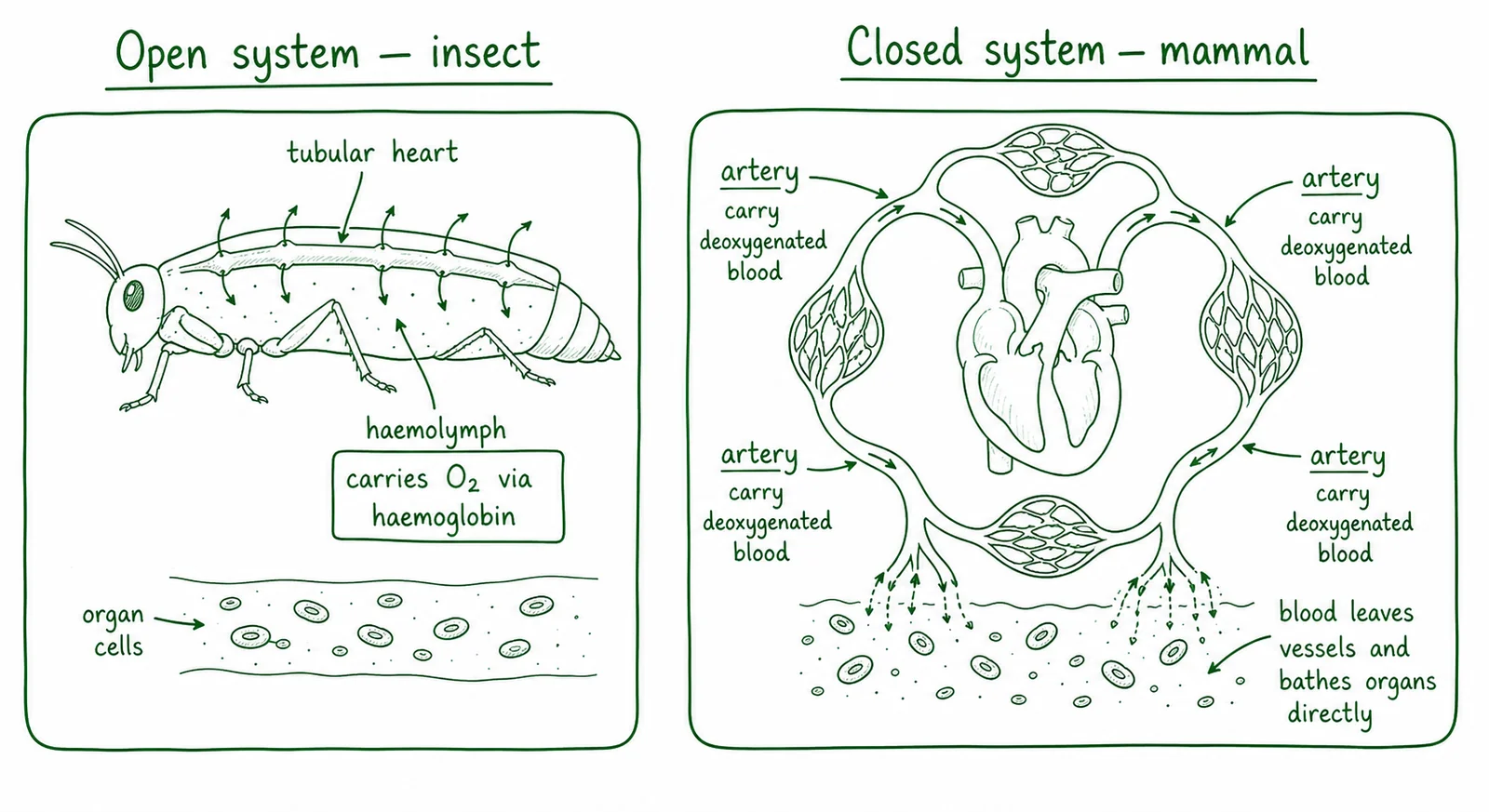
3.1 Error 1: What is wrong?
Correction:
3.2 Error 2: What is wrong?
Correction:
3.3 Error 3: What is wrong?
Correction:
4. Apply to a new scenario, the octopus paradox
Octopuses are molluscs, a phylum in which most species (snails, clams, mussels) have an open circulatory system. However, octopuses have a closed circulatory system with three hearts. Octopuses are highly active, jet-propelling predators that hunt actively at night and can respond to threats in milliseconds. 5 marks
4.1 Explain why the open circulatory system of most molluscs would be inadequate for an octopus's lifestyle, referring to metabolic demand and blood pressure. 2 marks
4.2 The octopus is an example of convergent evolution with vertebrates. Using this lesson's content, define convergent evolution in terms of transport systems and explain what this tells us about the closed system's advantage. 2 marks
4.3 A snail (also a mollusc) has an open circulatory system. Suggest one reason why a snail's open system is adequate for its lifestyle despite the octopus needing a closed system. 1 mark
Q1.1, O₂ drop from pulmonary vein to hepatic portal vein (2 marks)
The pulmonary vein carries blood that has just been reoxygenated at the alveoli, so haemoglobin is fully saturated (rating 5) [1]. By the time blood passes through the intestinal capillary beds (hepatic portal vein), intestinal cells have been actively absorbing nutrients and performing cellular respiration, consuming O₂ and releasing CO₂, so O₂ concentration falls to 3 [1].
Marking criteria: 1 mark for identifying reoxygenation at lungs for rating 5; 1 mark for O₂ consumption by intestinal cells during nutrient absorption/respiration for rating 3.
Q1.2, High glucose in hepatic portal vein; prediction for hepatic vein (3 marks)
Post-meal, the small intestine absorbs digested carbohydrates as glucose and other monosaccharides across the intestinal epithelium into the capillaries [1]. This nutrient-enriched blood drains directly into the hepatic portal vein, explaining the high glucose rating of 5 [1]. In the hepatic vein leaving the liver, the glucose rating would be lower (approximately 3), the liver removes excess glucose and stores it as glycogen (glycogenesis), regulating blood glucose back to the normal range [1].
Marking criteria: 1 mark for glucose absorption from intestinal digestion; 1 mark for hepatic portal vein receiving absorbed glucose directly; 1 mark for predicting lower glucose in hepatic vein with glycogen storage explanation.
Q1.3, Urea in renal vein (2 marks)
Urea rating in the renal vein would be 1–2 (low) [1]. The kidneys filter urea from the blood by ultrafiltration in the glomerulus and excrete it in urine; the processed blood leaving via the renal vein has had most of its urea removed [1].
Marking criteria: 1 mark for correct prediction (low/1–2); 1 mark for kidney filtration/excretion mechanism.
Q1.4, Aorta evidence and artery definition (1 mark)
Evidence: O₂ rating of 5 in the data table. The aorta is an artery. This is not a contradiction because arteries are defined by direction of flow, away from the heartnot by oxygen content. The aorta carries blood from the left ventricle to the body and happens to be oxygenated. [1 mark for any one correct point: identification as artery + direction rule]
Q2.1, Diffusion time at 1 mm; practical limit (2 marks)
From the graph, diffusion time at 1 mm is approximately 1 second [1]. Diffusion becomes biologically impractical beyond approximately 1 mm, at 10 mm it would take around 100 seconds, and at 1 metre it would take approximately 11 days, which is far too slow for cellular metabolism [1].
Marking criteria: 1 mark for ~1 s at 1 mm; 1 mark for identifying the practical limit at ~1 mm with supporting reasoning.
Q2.2, Non-linear growth: 1 mm to 10 mm body (2 marks)
Because diffusion time scales with distance squared (d² ∝ t), a 10-fold increase in body diameter causes a 100-fold increase in diffusion time [1]. Interior cells of a 10 mm organism would wait approximately 100 times longer for oxygen by diffusion than cells of a 1 mm organism, making diffusion wholly inadequate to sustain metabolic activity in interior cells [1].
Marking criteria: 1 mark for identifying the non-linear (d²) relationship; 1 mark for explaining the consequence for interior cells.
Q2.3, Insects can supply tissues via tracheal system (2 marks)
Insects do not rely on haemolymph to deliver O₂, instead, their tracheal system branches directly to within micrometres of each cell, meaning O₂ only needs to diffuse across the very short final distance (sub-millimetre) to the cell [1]. At this scale the graph shows diffusion is fast enough (milliseconds to seconds), making the open circulatory system's low pressure adequate for nutrient and waste transport while the tracheal system handles O₂ [1].
Marking criteria: 1 mark for tracheal system delivering O₂ independently; 1 mark for linking short diffusion distances to fast enough diffusion using the graph.
Q3, Diagram critique (6 marks)
3.1 Error 1, "haemolymph carries O₂ via haemoglobin": Insect haemolymph does not carry oxygen at all and does not contain haemoglobin. Correction: haemolymph transports nutrients and metabolic waste only; oxygen is delivered to cells via the tracheal system independently. [1 + 1]
3.2 Error 2, "all arteries carry deoxygenated blood": Arteries are defined by direction (blood flowing away from the heart), not O₂ content. Correction: arteries may carry oxygenated or deoxygenated blood, for example, the pulmonary artery carries deoxygenated blood while the aorta carries oxygenated blood. [1 + 1]
3.3 Error 3, "blood exits vessels to bathe tissues": In a closed system, blood never leaves the vessels. Correction: exchange of gases, nutrients, and waste between blood and tissue cells occurs only at thin-walled capillaries by diffusion across the capillary wall, blood remains enclosed at all times. [1 + 1]
Q4.1, Open system inadequate for octopus (2 marks)
Octopuses have very high metabolic demands, jet propulsion, rapid response, and active predation require fast, continuous O₂ delivery to muscles and nervous tissue [1]. An open system produces low blood pressure because fluid is not contained in vessels, so it cannot deliver O₂ and nutrients rapidly enough to sustain this activity; a closed system maintains high pressure, enabling fast, directed flow to every tissue [1].
Marking criteria: 1 mark for high metabolic demand requiring fast delivery; 1 mark for low pressure of open system being inadequate, links closed system to high pressure.
Q4.2, Convergent evolution and the closed system advantage (2 marks)
Convergent evolution is when unrelated lineages independently evolve the same structural solution in response to the same selective pressure [1]. The fact that both vertebrates and cephalopod molluscs (octopus) independently evolved closed circulatory systems, despite very different ancestry, is strong evidence that a closed system is the superior solution for animals with high metabolic demands and large body size; selection pressure drove both lineages to the same solution [1].
Marking criteria: 1 mark for defining convergent evolution (independent evolution of same feature in unrelated lineages); 1 mark for interpreting this as evidence that the closed system is advantageous for high-activity lifestyles.
Q4.3, Why snail's open system is adequate (1 mark)
Snails are sedentary animals with low metabolic rates, they move slowly, do not actively hunt, and require much lower rates of O₂ and nutrient delivery. Their open system's low pressure is sufficient to meet these modest demands. [1 mark for any valid lifestyle/metabolic rate comparison]