Biology • Year 11 • Module 2 • Lesson 13
Transport Systems in Animals: Overview and Blood
Lock in the core vocabulary, the open-vs-closed comparison, and the four blood components, the foundation of every harder question in this topic.
1. Label the blood components diagram
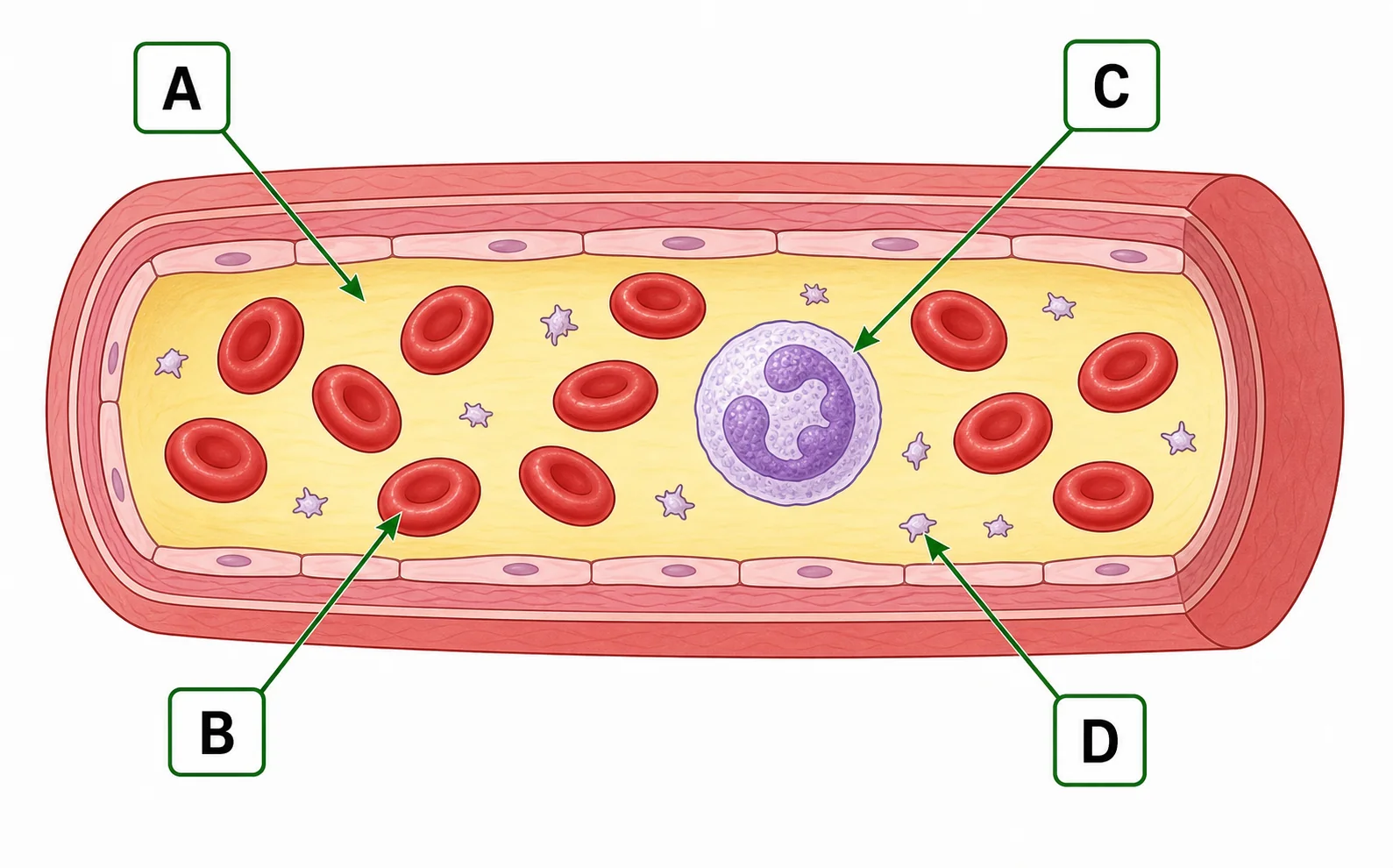
The diagram below shows the four components of blood in a vessel cross-section, with labels A–D pointing to each component. Write the correct component name and one function in the table below. 8 marks
| Label | Component name | One function / what it carries |
|---|---|---|
| A | ||
| B | ||
| C | ||
| D |
2. Term–definition match
Match each definition to the correct term from this list: transport medium, open circulatory system, closed circulatory system, haemolymph, plasma, red blood cell, white blood cell, platelet, capillary, haemocoel. 10 marks
| # | Definition (shuffled) | Matching term |
|---|---|---|
| 2.1 | The straw-coloured liquid matrix of blood (~55% of volume) that carries dissolved glucose, amino acids, hormones, urea, CO₂, and heat. | |
| 2.2 | A transport system in which fluid leaves the vessels and directly bathes the organs in a body cavity before draining back to the heart. | |
| 2.3 | The fluid that carries dissolved substances around an organism, for example, blood in vertebrates or haemolymph in insects. | |
| 2.4 | A biconcave, anucleate cell packed with haemoglobin that transports oxygen from the lungs to body tissues. | |
| 2.5 | The open body cavity in insects where haemolymph directly bathes the organs. | |
| 2.6 | A transport system in which blood remains enclosed within a continuous network of vessels at all times, maintaining higher pressure. | |
| 2.7 | A small cell fragment derived from bone marrow that releases clotting factors to form a fibrin mesh and seal wounds. | |
| 2.8 | The transport fluid in insects; circulates in an open system and does not carry oxygen in insects. | |
| 2.9 | The smallest blood vessel, one cell thick, where all exchange of gases, nutrients, and waste between blood and tissues occurs. | |
| 2.10 | A nucleated blood cell with immune functions including phagocytosis and, in B lymphocytes specifically, antibody production. |
3. True or false, with correction
For each statement, circle T or F. If the statement is false, write the corrected version on the line. 10 marks (1 mark T/F, 1 mark correction where needed)
3.1 In an open circulatory system, blood remains enclosed within a continuous network of vessels at all times. T / F
3.2 Insect haemolymph does not carry oxygen, oxygen is delivered directly to cells by the tracheal system. T / F
3.3 Red blood cells have a large prominent nucleus that allows them to divide and replace themselves continuously. T / F
3.4 All white blood cells produce antibodies as their immune function. T / F
3.5 The pulmonary artery carries deoxygenated blood from the right ventricle to the lungs. T / F
4. Function recall
Answer each in 1–2 sentences using precise terms from the lesson. 10 marks (2 each)
4.1 What is the function of the biconcave disc shape of red blood cells?
4.2 What is the function of platelets in blood?
4.3 What is the function of plasma as a transport medium?
4.4 Why do large multicellular organisms need a transport system instead of relying on diffusion alone?
4.5 What is the advantage of a closed circulatory system over an open one for a large, active animal?
5. Build a concept map
Draw labelled arrows between the six terms below to show how they connect. Each arrow must carry a linking phrase (e.g. "requires", "is pumped by", "remains enclosed in"). Aim for at least 6 labelled arrows. 6 marks
Supplied terms: heart · blood vessels · blood · capillaries · tissue cells · oxygen and nutrients.
Q1, Blood components diagram
A, Plasma: Straw-coloured liquid matrix (~55% of blood volume); carries dissolved glucose, amino acids, hormones, urea, CO₂, and heat.
B, Red blood cells (erythrocytes): Biconcave, anucleate cells; carry O₂ bound to haemoglobin and return CO₂ as bicarbonate in plasma.
C, White blood cell (leukocyte): Larger, nucleated cell; immune defence via phagocytosis (neutrophils) or antibody production (B lymphocytes only).
D, Platelets (thrombocytes): Small cell fragments; release clotting factors that trigger fibrin mesh formation (haemostasis).
Marking criteria (2 marks per row): 1 mark for correct component name; 1 mark for a correct and specific function/cargo.
Q2, Term–definition matches
2.1 plasma • 2.2 open circulatory system • 2.3 transport medium • 2.4 red blood cell • 2.5 haemocoel • 2.6 closed circulatory system • 2.7 platelet • 2.8 haemolymph • 2.9 capillary • 2.10 white blood cell.
Q3, True / false with correction
3.1 False. Correction: In an open circulatory system, fluid (haemolymph) leaves the vessels and bathes organs directly in the haemocoel. It is a closed circulatory system in which blood remains enclosed in vessels at all times.
3.2 True. Insect haemolymph carries nutrients and waste only; the tracheal system delivers O₂ directly to cells.
3.3 False. Correction: Mature red blood cells have no nucleus. They eject their nucleus during development, which is why they cannot divide and have a fixed lifespan of approximately 120 days.
3.4 False. Correction: Only B lymphocytes produce antibodies. Other white blood cells (e.g. neutrophils, monocytes, T lymphocytes) use different mechanisms such as phagocytosis or cell-mediated immunity.
3.5 True. Arteries are defined by direction (away from the heart), not oxygen content. The pulmonary artery carries deoxygenated blood from the right ventricle to the lungs for reoxygenation.
Q4.1, Biconcave disc shape of RBCs
The biconcave disc shape increases the surface area to volume ratio compared to a sphere, exposing more haemoglobin to O₂ at the cell membrane and reducing the maximum diffusion distance from the membrane to any internal haemoglobin. Both effects accelerate O₂ loading at the lungs and unloading at body tissues.
Q4.2, Function of platelets
Platelets aggregate at sites of vessel damage and release clotting factors that trigger a cascade culminating in fibrin mesh formation, sealing the wound and preventing blood loss (haemostasis).
Q4.3, Function of plasma
Plasma is the liquid matrix (~55% of blood volume, ~90% water) that suspends all blood cells and carries a wide range of dissolved substances in transit, including glucose, amino acids, fatty acids, CO₂ (as HCO₃⁻), hormones, antibodies, urea, vitamins, minerals, and heat.
Q4.4, Why large organisms need transport systems
As body size increases, the surface area to volume ratio decreases. Diffusion across distances greater than a few millimetres is extremely slow, diffusion across 1 metre would take approximately 11 days. A transport system replaces diffusion with bulk flow, delivering oxygen and nutrients to interior cells via the bloodstream in seconds.
Q4.5, Closed over open system for large, active animals
In a closed system, blood remains in vessels at all times, so the heart can maintain high pressure throughout the network, driving rapid, directed flow to every tissue. High pressure supports both large body size and high metabolic rates (e.g. sustained exercise), neither of which is achievable with the low-pressure open system.
Q5, Sample concept map
Acceptable arrows include:
- heartpumps → blood
- heartdrives flow through → blood vessels
- blood vesselsbranch into → capillaries
- bloodcarries → oxygen and nutrients
- capillariesallow exchange of → oxygen and nutrients
- oxygen and nutrientsdiffuse to → tissue cells
Award 1 mark per biologically valid labelled arrow (minimum 6 required). Causal direction must be correct.