Biology • Year 11 • Module 2 • Lesson 5
Cell Organisation, Review and Application
Lock in the vocabulary and structural logic of Lessons 01–04: the six levels of organisation, their emergent properties, the cell types and tissue types that underpin multicellular life.
1. Label the biological organisation hierarchy
The diagram below shows the six levels of biological organisation, with structural features and emergent properties. Write the missing labels into boxes A–H. Each label is drawn from the lesson’s Key Terms or from Cards 1–3 in the lesson. 8 marks
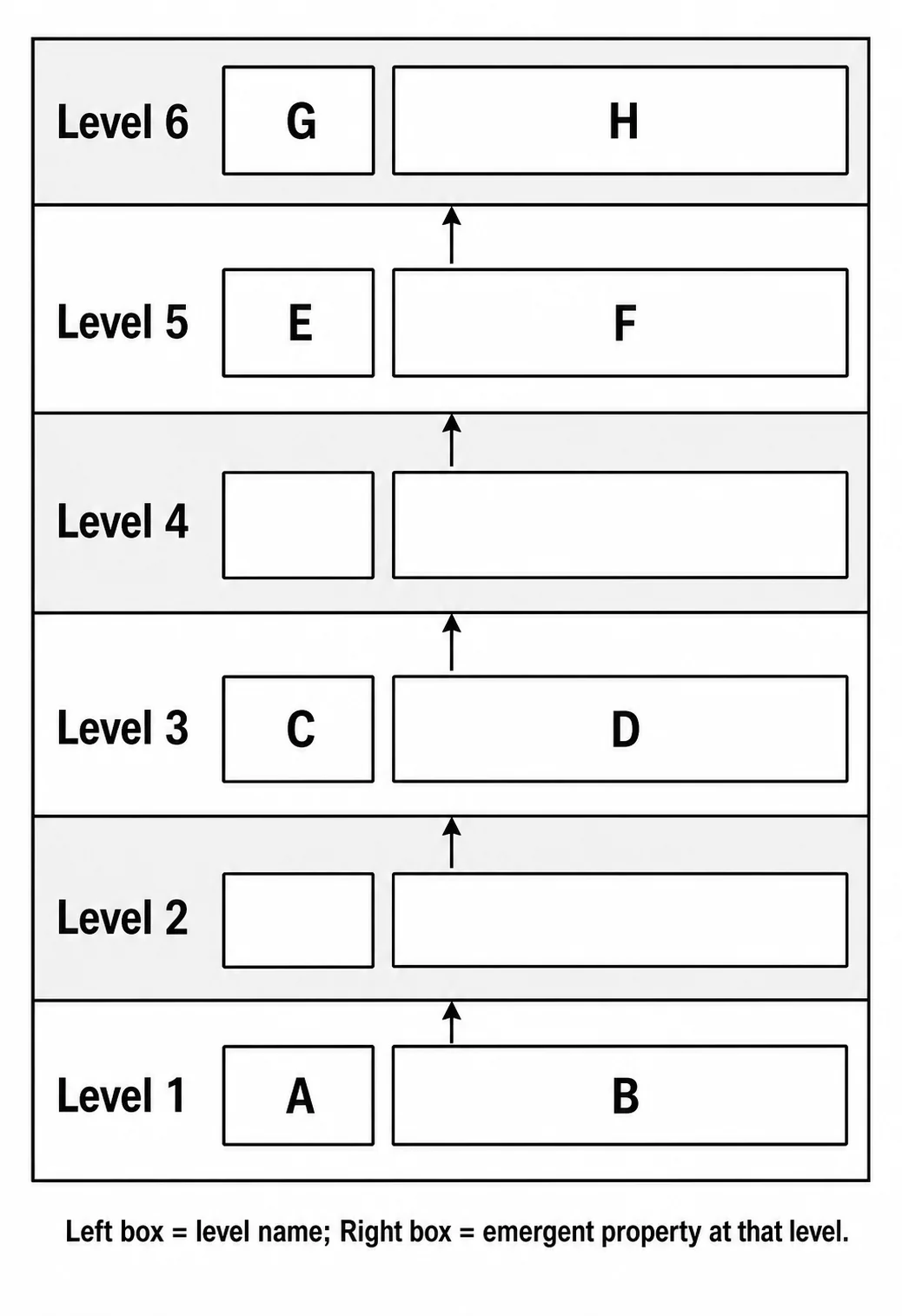
- A, level 1 name (subunit of a cell performing a specific function) _______________
- B, emergent property at level 2 (the basic unit of life capable of all life processes) _______________
- C, level 3 name (group of similar cells performing a shared function) _______________
- D, emergent property at level 3 (amplified, coordinated function no single cell can achieve) _______________
- E, level 4 name (structure integrating 2+ tissue types) _______________
- F, emergent property at level 4 (multi-step complex function no single tissue can perform) _______________
- G, level 5 name (multiple organs cooperating for a major physiological function) _______________
- H, emergent property at level 6 (full integration maintaining internal stability) _______________
| Box | Your label |
|---|---|
| A | |
| B | |
| C | |
| D | |
| E | |
| F | |
| G | |
| H |
2. Term–definition match
The ten definitions below are shuffled. In the right-hand column write the matching term from this list: biological hierarchy, specialised cell, tissue, organ, organ system, emergent property, structure–function relationship, division of labour, differentiation, multicellular organism. 10 marks
| # | Definition (shuffled) | Matching term |
|---|---|---|
| 2.1 | The ordered levels of organisation in living things from organelle to organism. | |
| 2.2 | A cell whose structure has been permanently modified through differentiation to perform one specific function efficiently. | |
| 2.3 | A new capability that arises at a given level of organisation, not present at lower levels. | |
| 2.4 | An organism whose body is composed of many structurally distinct, interdependent cells that cannot survive independently. | |
| 2.5 | The process by which a cell permanently changes its gene expression pattern to take on a particular structure and function. | |
| 2.6 | A group of similar cells working collectively to perform a shared function that no individual cell could achieve alone. | |
| 2.7 | A structure containing two or more tissue types integrated to perform a complex, multi-step biological function. | |
| 2.8 | A group of organs cooperating to perform a major physiological function for the whole organism. | |
| 2.9 | The principle that every structural feature of a cell, tissue, or organ exists because it improves performance of a specific function. | |
| 2.10 | The allocation of different tasks to different specialised cell types within a multicellular organism so that each task is performed more efficiently. |
3. True or false, with correction
For each statement, circle T or F. If the statement is false, write the corrected version on the line provided. 8 marks (1 for T/F, 1 for correction where needed)
3.1 An organ is defined simply as any large structure inside the body that has a name. T / F
3.2 Colonial organisms such as Volvox differ from multicellular organisms because their individual cells retain the ability to survive independently. T / F
3.3 In a multicellular organism, all cells contain the same DNA but express different genes, which is how specialised cell types arise. T / F
3.4 Nervous tissue is the most common tissue type and forms the outer lining of organs. T / F
4. Fill in the blanks, emergent properties in the hierarchy
Use the word bank to complete the paragraph. Each word or phrase is used once. 8 marks
Within a cell, (1) _______________ such as mitochondria and ribosomes are integrated to produce a self-contained living unit. When gene expression permanently modifies a cell to perform one function, the result is a (2) _______________. Millions of these cells grouped together, working collectively, form a (3) _______________; the coordinated output they generate is an (4) _______________ because it cannot be achieved by any one cell alone. When two or more tissue types are structurally integrated, the result is an (5) _______________, which can perform multi-step functions impossible for a single tissue. At the top of the hierarchy, the (6) _______________ coordinates all systems simultaneously to maintain (7) _______________, stable internal conditions. Cardiac muscle cells are connected via (8) _______________, which allow action potentials to pass rapidly from cell to cell so the heart contracts as a unit.
5. Build a concept map
Draw labelled arrows between the six terms below to show how they connect. Each arrow must carry a linking phrase (e.g. “gives rise to”, “is integrated into”, “generates”). Aim for at least 6 labelled arrows. 6 marks
Supplied terms: specialised cell · tissue · organ · emergent property · differentiation · division of labour.
Q1, Labelled hierarchy diagram
A: organelle. B: self-contained living unit / cell (capable of all life processes). C: tissue. D: amplified/coordinated function (emergent property of tissue level). E: organ. F: complex multi-step function / multi-tissue integration (emergent property of organ level). G: organ system. H: homeostasis (emergent property of organism level, all systems coordinated simultaneously).
Marking criteria: 1 mark per correct label. Accept equivalent biological phrasing for emergent properties (B, D, F, H) provided the level-specific new capability is correctly identified.
Q2, Term–definition matches
2.1 biological hierarchy • 2.2 specialised cell • 2.3 emergent property • 2.4 multicellular organism • 2.5 differentiation • 2.6 tissue • 2.7 organ • 2.8 organ system • 2.9 structure–function relationship • 2.10 division of labour.
Marking criteria: 1 mark per correct match.
Q3, True / false with correction
3.1 False. Correction: an organ is defined by containing two or more integrated tissue types that together perform a complex, multi-step biological function, size and naming alone are not the criterion.
3.2 True. The defining difference between colonial and multicellular organisms is that colonial cells (e.g. Volvox cells) retain independent viability; multicellular cells are permanently interdependent and cannot survive in isolation.
3.3 True. All somatic cells carry the same genome; differential gene expression during development produces structurally and functionally distinct cell types.
3.4 False. Correction: epithelial tissue is the most common tissue type that lines organ surfaces and body cavities; nervous tissue forms the brain, spinal cord and peripheral nerves.
Marking criteria: 1 mark for correctly identifying T/F; 1 mark for a biologically correct correction (only required for false statements).
Q4, Cloze answers (in order)
(1) organelles • (2) specialised cell • (3) tissue • (4) emergent property • (5) organ • (6) organism • (7) homeostasis • (8) intercalated discs.
Marking criteria: 1 mark per correct blank. Accept minor variation in phrasing but the key term must be identifiable.
Q5, Sample concept map
A correct map should include arrows such as:
- differentiationproduces → specialised cell
- specialised cellgroups into / forms → tissue
- tissueintegrates into → organ
- specialised cellenables → division of labour
- tissuegenerates → emergent property
- organgenerates → emergent property
Any biologically valid linking phrases accepted. Award 1 mark per correctly labelled, causally correct arrow, maximum 6.