Biology • Year 11 • Module 2 • Lesson 3
Tissues, Structure and Function
Apply knowledge of tissue structure to real experimental data, cause-and-effect chains, and scenario-based reasoning about both animal and plant tissues.
1. Interpret tissue-thickness data from a corneal transplant study
Corneal transplants replace damaged stratified squamous epithelium covering the front of the eye. A research team measured the average epithelial thickness (in micrometres, μm) at the centre and edge of donated corneas from four donor groups before transplantation. 7 marks
| Donor group | Age range (yr) | Centre thickness (μm) | Edge thickness (μm) |
|---|---|---|---|
| A | 18–29 | 52 | 64 |
| B | 30–49 | 49 | 61 |
| C | 50–69 | 44 | 56 |
| D | 70+ | 38 | 49 |
Hypothetical data modelled after published corneal morphometry studies.
1.1 Describe the trend in epithelial thickness as donor age increases, referring to both measurement sites. 2 marks
1.2 Epithelial tissue is avascular (contains no blood vessels) and relies on diffusion from underlying connective tissue for nutrients. Using this information, suggest why thinner epithelium might be more fragile. 3 marks
1.3 The corneal epithelium is described as stratified (multi-layered). Predict how this structural feature benefits the cornea compared with a simple (single-layer) epithelium at the same site. 2 marks
2. Cause-and-effect chain, myasthenia gravis and tissue coordination
In myasthenia gravis, antibodies destroy the receptors on muscle cells that normally receive signals from motor neurons. Use the cause boxes below to complete the effect boxes. Each effect should follow logically from the cause. 5 marks
3. Diagram critique, spot the errors in this plant vascular tissue description
A student has drawn a labelled diagram of a vascular bundle in a plant stem and written the following annotations. There are three biological errors. Identify each error and write the correction. 6 marks (2 per error: 1 identify, 1 correct)
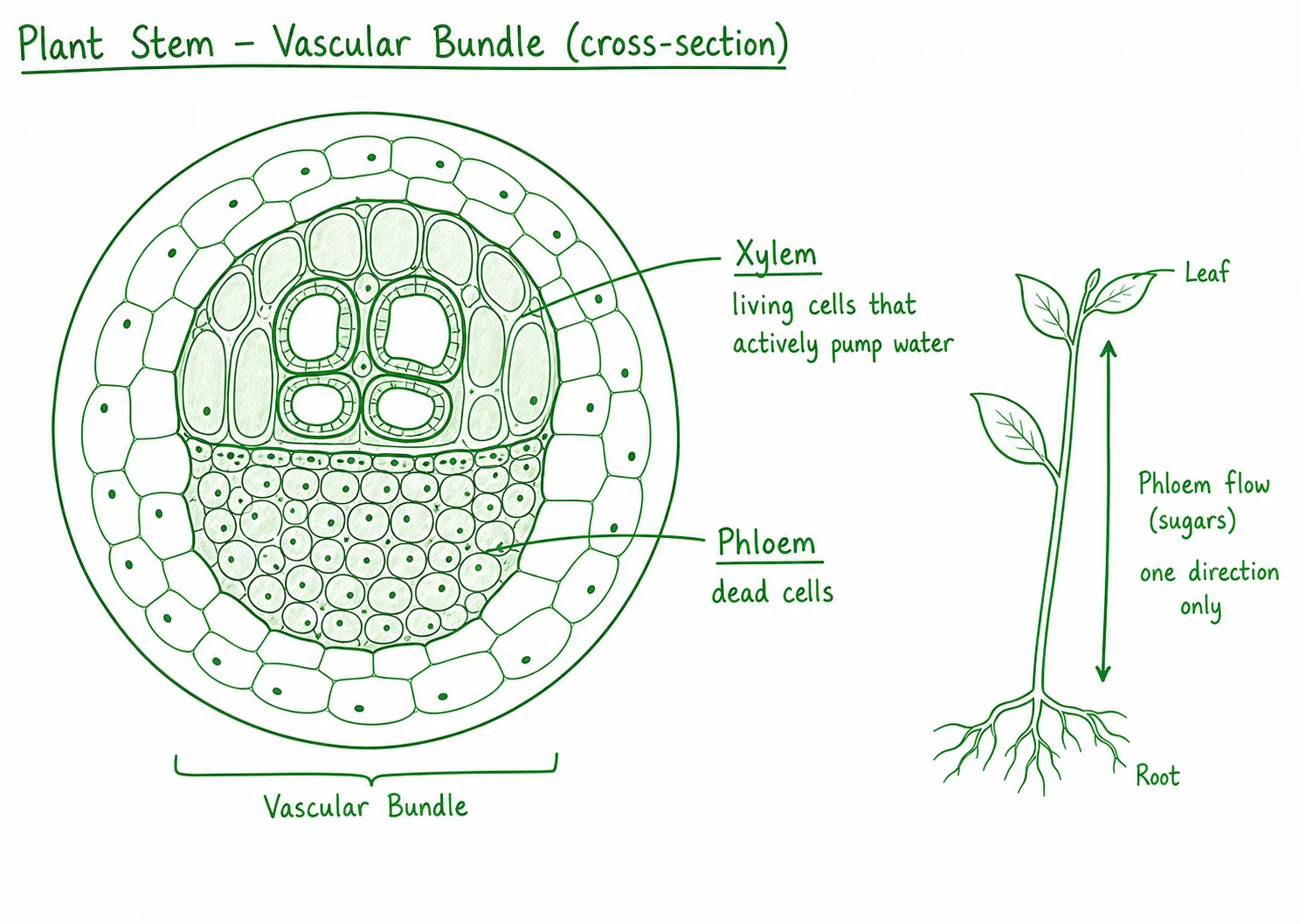
3.1 Error 1: What is wrong?
Correction:
3.2 Error 2: What is wrong?
Correction:
3.3 Error 3: What is wrong?
Correction:
4. Apply to a new scenario, a plant moved from water to dry land
A botanist takes an aquatic flowering plant that has been growing in a pond and transfers it to a dry terrestrial environment. After two weeks, the plant shows signs of water stress. 5 marks
4.1 Identify one structural feature of the plant’s dermal tissue that is absent or poorly developed because it evolved in water, which now makes survival on land difficult. Explain how this feature, if present, would help. 2 marks
4.2 The plant also has a poorly developed xylem compared with terrestrial plants. Explain, using your knowledge of xylem structure, why a thin-walled, weakly lignified xylem is a disadvantage in a terrestrial environment. 2 marks
4.3 Which plant tissue type would need to increase its activity for the plant to adapt and grow new, better-adapted structures? Give a reason. 1 mark
Q1.1, Trend description (2 marks)
At both measurement sites, epithelial thickness decreases as donor age increases [1]. The centre measurements decrease from 52 μm (Group A) to 38 μm (Group D), and edge measurements decrease from 64 μm to 49 μm over the same age range [1].
Q1.2, Why thinner epithelium is more fragile (3 marks)
Epithelial tissue is avascular, so all cells must receive oxygen and nutrients by diffusion from the underlying connective tissue [1]. In thicker epithelium, the surface cell layers are already at the maximum diffusion distance; in thinner epithelium, the total number of cell layers is reduced [1]. With fewer layers, the mechanical protection the tissue provides is lower, if the surface cells are damaged or lost, fewer backup layers remain to maintain the barrier, making the tissue more vulnerable to injury or pathogen entry [1].
Q1.3, Stratified vs simple epithelium at the cornea (2 marks)
Stratified squamous epithelium has multiple layers of cells stacked above the basement membrane [1]. At the cornea, a surface exposed to constant friction from eyelids and airborne particles, the outer cell layers can be worn away and replaced by underlying layers without exposing the basement membrane. A single-layer (simple) epithelium would be breached by mechanical abrasion much more easily, leaving the underlying structures unprotected [1].
Q2, Cause-and-effect chain (5 marks)
Effect 1: Neurotransmitter molecules are released into the synaptic cleft and bind to receptor proteins on the surface of the adjacent muscle cell, triggering it to contract [1].
Effect 2: The neurotransmitter released from the motor neuron cannot bind to the muscle cell because the receptors have been destroyed; the signal cannot be received [1].
Effect 3: Individual muscle cells remain relaxed, no contraction is initiated even though the nervous tissue is functioning normally [1].
Effect 4: The muscle weakens progressively; movements that depend on coordinated tissue-level contraction (e.g. lifting, swallowing, breathing) become increasingly difficult [1].
Overall outcome: Despite the nervous tissue being structurally intact, the breakdown of coordination between nervous tissue and muscle tissue produces progressive paralysis and weakness, demonstrating that tissue-level coordination, not just individual cell function, is essential for normal physiological function [1].
Q3, Diagram critique (6 marks)
3.1 Error 1 (“living cells that actively pump water”): Xylem cells are dead at maturity, their contents are removed during development, leaving hollow tubes. Correction: relabel xylem as “dead, hollow cells forming tubes reinforced with lignin; water moves by cohesion-tension, not active pumping.” [1 + 1]
3.2 Error 2 (“dead cells” on phloem): Phloem sieve tube elements must remain living to actively load and unload sucrose using ATP (facilitated by companion cells). Correction: relabel phloem as “living sieve tube elements + companion cells (living, with nucleus); actively transport sucrose.” [1 + 1]
3.3 Error 3 (phloem flow in one direction only): Unlike xylem, phloem can transport sucrose in both directions, from leaves downward to roots and from storage organs upward to growing tips depending on where the demand (sink) is. Correction: replace the one-way arrow with a two-headed arrow or two arrows, labelled “bidirectional flow from sources to sinks.” [1 + 1]
Q4.1, Absent dermal feature (2 marks)
An aquatic plant typically has no (or a very thin) waxy cuticle on its epidermis [1]. A well-developed cuticle would reduce transpiration (uncontrolled water loss by evaporation) from aerial surfaces, which is critical for survival in a dry terrestrial environment where the plant cannot simply absorb water from surrounding water [1]. Accept also: absence of functional stomata / guard cells that can close to reduce water loss.
Q4.2, Weakly lignified xylem disadvantage (2 marks)
In terrestrial plants, the thick lignified walls of xylem not only waterproof the hollow tubes but also provide structural support, preventing the plant from collapsing under its own weight in air [1]. An aquatic plant supported by surrounding water does not need this; transferred to land, its thin-walled xylem cannot provide the mechanical rigidity required to hold stems upright against gravity, and the tubes may collapse under negative pressure generated during transpiration, blocking water flow [1].
Q4.3, Tissue type that must increase activity (1 mark)
Meristematic tissue would need to increase its mitotic activity [1]. Meristematic tissue is the only plant tissue that can divide and produce new cells that then differentiate into other tissue types, including cells with a heavier cuticle (dermal) and more heavily lignified xylem (vascular). Without increased meristematic activity, no new adaptive structures can be formed.