Biology • Year 11 • Module 2 • Lesson 3
Tissues, Structure and Function
Lock in the definitions, tissue type names, key structural features, and the vocabulary needed to describe both animal and plant tissues.
1. Label the tissue classification diagram
The diagram below maps the eight tissue types you need to know for HSC Biology. Write the missing labels into boxes A–H. Draw on the lesson’s Key Terms and Cards 2–3. 8 marks
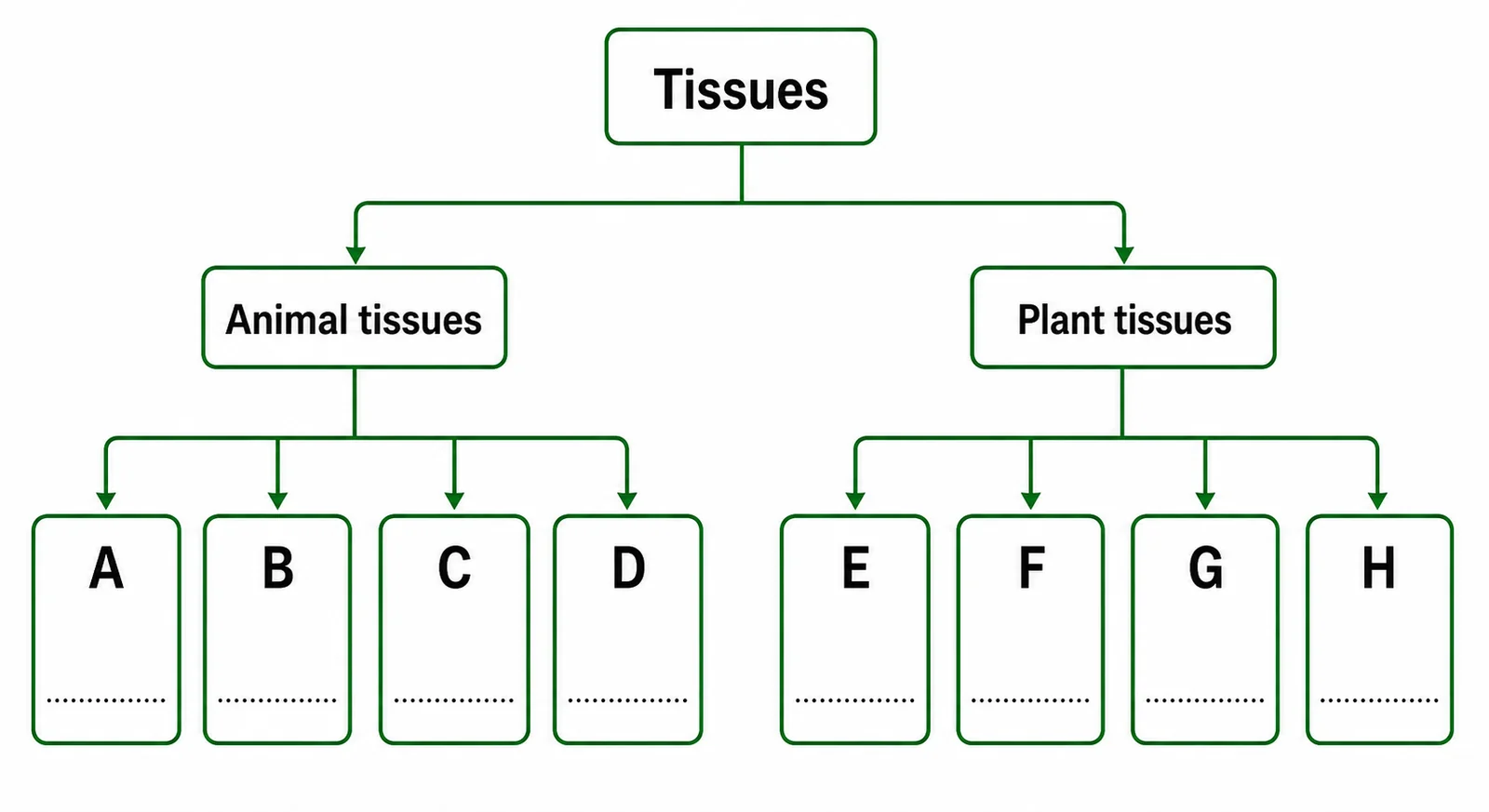
- A, animal tissue: tightly packed sheets; protection & exchange _______________________
- B, animal tissue: cells in an extracellular matrix; support & transport _______________________
- C, animal tissue: elongated, contractile cells; movement _______________________
- D, animal tissue: neurons + glial cells; signal transmission _______________________
- E, plant tissue: permanently undifferentiated; source of all growth _______________________
- F, plant tissue: xylem + phloem; water & sugar transport _______________________
- G, plant tissue: parenchyma, collenchyma, sclerenchyma; bulk of plant body _______________________
- H, plant tissue: epidermis + cuticle + guard cells; outer protection _______________________
| Box | Your label |
|---|---|
| A | |
| B | |
| C | |
| D | |
| E | |
| F | |
| G | |
| H |
2. Term–definition match
The ten definitions below are shuffled. In the right-hand column write the matching term from this list: tissue, epithelial tissue, connective tissue, muscle tissue, nervous tissue, meristematic tissue, vascular tissue, dermal tissue, extracellular matrix, differentiation. 10 marks
| # | Definition (shuffled) | Matching term |
|---|---|---|
| 2.1 | A group of similar cells with a shared structure and function that work together to perform a specific role. | |
| 2.2 | Tissue in which cells are spread within a gel, fluid or solid material that the cells themselves produce; functions include support, transport, and binding. | |
| 2.3 | The process by which unspecialised stem cells develop into cells with a specific structure and function. | |
| 2.4 | Permanently undifferentiated plant tissue located at root and shoot tips; the source of all plant growth. | |
| 2.5 | Sheets of tightly packed cells covering body surfaces and lining cavities; functions include protection, absorption, and secretion. | |
| 2.6 | Tissue specialised for contraction, enabling movement of the body, pumping of blood, and peristalsis. | |
| 2.7 | The outer protective layer of a plant including the epidermis, cuticle, guard cells, and root hairs. | |
| 2.8 | Tissue composed of neurons and glial cells that receives, processes, and transmits electrical signals. | |
| 2.9 | Plant tissue consisting of xylem and phloem that transports water, minerals, and sugars throughout the plant. | |
| 2.10 | The non-cellular material secreted by cells in connective tissue; can be fluid (plasma), gel (cartilage), or solid (bone). |
3. True or false, with correction
For each statement, circle T or F. If the statement is false, write the corrected version on the line below. 8 marks (1 for T/F, 1 for the correction where needed)
3.1 Tissues are groups of identical cells all doing exactly the same thing. T / F
3.2 Blood is classified as connective tissue because its cells are dispersed in a liquid extracellular matrix (plasma). T / F
3.3 Xylem cells must remain alive at maturity so they can actively pump water upward. T / F
3.4 Meristematic tissue retains the ability to divide and produce new cells throughout the entire life of a plant. T / F
4. Function recall
Answer each in 1–2 sentences using precise terms from the lesson. 10 marks (2 each)
4.1 What structural feature of epithelial tissue makes it an effective barrier between body compartments?
4.2 What is the function of the extracellular matrix in connective tissue?
4.3 What is the function of intercalated discs in cardiac muscle tissue?
4.4 What is the function of the waxy cuticle on the epidermis of a plant leaf?
4.5 What is the function of glial cells in nervous tissue?
5. Build a concept map
Draw labelled arrows between the five terms below to show how they connect. Each arrow must carry a linking phrase (e.g. “forms”, “is a type of”, “produces”, “results from”). Aim for at least 5 labelled arrows. 5 marks
Supplied terms: cell differentiation · tissue · specialised cells · organ · function.
Q1, Labelled diagram
A: epithelial tissue. B: connective tissue. C: muscle tissue. D: nervous tissue. E: meristematic tissue. F: vascular tissue. G: ground tissue. H: dermal tissue.
Q2, Term–definition matches
2.1 tissue • 2.2 connective tissue • 2.3 differentiation • 2.4 meristematic tissue • 2.5 epithelial tissue • 2.6 muscle tissue • 2.7 dermal tissue • 2.8 nervous tissue • 2.9 vascular tissue • 2.10 extracellular matrix.
Q3, True / false with correction
3.1 False. Correction: tissues are groups of similar cells with a shared structure and function; the cells need not be identical, but they work together to perform a specific role that no individual cell could achieve alone.
3.2 True. Blood cells (erythrocytes, leukocytes, platelets) are dispersed in plasma, a liquid extracellular matrix, which precisely matches the definition of connective tissue.
3.3 False. Correction: xylem cells are dead at maturity. Their living contents are removed, leaving hollow tubes reinforced with lignin; it is the hollow structure and the cohesion-tension mechanism (driven by transpiration) that moves water, not active pumping by living cells.
3.4 True. Meristematic tissue remains active from germination to death, unlike animal growth which is largely limited to developmental stages.
Q4.1, Barrier function of epithelial tissue
Epithelial cells are tightly packed together with very little extracellular space and are joined by specialised cell junctions (e.g. tight junctions). This close packing forms a continuous sheet that acts as a selectively permeable barrier, controlling what substances can pass between body compartments. The tissue sits on a basement membrane, further reinforcing the barrier.
Marking notes. 1 mark for tightly packed cells / cell junctions forming a continuous sheet. 1 mark for selective permeability / barrier function / controlling what passes between compartments.
Q4.2, Function of extracellular matrix
The extracellular matrix (ECM) is the non-cellular material that connects, supports, and anchors the cells of connective tissue. Depending on its composition (fluid, gel, or mineralised), it provides structural properties the cells alone cannot: plasma (fluid ECM in blood) transports materials; collagen in tendons provides tensile strength; the mineralised ECM in bone provides rigidity.
Marking notes. 1 mark for stating the ECM connects / supports / provides structural properties. 1 mark for giving an example of ECM type or property linked to function.
Q4.3, Function of intercalated discs
Intercalated discs connect adjacent cardiac muscle cells and contain gap junctions that allow electrical signals to pass directly from cell to cell. This ensures the entire heart wall contracts simultaneously as a single coordinated unit rather than individual cells contracting independently, producing the powerful, synchronised pump stroke the heart needs.
Marking notes. 1 mark for stating intercalated discs connect adjacent cells and contain gap junctions. 1 mark for explaining that this allows simultaneous / coordinated contraction of the whole heart wall.
Q4.4, Function of the waxy cuticle
The waxy cuticle is a layer of cutin secreted on the outer surface of epidermal cells of aerial plant parts (leaves, stems). It is hydrophobic and prevents uncontrolled water loss by evaporation (transpiration) from the leaf surface, which is essential for the survival of terrestrial plants. Aquatic plants lack a cuticle because water retention is not a problem.
Marking notes. 1 mark for identifying the cuticle as a waxy / hydrophobic layer. 1 mark for stating its function: preventing / reducing uncontrolled water loss (transpiration) from leaf or stem surfaces.
Q4.5, Function of glial cells
Glial cells are the non-conducting support cells of nervous tissue. They insulate neurons (Schwann cells / oligodendrocytes produce myelin sheaths that speed signal transmission), provide nutrition and metabolic support (astrocytes), perform immune defence (microglia), and maintain the structural integrity of the nervous system. Glial cells outnumber neurons roughly 10:1 and are essential for normal neuronal function, though they do not themselves transmit electrical signals.
Marking notes. 1 mark for identifying glial cells as non-conducting support / maintenance cells. 1 mark for at least one named function (insulation / myelination, nutrition, immune defence).
Q5, Sample concept map
A correct map should include arrows such as:
- cell differentiationproduces → specialised cells
- specialised cellsaggregate to form → tissue
- tissueperforms a specific → function
- multiple tissues combine to form → organ
- organcarries out a complex → function
Any biologically valid linking phrases are accepted. Award 1 mark per correctly labelled arrow that respects causal direction (max 5).