Biology • Year 11 • Module 2 • Lesson 2
Cell Specialisation and Differentiation
Lock in the key vocabulary, the gene-expression pathway that produces specialised cells, and the structure–function logic for four cell types studied in this lesson.
1. Label the cell differentiation pathway
The diagram below shows how a fertilised egg gives rise to specialised cells through selective gene expression. Write the correct label for each box A–H from this word bank: zygote, stem cell, chemical signals, selective gene expression, specialised cell, totipotent, committed progenitor cell, silenced genes. 8 marks
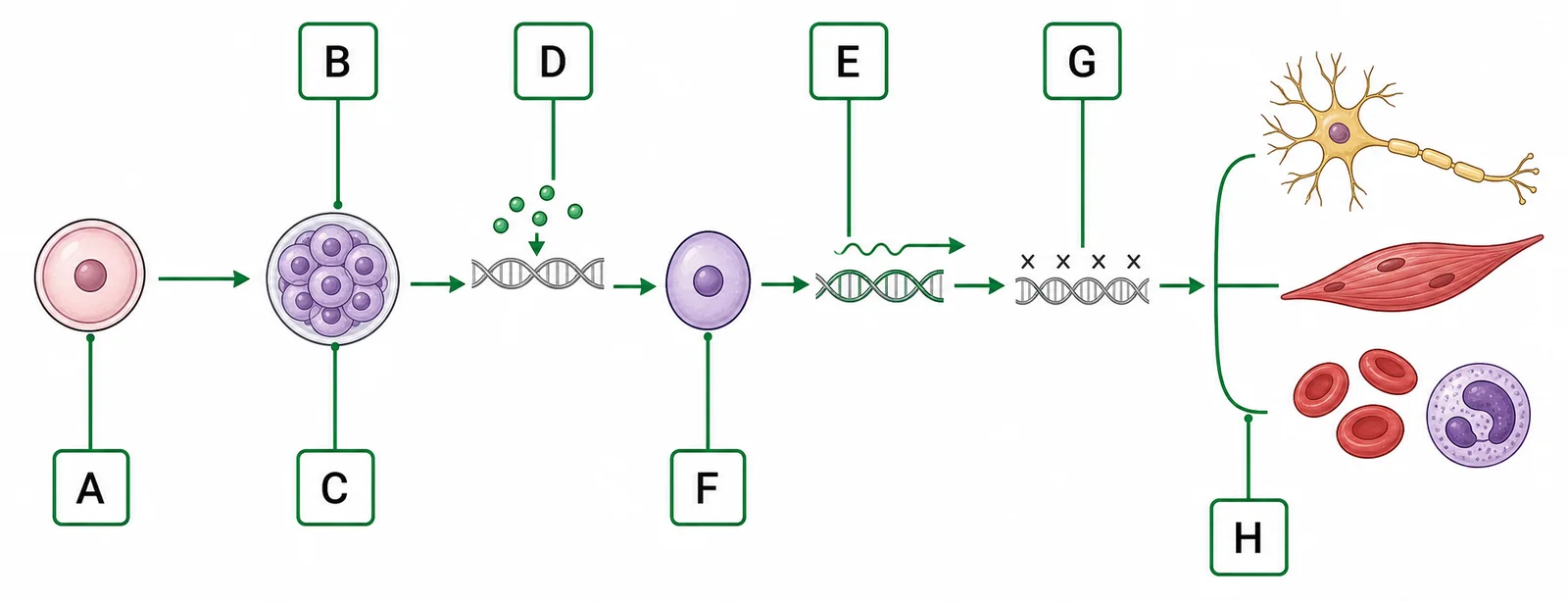
| Box | Your label |
|---|---|
| A | |
| B | |
| C | |
| D | |
| E | |
| F | |
| G | |
| H |
2. Term–definition match
The eight definitions below are shuffled. In the right-hand column, write the matching term from this list: cell differentiation, gene expression, stem cell, specialised cell, red blood cell, palisade mesophyll cell, root hair cell, neuron. 8 marks
| # | Definition (shuffled) | Matching term |
|---|---|---|
| 2.1 | A cell whose structure has been permanently modified to optimise performance of a specific function. | |
| 2.2 | The process by which a cell permanently becomes structurally and functionally specialised through selective gene expression. | |
| 2.3 | An undifferentiated cell capable of dividing and differentiating into one or more specialised cell types. | |
| 2.4 | The process by which the information in a gene is used to synthesise a functional product, typically a protein. | |
| 2.5 | A biconcave, anucleate cell packed with haemoglobin, specialised for oxygen transport in the bloodstream. | |
| 2.6 | A specialised nerve cell with dendrites and a long axon that transmits electrical signals throughout the nervous system. | |
| 2.7 | An elongated plant cell with many chloroplasts, positioned at the top of the leaf to maximise light capture for photosynthesis. | |
| 2.8 | A plant epidermal cell with a long thin extension that greatly increases surface area for water and mineral absorption. |
3. True or false, with correction
For each statement, circle T or F. If the statement is false, write the corrected version. 8 marks (1 for T/F, 1 for correction where needed)
3.1 Different specialised cells in the same organism contain different DNA. T / F
3.2 Cell differentiation is caused by selective gene expression, not by loss of genes. T / F
3.3 A mature red blood cell has no nucleus because it discarded its nucleus during maturation to maximise haemoglobin volume. T / F
3.4 Root hair cells contain many chloroplasts because they are in constant sunlight and must photosynthesise. T / F
4. Structure–function recall
For each structural feature listed, name the cell it belongs to and explain how that feature enables the cell’s function. Write 1–2 sentences using the format: “[Feature] enables [function] because [mechanism].” 10 marks (2 each)
4.1 Long axon (up to 1 m)
Cell: ________________________________
4.2 Biconcave disc shape
Cell: ________________________________
4.3 40–50 chloroplasts per cell
Cell: ________________________________
4.4 Long thin root hair extension
Cell: ________________________________
4.5 Myelin sheath around the axon
Cell: ________________________________
5. Organelle inference
Use your knowledge of organelle function to complete the table. For each organelle listed, state what its presence in large numbers tells you about the cell’s activity. 8 marks (2 each)
| Organelle present in high numbers | What this tells you about the cell’s activity (1–2 sentences) |
|---|---|
| Many mitochondria | |
| Many ribosomes + extensive rough ER | |
| Many chloroplasts | |
| Prominent Golgi apparatus |
Q1, Cell differentiation pathway labels
A: zygote (fertilised egg, full genome, all genes available). B: totipotent (able to produce any cell type, including the placenta). C: stem cell (undifferentiated, capable of self-renewal and differentiation). D: chemical signals (activate specific transcription factors in the stem cell). E: selective gene expression (certain genes switched on; others silenced). F: committed progenitor cell (fate partially determined; can still differentiate into a limited range of cell types). G: silenced genes (permanently switched off in the differentiated cell). H: specialised cell (structure and function fixed, e.g. neuron, red blood cell, palisade cell).
Q2, Term–definition matches
2.1 specialised cell • 2.2 cell differentiation • 2.3 stem cell • 2.4 gene expression • 2.5 red blood cell • 2.6 neuron • 2.7 palisade mesophyll cell • 2.8 root hair cell.
Q3, True / false with correction
3.1 False. Correction: Nearly all cells in a multicellular organism contain identical DNA. They differ because of selective gene expression, different genes are switched on or off in each cell type, not because the DNA itself differs.
3.2 True.
3.3 True. The absence of a nucleus frees internal volume for haemoglobin, maximising oxygen-carrying capacity.
3.4 False. Correction: Root hair cells contain no chloroplasts. They are underground where light is unavailable, so photosynthesis is impossible; producing chloroplasts would waste energy for no benefit.
Q4, Structure–function recall
4.1 Cell: Neuron. The long axon enables transmission of electrical signals over large distances within the body because it physically bridges distant parts of the nervous system that could not otherwise communicate via diffusion alone.
4.2 Cell: Red blood cell. The biconcave disc shape increases the surface area-to-volume (SA:V) ratio, enabling faster diffusion of O&sub2; and CO&sub2; across the plasma membrane because a larger membrane area is exposed relative to the cell’s volume.
4.3 Cell: Palisade mesophyll cell. The high density of chloroplasts (40–50 per cell) maximises the rate of photosynthesis because each chloroplast captures light energy independently, so more light is absorbed per unit time compared to a cell with fewer chloroplasts.
4.4 Cell: Root hair cell. The long thin root hair extension increases the surface area available for absorption by up to 10 times, enabling more water and minerals to be taken up by osmosis and active transport because a greater membrane area is in contact with the soil solution.
4.5 Cell: Neuron. The myelin sheath dramatically increases signal conduction speed because its insulating fatty layer forces the electrical impulse to jump between exposed gaps (nodes of Ranvier) rather than depolarising the entire membrane, a process called saltatory conduction.
Q5, Organelle inference
Many mitochondria: The cell has a very high demand for ATP (chemical energy). It carries out energy-intensive processes continuously, for example, active transport, muscle contraction, or flagellar movement.
Many ribosomes + extensive rough ER: The cell produces large quantities of protein. This is typical of secretory cells (e.g. goblet cells, pancreatic cells) or cells with very high metabolic activity, such as liver cells (hepatocytes).
Many chloroplasts: The cell carries out photosynthesis at a high rate. It is a plant cell exposed to significant light, most likely a palisade mesophyll cell in the upper leaf layer.
Prominent Golgi apparatus: The cell packages and secretes large quantities of protein or polysaccharide. The Golgi modifies and packages proteins from the rough ER into vesicles for secretion, this is characteristic of secretory cells such as goblet cells or hormone-producing cells.