Biology • Year 11 • Module 2 • Lesson 1
Unicellular, Colonial and Multicellular Organisms
Apply the three categories of cellular organisation to real data, novel scenarios, and a diagram critique.
1. Interpret surface area : volume (SA:V) ratio data
The table below shows calculated surface area, volume and SA:V ratio for cube-shaped cells of increasing width. Use these data to answer the questions. 8 marks
| Cell width (µm) | Surface area (µm²) | Volume (µm³) | SA:V ratio |
|---|---|---|---|
| 1 | 6 | 1 | 6.00 |
| 2 | 24 | 8 | 3.00 |
| 5 | 150 | 125 | 1.20 |
| 10 | 600 | 1000 | 0.60 |
| 20 | 2400 | 8000 | 0.30 |
| 50 | 15 000 | 125 000 | 0.12 |
1.1 Using the data in the table, draw a line graph of SA:V ratio (y-axis) against cell width (x-axis) in the space below. Label both axes with units. 3 marks
1.2 Describe the trend shown in your graph. 1 mark
1.3 Use the data to explain why a unicellular organism cannot grow indefinitely large. Refer to the role of the cell membrane and diffusion in your answer. 2 marks
1.4 Explain how multicellular organisation overcomes the SA:V constraint without reducing the size of the whole organism. 2 marks
2. Interpret graph, cell survival after separation
A laboratory investigation placed individual cells from three organism types into nutrient broth and measured the percentage of cells still alive after 24 hours. The results are shown below. 6 marks
Figure 2, Stylised laboratory survival data illustrating differences in cell independence across organism types.
2.1 Describe the pattern shown by the three bars. 1 mark
2.2 Using lesson content, explain why Amoeba cells survived at ~98% but separated human muscle cells survived at only ~4%. 3 marks
2.3 The separated Volvox cells survived at ~72%, intermediate between the other two. Explain this result in terms of the difference between colonial and multicellular organisation. 2 marks
3. Diagram critique, what has this student drawn incorrectly?
A Year 11 student drew the diagram below to explain the difference between colonial and multicellular organisms. There are three biological errors. Identify each error and write the correction. 6 marks: 2 per error, 1 identify, 1 correct)
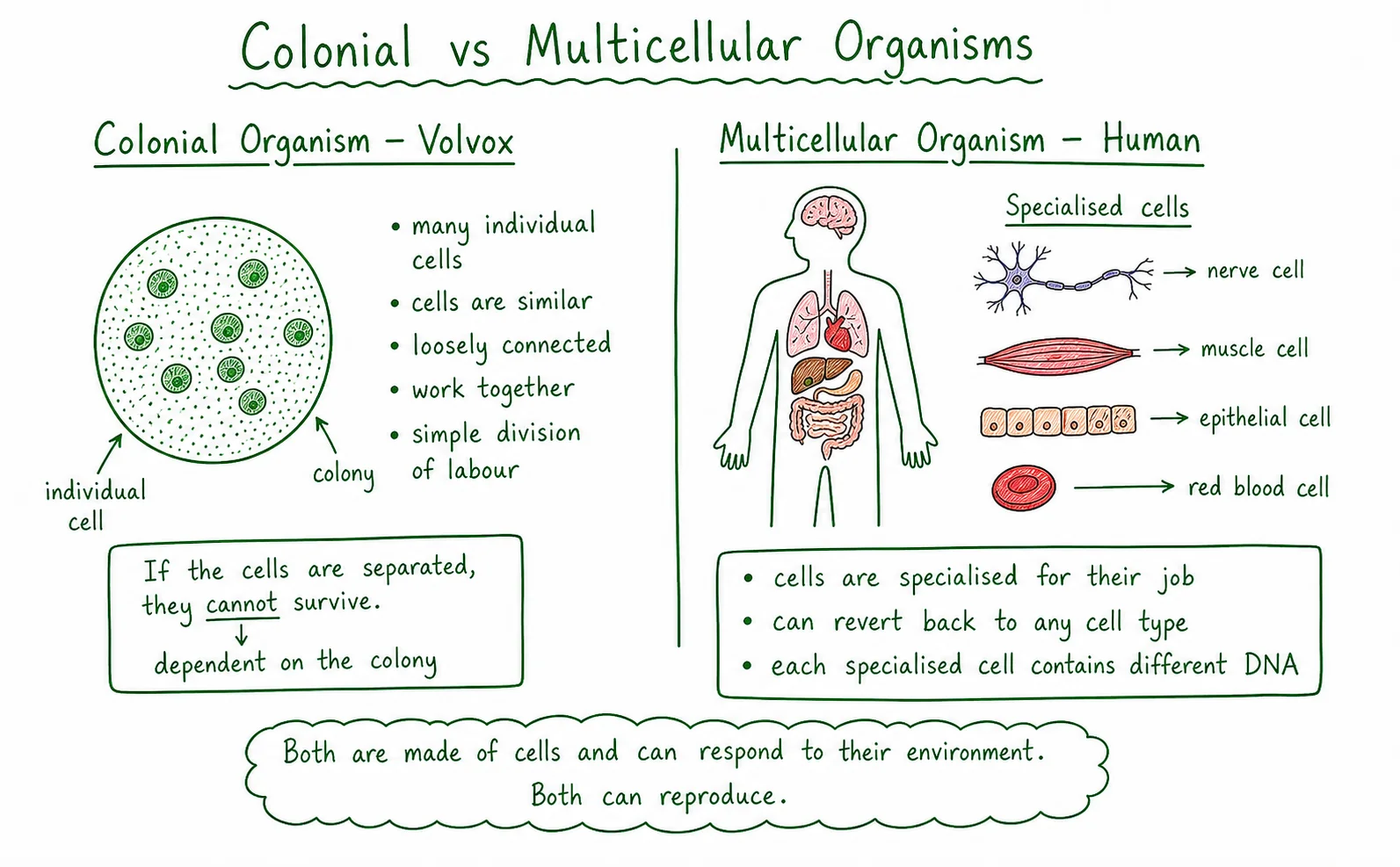
3.1 Error 1: What is wrong?
Correction:
3.2 Error 2: What is wrong?
Correction:
3.3 Error 3: What is wrong?
Correction:
4. Apply to a new scenario, coral bleaching
Coral reefs are built by coral polyps, small multicellular animals that form permanent colonies. Each polyp has specialised cells (cnidocytes for stinging prey, gastrodermal cells for digestion, epidermal cells for protection). During bleaching events, polyps expel their photosynthetic symbiotic algae (Symbiodinium) in response to heat stress. Individual expelled Symbiodinium cells can survive in the water column for several days. 6 marks
4.1 A student argues that coral polyps are a colonial organism because many polyps live together in a reef structure. Using lesson terminology, explain why this is incorrect. 2 marks
4.2 Symbiodinium are unicellular algae that can survive alone. Using the definition of colonial and unicellular organisms from the lesson, explain which category Symbiodinium belongs to. 2 marks
4.3 During bleaching, cnidocyte cells that are expelled alongside Symbiodinium die within hours. Explain why, using the concept of interdependence. 2 marks
Q1.1, Graph
Correct graph should show: x-axis labelled "Cell width (µm)" with values 1, 2, 5, 10, 20, 50; y-axis labelled "SA:V ratio" ranging from 0 to at least 6; points plotted at (1, 6.00), (2, 3.00), (5, 1.20), (10, 0.60), (20, 0.30), (50, 0.12) connected with a smooth curve. Mark allocation: 1 for correct axes and labels; 1 for correctly plotted points; 1 for correct curve shape (decreasing, non-linear).
Q1.2, Trend description
As cell width increases, the SA:V ratio decreases. The relationship is non-linear, the ratio falls steeply at first (from 6.00 to 0.60 over the first tenfold increase in width) and then more gradually.
Q1.3, SA:V and cell size limit (2 marks)
All exchange of nutrients, gases and waste occurs across the cell membrane (the surface). As a cell grows, its volume increases much faster than its surface area (volume scales with width cubed; surface area with width squared), so the SA:V ratio falls [1]. A very large cell cannot exchange materials fast enough across its membrane to supply or remove substances from its interior by diffusion, the centre becomes deprived of oxygen and nutrients and waste accumulates, limiting the maximum viable size [1].
Q1.4, How multicellularity overcomes SA:V (2 marks)
Multicellular organisms keep individual cells small, so each cell maintains a high SA:V ratio for efficient exchange [1]. Specialised internal transport systems (the circulatory system in animals, vascular tissue in plants) then distribute materials to every cell in the body, allowing the whole organism to be large without any individual cell becoming diffusion-limited [1].
Q2.1, Bar graph pattern (1 mark)
Cell survival decreases across the three categories: unicellular Amoeba cells show the highest survival (~98%), separated colonial Volvox cells show intermediate survival (~72%), and specialised human muscle cells show very low survival (~4%).
Q2.2, Why Amoeba survived but muscle cells did not (3 marks)
Amoeba is a unicellular organism, a single cell that performs all life functions independently (obtaining nutrients, gas exchange, osmoregulation, reproduction) [1]. It has no structural dependence on any other cell, so isolation in nutrient broth causes no deficit. In contrast, a human muscle cell is a permanently specialised cell within a multicellular organism [1]. Its structure is optimised for contraction and it relies on other cells and systems (the cardiovascular system for oxygen and glucose, the nervous system for signals) to supply essential materials. When isolated, these supply chains are severed and the specialised cell cannot survive alone, this is interdependence [1].
Q2.3, Volvox intermediate result (2 marks)
Volvox is a colonial organism: its cells show limited division of labour but each cell retains the ability to survive independently if separated [1]. Unlike multicellular cells, colonial cells are not permanently specialised, the separation does not irreversibly sever essential supply chains, so many cells survive. However, the ~72% (not ~100%) survival suggests some cells were partially dependent on colonial connections (e.g. coordinated flagellar beating, shared resources via cytoplasmic bridges) and struggled when isolated [1].
Q3, Diagram critique (6 marks)
3.1 Common error, "Colonial cells cannot survive alone": This is the defining feature of multicellular cells, not colonial cells. Correction: the diagram should show that colonial cells (e.g. Volvox somatic cells) CAN survive if separated from the colony, this is what distinguishes colonial from multicellular organisation. [1 + 1]
3.2 Common error, "All cells in a multicellular organism have different DNA": This is biologically wrong. Correction: nearly all cells in a multicellular organism share identical DNA; cell differences arise from selective gene expression, not from different DNA sequences. [1 + 1]
3.3 Common error, Showing Volvox as a type of multicellular organism: Colonial and multicellular organisms are fundamentally different categories. Correction: Volvox is a colonial organism; it should be shown as a separate, intermediate category between unicellular and multicellular, not as a subcategory of multicellular. [1 + 1]
Q4.1, Why coral polyps are not colonial (2 marks)
Coral polyps are multicellular organisms, not colonial ones [1]. Each polyp contains permanently specialised, interdependent cells (cnidocytes, gastrodermal cells, epidermal cells) that cannot survive independently, this is the defining feature of multicellularity. A colonial organism is made of genetically identical cells where each individual cell can survive alone; the cells within a single coral polyp cannot do this [1].
Q4.2, Symbiodinium category (2 marks)
Symbiodinium are unicellular organisms [1]. A unicellular organism is a single cell that performs all life functions independently. The fact that individual Symbiodinium cells can survive in the water column for several days confirms they are self-sufficient and fully independent, which matches the definition of unicellular [1].
Q4.3, Cnidocyte death and interdependence (2 marks)
Cnidocytes are permanently specialised cells, their structure is optimised for stinging and capturing prey, not for independent survival [1]. They depend on other cells and systems within the polyp (e.g. the gastrodermal cells to supply digested nutrients, the circulatory system for oxygen and waste removal). This mutual reliance is interdependence. When expelled, the supply chains are broken and the cnidocyte dies rapidly because it cannot independently perform all the life functions needed to sustain itself [1].