Biology • Year 11 • Module 2 • Lesson 1
Unicellular, Colonial and Multicellular Organisms
Lock in the core vocabulary and key distinctions between unicellular, colonial and multicellular organisation before moving on to cell specialisation.
1. Label the cellular organisation spectrum
The diagram below places three types of cellular organisation on a spectrum from least to most complex. Write the missing labels into boxes A–H using terms from the lesson's Key Terms panel and Cards 1–3. 8 marks
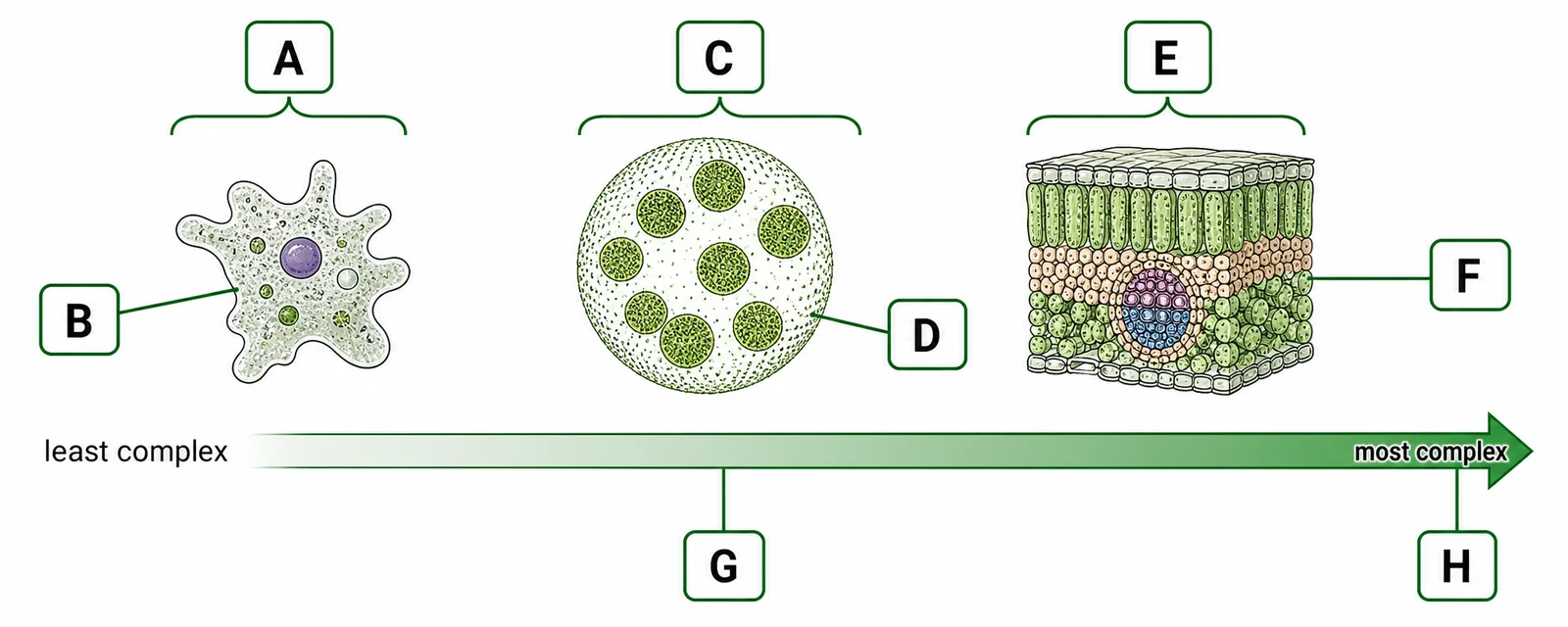
- A, name of the simplest category (one cell, all functions) ___________________________
- B, whether cells can survive alone in this category ___________________________
- C, name of the intermediate category ___________________________
- D, the key structure connecting cells in Volvox ___________________________
- E, name of the most complex category ___________________________
- F, whether cell specialisation is permanent or reversible in this category ___________________________
- G, the process that causes cells to become different types ___________________________
- H, the critical boundary feature between colonial and multicellular ___________________________
| Box | Your label |
|---|---|
| A | |
| B | |
| C | |
| D | |
| E | |
| F | |
| G | |
| H |
2. Term–definition match
Ten definitions are listed below in shuffled order. In the right-hand column write the matching term from this list: unicellular organism, colonial organism, multicellular organism, cell specialisation, interdependence, selective gene expression, cell adhesion, cell communication, cell differentiation, division of labour. 10 marks
| # | Definition (shuffled) | Matching term |
|---|---|---|
| 2.1 | An organism consisting of a single cell that performs all life functions independently. | |
| 2.2 | A group of genetically identical cells living together where each cell retains the ability to survive independently. | |
| 2.3 | An organism made of many permanently specialised, interdependent cells that cannot survive alone. | |
| 2.4 | The permanent modification of a cell's structure to optimise it for a specific function. | |
| 2.5 | The mutual reliance of specialised cells on one another for survival within a multicellular organism. | |
| 2.6 | The process by which specific genes are switched on or off in a cell, causing it to produce particular proteins and develop a specialised structure. | |
| 2.7 | Cells physically sticking together, one of the three requirements of multicellularity. | |
| 2.8 | Cells signalling each other via hormones, nerves or gap junctions; a second requirement of multicellularity. | |
| 2.9 | The process by which cells permanently adopt a specialised role, driven by selective gene expression; a third requirement of multicellularity. | |
| 2.10 | The allocation of different roles to different cells within a colony or organism, increasing overall efficiency. |
3. True or false, with correction
For each statement, circle T or F. If the statement is false, rewrite it to make it correct. 8 marks (1 for T/F, 1 for the correction where needed)
3.1 In a colonial organism such as Volvox, all cells are permanently specialised and cannot survive if separated from the colony. T / F
3.2 Nearly all cells in a multicellular organism contain identical DNA; they differ because of selective gene expression. T / F
3.3 The contractile vacuole in Amoeba is an example of a structure-function relationship: it expels excess water to prevent cell lysis in hypotonic (freshwater) environments. T / F
3.4 Cancer is an example of multicellular organisation working correctly, because cells replicate rapidly. T / F
4. Classify each organism
For each organism below, circle the correct category and write one structural reason that justifies your choice. 8 marks (1 for category, 1 for justification)
4.1 Amoeba proteus Unicellular / Colonial / Multicellular
Justification:
4.2 Volvox Unicellular / Colonial / Multicellular
Justification:
4.3 A human Unicellular / Colonial / Multicellular
Justification:
4.4 Escherichia coli Unicellular / Colonial / Multicellular
Justification:
5. Structure–function recall
Answer each in 1–2 sentences using precise terms from the lesson. 10 marks (2 each)
5.1 What is the function of the contractile vacuole in Amoeba, and why is this function necessary in a freshwater environment?
5.2 Why does a red blood cell lack a nucleus, and how does this relate to its specialised function?
5.3 What structural feature of the palisade mesophyll cell allows it to perform photosynthesis most efficiently?
5.4 What is the function of gonidia in Volvox, and how does this demonstrate limited division of labour?
5.5 Name the three requirements of multicellularity and briefly state the consequence if any one is missing.
6. Sort the hierarchy
The six levels of biological organisation below are in scrambled order. Re-write them in the correct sequence from simplest (1) to most complex (6), and give one example for each level. 6 marks (1 per correct level with example)
Scrambled: Tissue | Organism | Organelle | Organ | System | Cell
| Level | Name | Your example |
|---|---|---|
| 1 | ||
| 2 | ||
| 3 | ||
| 4 | ||
| 5 | ||
| 6 |
Q1, Labelled diagram
A: Unicellular. B: Yes, a single unicellular organism is fully independent (there is no colony to separate from). C: Colonial. D: Cytoplasmic bridges. E: Multicellular. F: Permanent, cell specialisation in multicellular organisms is irreversible. G: Selective gene expression (cell differentiation). H: Permanent interdependence, cells in a multicellular organism cannot survive alone (unlike colonial cells, which can).
Q2, Term–definition matches
2.1 unicellular organism • 2.2 colonial organism • 2.3 multicellular organism • 2.4 cell specialisation • 2.5 interdependence • 2.6 selective gene expression • 2.7 cell adhesion • 2.8 cell communication • 2.9 cell differentiation • 2.10 division of labour.
Q3, True / false with correction
3.1 False. Correction: in a colonial organism such as Volvox, cells are not permanently specialised, they retain the ability to survive independently if separated from the colony. This is what distinguishes colonial from multicellular organisation.
3.2 True.
3.3 True.
3.4 False. Correction: cancer is an example of the breakdown of multicellular organisation, cell communication and/or differentiation fail, causing cells to replicate uncontrollably rather than cooperating for the whole organism's benefit.
Q4, Organism classification
4.1 Unicellular. Amoeba proteus is a single eukaryotic cell that performs all life functions (movement by pseudopodia, feeding by phagocytosis, water regulation by contractile vacuole, reproduction by binary fission) independently.
4.2 Colonial. Volvox is a colony of 500–50,000 genetically identical cells embedded in a glycoprotein matrix. Cells show limited division of labour (somatic cells vs gonidia) but each cell can survive independently if separated, so it is colonial, not multicellular.
4.3 Multicellular. A human consists of trillions of permanently specialised, interdependent cells (e.g. red blood cells, neurons, muscle cells) that cannot survive alone, the defining feature of multicellularity.
4.4 Unicellular. E. coli is a single prokaryotic cell with no membrane-bound nucleus; it performs all life functions independently and reproduces rapidly by binary fission.
Q5, Structure–function recall
5.1 The contractile vacuole rhythmically fills with water and contracts to expel it from the cell. This is necessary in freshwater (hypotonic) environments because water constantly enters Amoeba by osmosis; without this mechanism the cell would swell and lyse.
5.2 The red blood cell lacks a nucleus because during differentiation (maturation) it is ejected. This removes a large organelle and maximises the internal volume available for haemoglobin, increasing the cell's oxygen-carrying capacity. The biconcave disc shape further increases surface area for gas exchange.
5.3 The palisade mesophyll cell has a high density of chloroplasts and is elongated, positioned near the top of the leaf. This maximises light absorption for photosynthesis and provides large surface area for CO₂ diffusion.
5.4 Gonidia are specialised reproductive cells in Volvox that handle reproduction exclusively, while somatic cells handle movement and photosynthesis. This is limited division of labour because two cell types perform distinct roles, an early precursor of the permanent specialisation seen in true multicellular organisms.
5.5 The three requirements are cell adhesion (cells sticking together), cell communication (cells signalling each other), and cell differentiation (cells permanently specialising). If any one is absent, true multicellularity cannot exist, e.g. loss of communication/differentiation leads to cancer.
Q6, Hierarchy ordering
1. Organelle (e.g. mitochondria, nucleus). 2. Cell (e.g. red blood cell, neuron). 3. Tissue (e.g. cardiac muscle tissue, epithelial tissue). 4. Organ (e.g. heart, lung). 5. System (e.g. cardiovascular system, respiratory system). 6. Organism (e.g. a human, a eucalyptus tree). Any biologically correct examples are accepted.