Comparing Transport Systems, Plants and Animals
Xylem and arteries both carry fluid under pressure. Phloem and veins both return fluid toward the "centre." Capillaries and leaf mesophyll spaces both serve as exchange zones. The parallels are striking, but so are the differences. This lesson puts them side by side.
Practise this lesson
Four printable worksheets that build from the foundations up to exam-style questions, start at whatever level suits you.
Before you begin this lesson, take a moment to think about what you already know about this topic. Jot down your ideas, you will revisit them at the end.
Know
- Compare xylem vessels with arteries, structure, pressure, and mechanism
- Compare phloem with veins, contents, direction, and driving force
- Explain how capillaries and leaf gas exchange surfaces share functional design
- Identify convergent solutions across plant and animal transport systems
- Explain key differences that reflect fundamentally different biology
Understand
- Compare transport in plants and animals, IQ3 synthesis
- Connects all of Module 2 IQ2 (plant) and IQ3 (animal) transport content
- Draws on: L13–14 (blood/cardiovascular), L16–17 (plant xylem/phloem)
- Exam-ready synthesis for full-module comparison questions
Can Do
- Construct a table comparing xylem, phloem, arteries, veins, and capillaries across five features
- Explain two similarities and two differences between xylem and arteries
- Write a Band 6 extended response comparing plant and animal transport systems
- Explain why plants can rely on passive transport where animals cannot
- Identify three convergent functional solutions across plant and animal biology
Content from this lesson that appears directly in HSC Biology exams
Cross-kingdom comparison questions appear regularly as 4–6 mark extended responses in Section II. Must compare mechanism, driving force, energy requirements, contents, and directionality, not just describe each system separately. "Compare" means explicitly stating similarities and differences.
Direct structural parallels and contrasts between plant and animal vessels. Tested as 3–4 mark Section II comparison questions. Students who only describe each structure without explicitly comparing using "whereas/in contrast" language score Band 3–4, not Band 5–6.
Explaining why plant xylem transport requires no metabolic energy while animal circulation requires continuous cardiac output. Tested as 2–3 mark mechanism questions, must explain the underlying physics (transpiration pull vs ventricular contraction) not just state the labels.
Comparing how plant (xylem sap, phloem sap) and animal (blood) transport media change composition in transit. Tested as 3–4 mark application questions with data tables or diagrams showing composition at different locations.
Side by Side
Misconceptions to Fix
Wrong: Xylem and arteries are structurally and functionally identical.
Right: While both transport fluid under pressure away from a source, they differ fundamentally: xylem is composed of dead cells with lignin walls, driven by passive transpiration pull; arteries contain living cells with elastic fibres and smooth muscle, driven by active cardiac pumping. Xylem transports water; arteries transport blood.
Xylem vs Artery, Two High-Pressure Delivery Systems
Both carry fluid under pressure away from the "source", but the pressures have opposite signs
Xylem and arteries are the most tempting comparison in Module 2, both are rigid-walled vessels carrying fluid under pressure away from a driving source. But the physics is fundamentally different: xylem operates under negative pressure (tension, the water column is being pulled), while arteries operate under positive pressure (the heart pushes). This single difference explains almost every structural difference between them.
- Contents: Water + dissolved minerals (inorganic ions)
- Pressure: Negative (tension, pulled from above by transpiration)
- Driving force: Transpiration pull, solar energy, no ATP at xylem
- Direction: Upward only, roots to leaves
- Wall: Thick, lignified, resists collapse under tension
- Living cells? Dead, hollow tubes, no cytoplasm
- Pulsatile flow? No, continuous steady pull
- Contents: Blood (RBCs, WBCs, platelets, plasma with dissolved substances)
- Pressure: Positive (120/80 mmHg), pushed from behind by heart
- Driving force: Left ventricular contraction, requires continuous ATP
- Direction: Away from heart, to all body tissues
- Wall: Thick, muscular and elastic, withstands and smooths positive pressure
- Living cells? Yes, smooth muscle in wall actively regulates diameter
- Pulsatile flow? Yes, elastic walls smooth the pulse between beats
Check Your Understanding
Write one sentence summarising the main idea of this section.
Phloem vs Vein, Return Journeys Under Low Pressure
Both return fluid toward the "centre" at low pressure, the similarities end there
Phloem and veins are both "return" vessels in a loose sense, phloem moves sugars from sources (leaves) toward sinks (roots, growing regions), and veins return blood from tissues back to the heart. Both operate under lower pressure than their respective "outgoing" vessels. But their contents, mechanisms, and directionality are profoundly different.
- Contents: Sucrose, amino acids, hormones, some minerals in phloem sap
- Pressure: Positive turgor pressure (osmotically generated at source)
- Driving force: Active sucrose loading at source → osmotic turgor → bulk flow
- Direction: Bidirectional, source to sink (any direction in plant)
- Living cells? Yes, sieve tubes + companion cells, both living
- Energy required? Yes, ATP for active sucrose loading at source
- Valves? No, flow direction set by source-sink turgor gradient
- Contents: Deoxygenated blood (same four components as arteries)
- Pressure: Low positive pressure (~5–10 mmHg)
- Driving force: Residual arterial pressure + skeletal muscle compression + breathing
- Direction: Always toward the heart (unidirectional return)
- Living cells? Yes, thinner muscle wall, but structurally similar to artery
- Energy required? Yes, indirect (cardiac cycle maintains system pressure)
- Valves? Yes, pocket valves prevent backflow at low pressure
Check Your Understanding
Write one sentence summarising the main idea of this section.
Exchange Zones, The Universal Design Problem
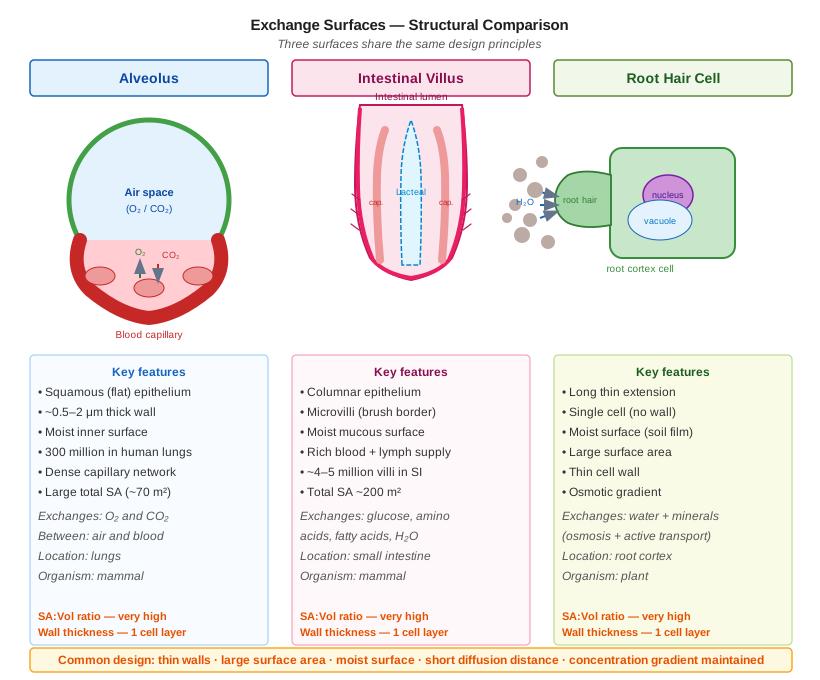
Capillaries, leaf mesophyll spaces, and alveoli all solve the same problem the same way
Regardless of whether we are looking at a plant leaf, a mammalian lung, or a capillary bed in muscle, the zone where actual exchange of materials between the transport system and the cell occurs always shows the same four features. This is a convergent solution to a universal problem, every exchange surface needs to be thin, extensive, moist, and maintain a gradient.
Figure: Three exchange zones share the same four design features. Each is an independent convergent application of Fick's law, large SA, thin membrane, maintained gradient, moist surface.
The Master Comparison, Plants vs Animals
What the two kingdoms share, and where they fundamentally diverge
✓ Similarities, Convergent Solutions
- Both have specialised vessels that carry transport fluid through the organism
- Both transport fluid contains dissolved substances (minerals in xylem sap; glucose, ions in blood)
- Both rely on bulk flow over long distances, diffusion alone is too slow for either
- Both have exchange zones with large surface area, thin membranes, and maintained gradients
- Both have transport media that change composition as they move through the organism (IQ3)
- Both have structural features that prevent backflow where needed (lignin vs valves)
- Both use two types of vessels for different functions (xylem/phloem; arteries/veins)
✗ Differences, Fundamentally Different Biology
- Plants: xylem transport is passive, no ATP at the vessel. Animals: circulation requires continuous cardiac output
- Plants: xylem under negative pressure (tension). Animals: arteries under positive pressure (pushed)
- Plants: xylem vessels are dead cells, no living contents. Animals: all blood vessels have living walls
- Plants: phloem is bidirectional (source → sink). Animals: veins are always unidirectional (toward heart)
- Plants: xylem carries inorganic substances only. Animals: blood carries both organic and inorganic
- Plants have no heart, multiple passive driving forces. Animals depend on a central pump
- Plants: open stomata / Casparian strip regulate water and mineral entry. Animals: hormonal/neural regulation of vessel diameter
Transport Medium Composition, Plants vs Animals
Complete the table comparing how the composition of plant and animal transport fluids changes as they move through the organism.
| Location / Stage | Xylem Sap | Phloem Sap | Blood (Plasma) |
|---|---|---|---|
| At the "source" / loading point | |||
| After passing through metabolically active tissue | |||
| One substance that INCREASES in transit |
The Complete Five-Vessel Comparison
All five vessel types across all key features, exam-ready reference
This table synthesises the entire module's transport content into one comparison. Cover columns and test yourself, if you can reconstruct this from memory, you are ready for any comparison question the HSC can produce.
Figure: All five vessel types across five features. Green = xylem, amber = phloem, red = artery, blue = vein, orange = capillary. Full detail in the table below.
| Feature | Xylem | Phloem | Artery | Vein | Capillary |
|---|---|---|---|---|---|
| Organism | Plant | Plant | Animal | Animal | Animal |
| Contents | Water + minerals | Sucrose, amino acids, hormones | Oxygenated blood* | Deoxygenated blood* | Blood (both directions across wall) |
| Direction | Up (roots → leaves) | Any (source → sink) | Away from heart | Toward heart | Delivers/collects in tissues |
| Driving force | Transpiration pull (cohesion-tension) | Turgor pressure gradient (active loading) | Left ventricular contraction | Residual pressure + muscle compression | Arterial pressure gradient |
| Energy required? | No (passive at xylem) | Yes (ATP for loading) | Yes (cardiac output) | Yes (indirect, heart) | No (passive diffusion) |
| Pressure | Negative (tension) | Positive (turgor) | High positive (~120 mmHg) | Low positive (~5–10 mmHg) | Very low (~25–35 mmHg) |
| Wall structure | Thick, lignified | Thin, unlignified | Thick, muscular + elastic | Thin, less muscle | One cell thick (endothelium only) |
| Living cells? | No (dead at maturity) | Yes (sieve tubes + companion cells) | Yes (smooth muscle wall) | Yes (thinner muscle wall) | Yes (endothelial cells) |
| Valves? | No | No (sieve plates only) | No | Yes (pocket valves) | No |
| Primary function | Deliver water and minerals upward | Distribute photosynthate to sinks | Deliver O₂ and nutrients to tissues | Return deoxygenated blood to heart | Exchange O₂, CO₂, nutrients, waste |
* Except pulmonary artery (deoxygenated) and pulmonary vein (oxygenated), arteries and veins are defined by direction, not oxygen content.
Animals are mobile, high-metabolism organisms with concentrated organs (brain, heart, muscles) that demand instant, high-volume delivery of O₂ and nutrients. A passive system would be far too slow, brain cells begin dying within 4 minutes of O₂ deprivation. Animals need a pump because their physiology has outpaced what passive forces can deliver.
Extended Response, Plant vs Animal Transport Comparison
"Compare the transport systems of plants and animals. In your answer, describe the vessels used in each organism, compare the mechanisms that drive fluid movement, and identify one similarity and one difference in how the transport medium changes composition in transit." (6 marks)
Structure: Plant vessels (xylem/phloem) + mechanisms → Animal vessels (arteries/veins/capillaries) + mechanisms → Explicit similarity with example → Explicit difference with explanation. Use "whereas / in contrast / similarly" language. Band 6 = every claim linked to a mechanism.
Convergent Evolution, Same Problem, Same Solution
Three structural parallels that evolution arrived at independently in plants and animals
Despite plants and animals diverging from a common ancestor over 1.5 billion years ago, their transport systems share striking structural parallels. These are not homologous, they evolved independently in response to the same physical constraints. This is convergent evolution, and it is powerful evidence that the laws of physics constrain what biological solutions are possible.
Check Your Understanding
Write one sentence summarising the main idea of this section.
Copy into your books
▼Xylem vs Artery Key Contrasts
- Xylem: dead cells, negative pressure, passive (solar energy). Artery: living cells, positive pressure, active (ATP).
- Both: thick walls, carry fluid under pressure away from source.
- Lignin (xylem) resists collapse under tension; elastic fibres (artery) resist burst under positive pressure.
Phloem vs Vein Key Contrasts
- Phloem: bidirectional, organic contents, positive turgor, no valves.
- Vein: unidirectional (heart), blood, low positive pressure, pocket valves.
- Both: operate at lower pressure than the "outgoing" vessel.
Why Passive Transport Works in Plants
- Plants are sessile, slower delivery tolerable.
- Solar energy drives transpiration pull for free.
- Animals: mobile, high-metabolism, brain needs instant O₂, passive too slow.
Universal Exchange Zone Features
- Large SA (mesophyll spaces / alveoli / capillary network).
- Thin membrane (~0.5 μm in all three cases).
- Moist surface (water film in leaves / lining fluid in alveoli / plasma).
- Maintained gradient (ventilation + flow / stomata + phloem loading).
Activities
Assessment
Multiple Choice
5 random review questions from a replayable lesson bank
Short Answer
6. Compare the structure and function of xylem vessels and arteries. Describe two structural differences and explain how each difference reflects the different physical conditions in each vessel. 4 MARKS
Two differences × two marks: structural feature + explanation linking to pressure conditions.
7. Explain why xylem transport requires no metabolic energy expenditure at the vessel itself, while animal blood circulation requires continuous cardiac output. 3 MARKS
8. Identify one structural similarity between leaf mesophyll air spaces (gas exchange in plants) and pulmonary alveoli (gas exchange in animals). Explain how this shared feature increases the rate of gas exchange in both organisms, referring to Fick's law. 3 MARKS
Comprehensive Answers
▼Multiple Choice
1. BBoth xylem and arteries have thick, structurally reinforced walls that resist vessel deformation under pressure. The specific reinforcement differs (lignin in xylem, elastic fibres + collagen + smooth muscle in arteries) and they resist opposite pressure signs (negative vs positive), but the shared function, preventing the vessel from changing shape under internal fluid pressure, is the structural similarity. Xylem are dead (arteries are not); neither has valves; xylem pressure is negative not positive.
2. DPhloem direction is not mechanically fixed, it follows the source-to-sink turgor pressure gradient, which changes depending on where sources (photosynthesising leaves) and sinks (growing roots, fruits, meristems) are located. These can be above or below the source leaf simultaneously, driving sap in both directions in different phloem bundles. Venous return is unidirectional because all venous blood must return to the right atrium, the heart creates a single unified pressure gradient pulling blood toward the thorax.
3. CThe claim is incorrect for xylem. Xylem transport is driven by transpiration pull, solar energy (not metabolic ATP) evaporates water from leaves. No ATP is consumed at the xylem vessel. The student may be confusing xylem with phloem loading (which does require ATP) or with root pressure (which requires some metabolic energy at root cells to load minerals into xylem). Arterial blood flow does require continuous ATP via cardiac contraction, this part is correct.
4. AConvergent evolution means independent evolution of similar structures or functions in unrelated lineages. Alveoli and leaf mesophyll air spaces evolved in completely separate lineages (animals and plants diverged over 1 billion years ago) but both independently arrived at the same structural solution to gas exchange: large surface area, thin membrane, moist surface, maintained gradient. This is textbook convergent evolution driven by the same physical constraint (Fick's law).
5. CThe correct explanation integrates both sides: plants can use free solar energy passively and their cells tolerate slower O₂ delivery; animals cannot because high-metabolism organs (brain, heart muscle, liver) require rapid, uninterrupted O₂ delivery at rates only a pressurised pump can provide. The body size argument (A) fails because some trees are 100m tall, larger than most animals. Cell wall argument (B) is irrelevant to transport pressure. The "lighter contents" argument (D) misunderstands the physics, blood density is not the relevant variable.
Q6, Model Answer
Difference 1, Cell viability: Xylem vessel elements are dead at functional maturity, their cytoplasm, nucleus, and organelles have been removed, leaving a hollow tube. Artery walls consist of living smooth muscle cells, elastic fibres, and endothelial cells. Xylem cell death is necessary because living cytoplasm would obstruct the water column and impose osmotic resistance, slowing bulk flow, the hollow lumen is essential for low-resistance transport. Artery smooth muscle must remain living because its active contraction and relaxation (vasoconstriction/vasodilation) regulates blood distribution to organs in response to demand, a function impossible for dead cells.
Difference 2, Reinforcement material and pressure sign: Xylem walls are impregnated with lignin, a rigid polymer that prevents the vessel from collapsing inward. Artery walls contain elastic fibres, collagen, and smooth muscle that prevent bursting outward and allow elastic recoil. The difference reflects the pressure regime: xylem operates under negative pressure (tension, below atmospheric), so the vessel walls face an inward collapsing force that lignin resists. Arteries operate under high positive pressure (up to ~120 mmHg during systole), so vessel walls face an outward bursting force that elastic fibres and collagen resist. Both solve the same problem, vessel integrity under pressure, but for opposite pressure directions.
Q7, Model Answer
Xylem transport requires no metabolic energy at the vessel because its driving force, transpiration pull, is powered by solar energy rather than ATP. Solar radiation evaporates water from mesophyll cell surfaces in the leaf, creating a water deficit that lowers water potential at the top of the xylem column. This generates tension (negative pressure) that is transmitted through the continuous cohesive water column from leaf to root, drawing water upward. The energy comes from photons of sunlight, not from the plant's own metabolism, the xylem vessel itself is entirely passive.
Animal blood circulation requires continuous cardiac ATP output because there is no equivalent external energy source available to drive fluid through a closed vessel network against flow resistance. The heart must actively contract against the back-pressure of the systemic circuit to maintain blood pressure and flow. If the heart stops, blood pressure immediately collapses, unlike transpiration, which continues as long as sunlight and water are available. Additionally, blood is a dense, viscous fluid in a high-resistance network, requiring substantial force to maintain adequate flow to all organs, especially at the distances involved in large mammals.
The fundamental difference is energy source: solar energy is captured from outside the organism to power plant xylem transport; metabolic energy must be continuously generated internally to power animal circulation.
Q8, Model Answer
A shared structural feature is large total surface area achieved through extensive internal subdivision, both leaf mesophyll air spaces and alveoli maximise exchange surface within a compact volume through folding and branching.
In plants, the spongy mesophyll layer contains highly irregular cells with large air spaces between them, creating an enormous internal surface area relative to the leaf's external dimensions. In animals, the lung contains approximately 500 million alveoli, tiny air sacs produced by progressive branching of airways, providing approximately 250m² of total exchange surface area within an organ that fits in the thorax.
According to Fick's law, rate of diffusion is directly proportional to surface area: Rate ∝ (SA × concentration gradient) / membrane thickness. A larger surface area means more molecules can diffuse across the membrane simultaneously. For a given concentration gradient and membrane thickness, doubling the surface area doubles the total diffusion rate. Without this large surface area, neither organism could obtain enough O₂ (or expel enough CO₂) by diffusion alone to meet the metabolic demands of their cells, the small surface area of the outer body surface would be wholly inadequate.
Race Through Transport Comparisons
Answer questions on plant vs animal transport, open vs closed circulatory systems and key adaptations before your opponents cross the line. Fast answers = faster car.
Mark lesson as complete
Tick when you've finished all activities and checked your answers.
Look back at what you wrote at the start of this lesson. How has your thinking changed? What new connections can you make?