Unicellular, Colonial and Multicellular Organisms
From the single-celled Amoeba to the trillions of cells in a human body, how life is organised at the cellular level, and why multicellularity changes everything.
Practise this lesson
Four printable worksheets that build from the foundations up to exam-style questions, start at whatever level suits you.
Think about the cells in your own body. You started as a single fertilised egg cell, yet today you have hundreds of different cell types including muscle cells, neurons, and red blood cells. How is this possible if all your cells contain the same DNA? What do you think causes cells to become different from each other?
Type your initial response below, you will revisit this at the end of the lesson.
Write your initial response in your book. You will revisit it at the end of the lesson.
Know
- Define unicellular, colonial and multicellular organisms
- Compare structural differences at the cell and organelle level
- Explain why multicellularity requires cell specialisation
- Relate cell structure to function in specialised cells
- Justify the advantages of multicellular organisation
Understand
- Compare unicellular, colonial and multicellular organisms
- Investigate structures at the cell and organelle level
- Relate cell structure and specialisation to function
- Justify the hierarchical structural organisation of living things
Can Do
- Correctly classify organisms as unicellular, colonial or multicellular
- Describe structural differences using correct terminology
- Explain cell specialisation using at least two examples
- Construct a comparison table of organism types
- Write an extended response justifying multicellular organisation
Core Content
Misconceptions to Fix
Wrong: Colonial organisms are just a simple type of multicellular organism.
Right: Colonial and multicellular organisms are fundamentally different. In colonial organisms such as Volvox, individual cells can often survive if separated from the colony. In multicellular organisms, cells are permanently specialised and interdependent, so most cannot survive alone.
Wrong: All cells in a multicellular organism have different DNA.
Right: Nearly all cells in a multicellular organism contain identical DNA. They become different because of selective gene expression, where transcription factors switch specific genes on or off and cause cells to produce different proteins.
The Spectrum of Cellular Organisation
Unicellular · Colonial · Multicellular
All living things are made of cells, but cells can be organised in fundamentally different ways. Rather than three isolated categories, cellular organisation is best understood as a continuum: from organisms made of a single cell performing every life function independently, to vast communities of permanently specialised, interdependent cells.

The progression from unicellular to multicellular, each step adds new capabilities
Comparison Table, Cell Organisation
| Feature | Unicellular | Colonial | Multicellular |
|---|---|---|---|
| Cell specialisation | |||
| Cell independence | |||
| Division of labour | |||
| Similarities, what do all three share? | |||
Key Terms
Unicellular Organisms
One cell · All life functions · Fully independent
A unicellular organism consists of a single cell responsible for every life process, obtaining nutrients, gas exchange, responding to stimuli, reproduction, and waste removal. Despite their apparent simplicity, unicellular organisms are extraordinarily successful and represent the majority of life on Earth by number.
| Organism | Type | Key Structures | How Life Functions Are Performed |
|---|---|---|---|
| Amoeba proteus | Eukaryote, Protist | Nucleus, pseudopodia, food vacuoles, contractile vacuole, cell membrane | Pseudopodia engulf food (phagocytosis); contractile vacuole expels excess water; reproduces by binary fission |
| Paramecium | Eukaryote, Protist | Cilia, oral groove, macronucleus, micronucleus, contractile vacuoles | Cilia sweep food into oral groove; macronucleus controls metabolism; micronucleus used in reproduction |
| Escherichia coli | Prokaryote, Bacterium | Cell wall, circular DNA (no nucleus), ribosomes, flagella, cell membrane | Nutrients absorbed directly across membrane; flagella for movement; reproduces rapidly by binary fission |
| Saccharomyces cerevisiae (yeast) | Eukaryote, Fungus | Nucleus, mitochondria, cell wall (chitin), large central vacuole | Absorbs glucose; can perform aerobic respiration or anaerobic fermentation; reproduces by budding |
Colonial Organisms
Identical cells · Limited division of labour · Cells remain independent
A colonial organism consists of genetically identical cells living together, where cells may show limited division of labour but each cell retains the ability to survive independently. Colonial organisation sits between unicellular and multicellular life and provides important insight into how multicellularity evolved.
Volvox, The Defining Example
Graphing Task, Surface Area to Volume Ratio

As cells grow larger, volume increases faster than surface area, making diffusion insufficient and requiring specialised exchange surfaces
- Plot SA:V ratio (y-axis) against cell width (x-axis) as a line graph in your book.
- Describe the trend shown in your graph.
- Explain why a decreasing SA:V ratio limits the maximum size of a unicellular organism.
- Explain how multicellular organisation overcomes this limitation.
Type your written responses here or answer in your book.
Check Your Understanding
Write one sentence summarising the main idea of this section.
Multicellular Organisms
Specialised cells · Permanent interdependence · Division of labour
A multicellular organism consists of many permanently specialised cells that are interdependent, no individual cell can survive alone. This permanent commitment to specialisation is what distinguishes multicellular from colonial organisation.
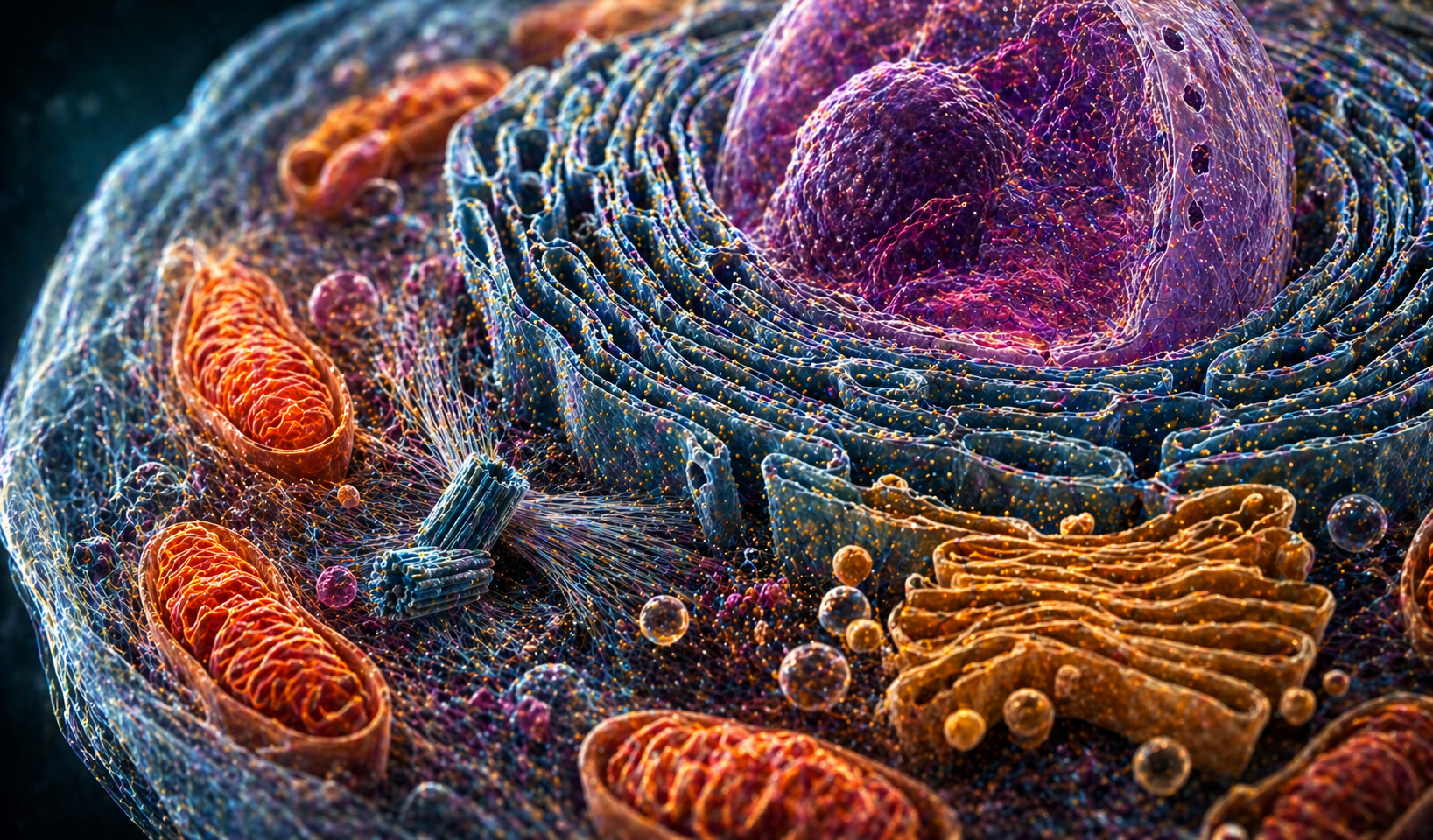
Eukaryotic animal cell, organelles such as the nucleus, mitochondria, endoplasmic reticulum and Golgi apparatus support specialised cell function
The Three Requirements of Multicellularity

All three pillars must be present for true multicellularity, missing any one results in colonial or unicellular organisation
Australian / Clinical Context
What happens when cell communication and differentiation break down in a multicellular organism? Cells stop acting as a team, they revert to uncontrolled, selfish replication. We call this cancer. This connection will be revisited in Year 12 Module 8 (Non-infectious Disease), where understanding the molecular basis of cell differentiation is essential for Band 6 responses.
Advantages of Multicellularity
Specialised Multicellular Cells, Structure to Function
To satisfy the NESA dot point, you must be able to describe specific specialised cells and explicitly link their structural features to their functions:
Check Your Understanding
Write one sentence summarising the main idea of this section.
Hierarchical Organisation of Living Things
Organelle → Cell → Tissue → Organ → System → Organism
Multicellular life is organised into a hierarchy of increasing structural and functional complexity. Each level is built from the level below it, and each level performs functions that the level below cannot perform alone. NESA requires you to justify this hierarchy, not merely name it.
Check Your Understanding
Write one sentence summarising the main idea of this section.
Summary Comparison
Use this as your HSC reference, every row is examinable
Unicellular vs Colonial vs Multicellular, Key Features
Check Your Understanding
Write one sentence summarising the main idea of this section.
Copy into your books
▼Definitions
- Unicellular: single cell performs all life functions independently.
- Colonial: identical cells live together; each can still survive alone.
- Multicellular: many specialised, permanently interdependent cells.
- Cell differentiation: cells switch gene expression to specialise permanently.
Key Examples
- Unicellular: Amoeba, Paramecium, E. coli, yeast.
- Colonial: Volvox, gonidia show limited division of labour.
- Multicellular: humans, plants, most animals.
- All cells share: cell membrane, cytosol, ribosomes, DNA.
Three Requirements of Multicellularity
- Cell adhesion → cells must physically stick together.
- Cell communication → cells must signal each other.
- Cell differentiation → cells must specialise permanently.
- Breakdown of communication/differentiation → cancer.
Hierarchy (organelle → organism)
- Organelle → Cell → Tissue → Organ → System → Organism.
- Each level enables functions impossible at the level below.
- Red blood cell: no nucleus → maximises haemoglobin for O₂ transport.
- Palisade cell: dense chloroplasts + top of leaf → max photosynthesis.
Activities
Revisit Your Initial Thinking
Earlier you were asked: How is it possible that all your cells contain the same DNA yet hundreds of different cell types exist? What causes cells to become different from each other?
This lesson revealed that differentiation is driven by selective gene expression, all cells contain identical DNA, but chemical signals in the cell's environment activate transcription factors that switch specific genes on or off. The result is that cells with the same genome produce entirely different proteins and develop structurally distinct forms suited to unique functions.
Now revisit your initial response. What did you get right? What has changed in your thinking?
Look back at your initial response in your book. Annotate it with what you now understand differently.
Assessment
Multiple Choice
5 random questions from a replayable lesson bank, feedback shown immediately
Short Answer
Write full sentences, marks are awarded for correct use of HSC terminology
6. Compare the structural organisation of Amoeba (unicellular) and Volvox (colonial). In your answer, identify at least one similarity and two differences, and refer specifically to cell specialisation, division of labour and cell independence. 4 MARKS
Use comparative language: whereas / however / both / similarly / in contrast
7. Explain how a decreasing surface area to volume ratio limits the maximum size of unicellular organisms, and explain how multicellular organisation overcomes this limitation. 3 MARKS
8. Justify the advantages of multicellular organisation over unicellular life. In your answer, refer to at least three advantages and explain the structural basis for each. 3 MARKS
Comprehensive Answers
▼Multiple Choice
1. BColonial organisms are groups of identical cells living together where each can survive independently. Option C describes multicellular.
2. CThe defining feature of multicellularity is permanent specialisation: cells cannot survive alone. Size (A) and cell count (B) are not the defining distinctions.
3. AThe gonidia are specialised exclusively for reproduction while somatic cells handle movement and photosynthesis, this is limited division of labour, characteristic of the colonial-multicellular boundary.
4. DAs cell size increases, volume (r³) grows faster than surface area (r²), so the SA:V ratio decreases, reducing exchange efficiency.
5. BThe three requirements are adhesion, communication, and differentiation. Cell competition is not a requirement.
Short Answer, Model Responses
Q6, Band 6 comparative structure: Similarity: Both Amoeba and Volvox consist of cells capable of independent survival if separated from the group. Difference 1: However, whereas Amoeba is a single cell with zero division of labour, one cell performs all life functions including movement, nutrition and reproduction, Volvox is a colony exhibiting limited division of labour, where somatic cells handle movement and photosynthesis while specialised gonidia handle reproduction exclusively. Difference 2: In terms of cell specialisation, Amoeba shows none, as all functions are performed by one generalised cell, whereas Volvox has two functionally distinct cell types, representing an early stage of the specialisation seen in true multicellular organisms.
Q7: As a cell grows larger, its volume increases proportionally faster than its surface area, volume scales with the cube of the radius while surface area scales with the square. This means the SA:V ratio decreases. Since all exchange of nutrients, gases and waste must occur across the cell membrane (the surface), a very large cell cannot exchange materials fast enough to supply its interior, the centre becomes deprived of oxygen and nutrients. Multicellular organisms overcome this by keeping individual cells small (maintaining a high SA:V ratio per cell) and using dedicated internal transport systems (the circulatory system in animals, vascular tissue in plants) to deliver materials to all cells throughout the organism.
Q8: First, division of labour is justified because permanently specialised cells can optimise their entire structure for one function, red blood cells discard their nucleus to maximise haemoglobin volume for oxygen transport, which would be impossible if the cell also had to perform reproduction or protein synthesis. Second, larger body size is achievable because multicellular organisms bypass the SA:V ratio constraint using transport systems rather than relying on diffusion across a single cell surface, enabling access to food sources and habitats unavailable to microscopic organisms. Third, a longer lifespan is possible because stem cells continuously replace damaged or lost specialised cells, whereas a damaged unicellular organism has no mechanism for self-repair and typically dies.
Jump Into Cell Organisation
Climb platforms, hit checkpoints, and answer questions on unicellular, colonial and multicellular organisms and their key structural features. Quick recall from lesson 1.
Mark lesson as complete
Tick when you've finished all activities and checked your answers.